
The Real Job of a Marketing Engineer Is Closing the Gap Between Insight and Action
The useful job of a Marketing Engineer begins where a recommendation can stall: a named owner, a bounded proposal, clear approval, confirmation of the change and an outcome review.
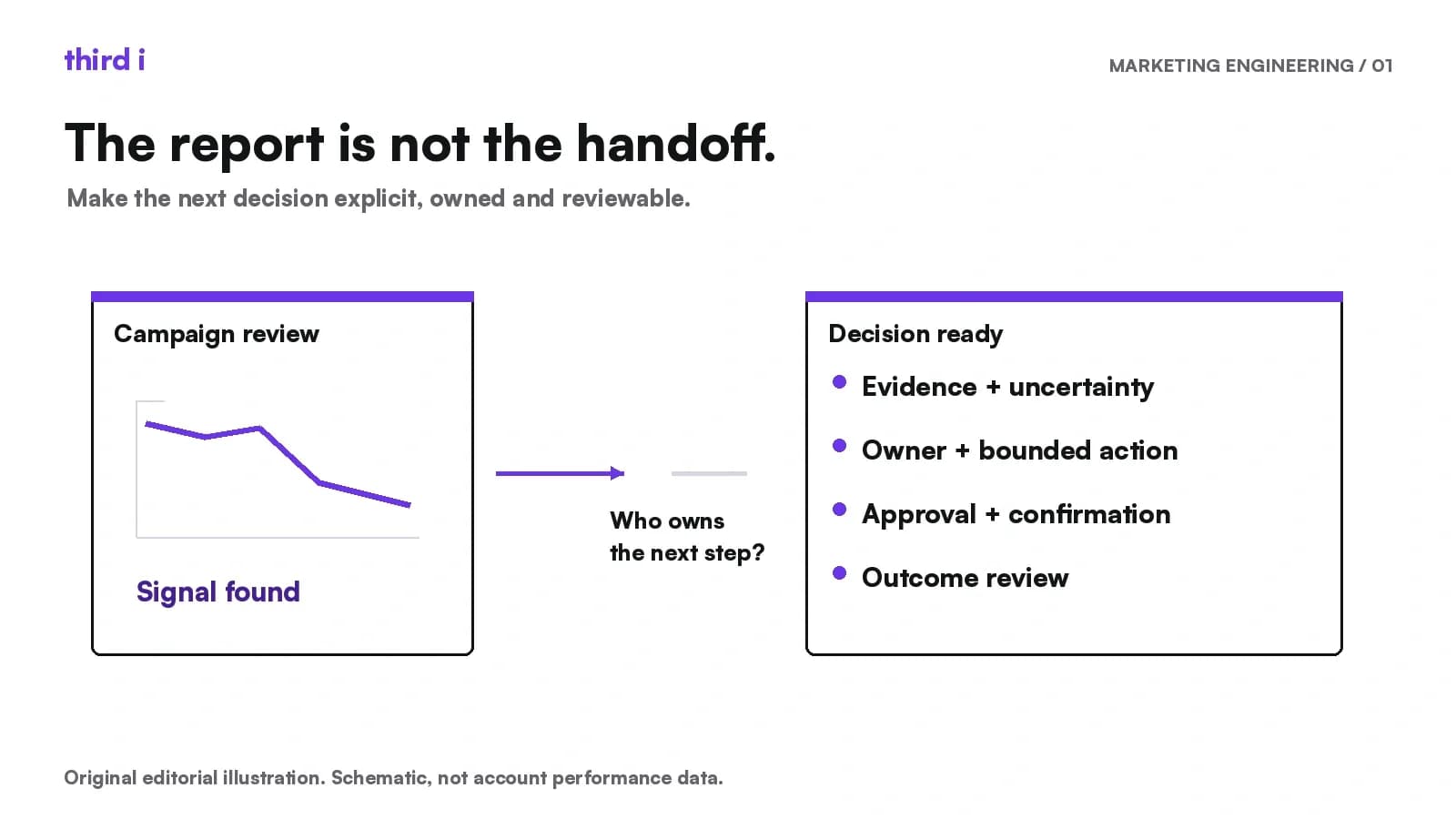
A recommendation can be right and still go nowhere. Someone shares an insight, the team agrees it matters, and the conversation moves on. The missing piece is not always better analysis. Sometimes nobody has turned the recommendation into work another person can safely accept.
That is the job I want a Marketing Engineer to own: the handoff from insight to action. Name the owner. Bound the proposal. Get the right approval. Confirm what actually changed. Bring the outcome back for review.
The technical work matters because it can make that handoff repeatable, rather than dependent on someone remembering to chase it.
What the role connects
Nick Lafferty, Founding Marketing Engineer at Profound, helps give the role a concrete shape. Profound's introduction to The Marketing Engineer podcast describes people who combine marketing creativity, technical ability, systems thinking and taste.
His Zero Click New York 2026 presentation adds a useful picture: someone who thinks in architecture, connects the dots, ships full systems end-to-end, works across functions, and builds with taste and experience. I read that as responsibility for the connections between pieces of work, not simply the ability to build each piece.
These sources describe a role. They do not prove that adopting the title improves performance. My interpretation is that a Marketing Engineer should make a useful recommendation easier for the next person to act on, without stripping away the judgement that person needs to exercise.
Begin where the investigation ends
Our guide to cross-channel marketing analysis covers the upstream work: aligning evidence, separating observations from explanations and deciding what deserves investigation. This article starts later, when a team has a reasonable next step but has not carried it through.
Consider an illustrative campaign for a software business promoting demos through Meta and Google. This is a constructed example, not a customer result. Suppose the review identifies a Meta prospecting campaign worth reducing while the team investigates the relevance of its leads.
That is still not an executable instruction. Which campaign? Reduce it to what? For how long? Should the money stay unspent or move elsewhere? Who has authority to accept the commercial trade-off?
The distinction matters to the argument in why reporting is solved but decision making is not. A clear insight is useful. A colleague should not have to reconstruct the intended action from it.
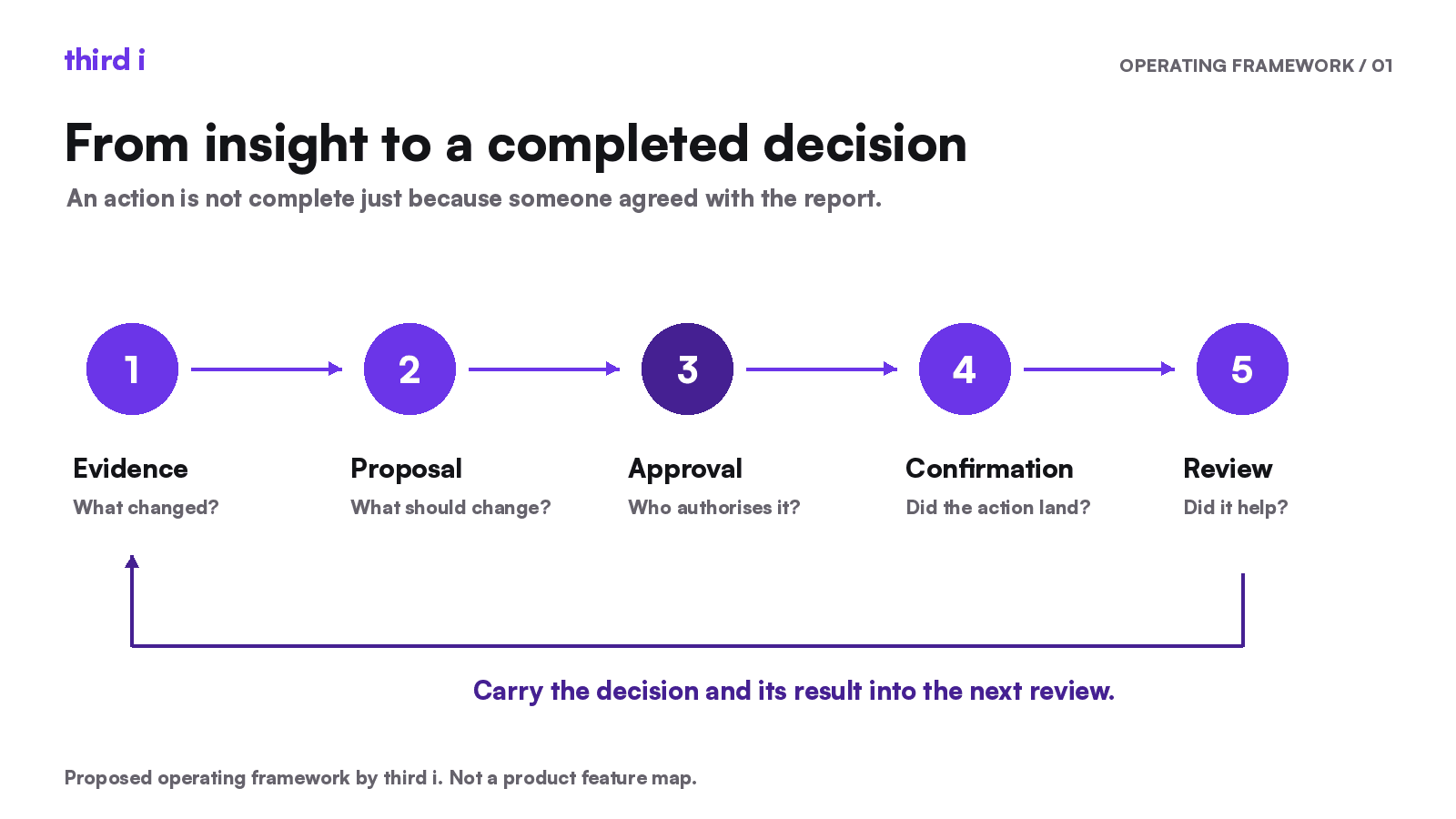
The decision loop carries evidence into a bounded proposal, approval, execution confirmation and an outcome review. Proposed third i operating framework, not a product feature map.
Give the proposal a named owner and a boundary
In this example, I would give the media lead ownership of the proposal. Ownership means resolving open questions and taking it through review, not personally doing every task. The account manager might supply client context. A sales colleague might explain the lead-quality concern.
The proposal should identify the exact account and campaign, the current and proposed daily budget, the intended duration and what happens to the unspent amount. Those values must come from the real account and the team's constraints, not a generic optimisation rule.
It should also name what stays unchanged. No audience edit, creative replacement or automatic transfer to Google unless separately proposed. This keeps an apparently small approval from expanding into several decisions the approver never considered.
I think this is where building with taste becomes practical. A good handoff contains enough detail to decide, without burying the decision in everything the system knows.
Approval is a decision, not a reaction emoji
The person approving the change needs to see the proposal, its limits and its uncertainty together. In the illustrative campaign, concern about lead relevance supports a cautious response. It does not establish that the campaign caused poor lead quality or that a budget reduction will improve it.
A useful approval says who authorised which version of the change. If the proposed budget, destination or duration changes, it goes back for approval. Agreement with the original insight should not be treated as permission for whatever action follows.
The Marketing Engineer can build this handoff into the tools people already use. The important work is preserving the relationship between evidence, proposal and approval. A beautifully worded message that loses that relationship is not a better decision process.
Approved is not the same as applied
Once approval is given, someone or something still has to make the change. The next handoff should return confirmation of the target, the resulting setting and when it was applied. If it failed or only part of the proposal went through, the owner needs that information instead of a completion label.
For the illustrative campaign, a confirmation would establish that the approved budget is now set on the intended Meta campaign. It would not imply that the team also changed Google spend or that the new setting has already improved results.
This is not an argument for making every marketer an infrastructure specialist. It is about making the status legible to the people responsible for the campaign. Proposed, approved, applied and reviewed mean different things. The handoff should not blur them.
A compact decision note for the whole handoff
My proposed operating model remains evidence → hypothesis → decision → approved action → review. The investigation supplies the first two. The Marketing Engineer builds the repeatable handoff through the rest.
Here is the compact note I would use:
Evidence and hypothesis: link the investigation and state the unresolved uncertainty.
Decision and owner: name the exact change, why it is preferable to waiting, and the person carrying it through.
Bounds: specify targets, limits, duration and exclusions.
Approval: record who approved which proposal.
Execution: record the actual change or failure.
Review: name the date, owner, outcome to inspect and stop condition.
The note is not another report. It is a small shared object that can travel between the analyst, account lead, approver and executor without changing meaning. A shared document can be enough before anyone builds a more elaborate workflow.
Where third i supports part of that handoff
The third i MCP documentation gives a documented example of connected evidence and approved action. It describes querying connected Meta, Google and GA4 marketing data through compatible assistants, checking connection health, and opening, building and saving reports.
It also describes Google Ads and Meta Ads changes, including budget shifts and pauses, prepared through an assistant and applied after human approval in third i. That is a specific capability boundary: preparation in the conversation does not bypass approval in third i.
The decision note brings these capabilities into a broader working model. The template, versioning and confirmation requirements above are the standard I would work towards, not a claim that the connector supplies every step automatically.
Bring the outcome back to the people who decided
The handoff ends with review, not a success notification. Revisit the campaign against the intended business outcome and the original uncertainty. If lead relevance was the concern, a lower spend figure alone does not answer it. The owner may need sales feedback as well as platform data.
A change followed by an improvement is not automatic proof of cause. Record what the team can reasonably conclude, what remains unknown, and whether to continue, reverse or propose another step.
Start with one recommendation that has stalled after a review. Give it an owner and fill in the missing handoff. If an outside conversation would help, bring one stalled recommendation to third i. There is no need to begin with a new automation.
See this on your own accounts
third i connects to the platforms you already run and does this work against your live numbers.
Read more
View all articles
Using third i Alongside Semrush, Ahrefs and Claude
Keep the tools your team trusts. See where third i adds connected marketing context, competitor creative research and a shared route into Claude.


How to Connect Claude to Your Google Ads + Meta Ads Data (And What to Ask It)
A step-by-step guide to connecting Claude to your Google and Meta Ads data using MCP - with 5 copy-paste prompts for cross-channel insights.


How does Growth Marketing differ from Growth Hacking?
Learn the crucial differences between growth marketing and growth hacking to choose the best strategy for your business's sustainable growth or rapid expansion.
