
Cross-Channel Marketing Analysis Without Replacing Your Stack
Separate reports can all be right and still leave the decision unresolved. Learn how to investigate across channels while keeping your specialist tools.

Cross-channel marketing analysis is not simply putting several reports into one dashboard. It is examining related signals together, with their definitions and limitations intact, so the team can decide what to investigate or change. You can do that while keeping the specialist tools you already trust.
The problem is often not that a tool is bad. It is that the decision belongs to more than one tool.
Search research, paid media reports and website analytics each show something useful. An AI assistant can help interpret them. Yet the person running the review still has to establish whether the reports refer to the same period, the same audience and the same business outcome.
I think this is where ‘all in one place’ becomes too weak a promise. The data can sit together and still tell several incompatible stories. The work is in making the differences understandable.
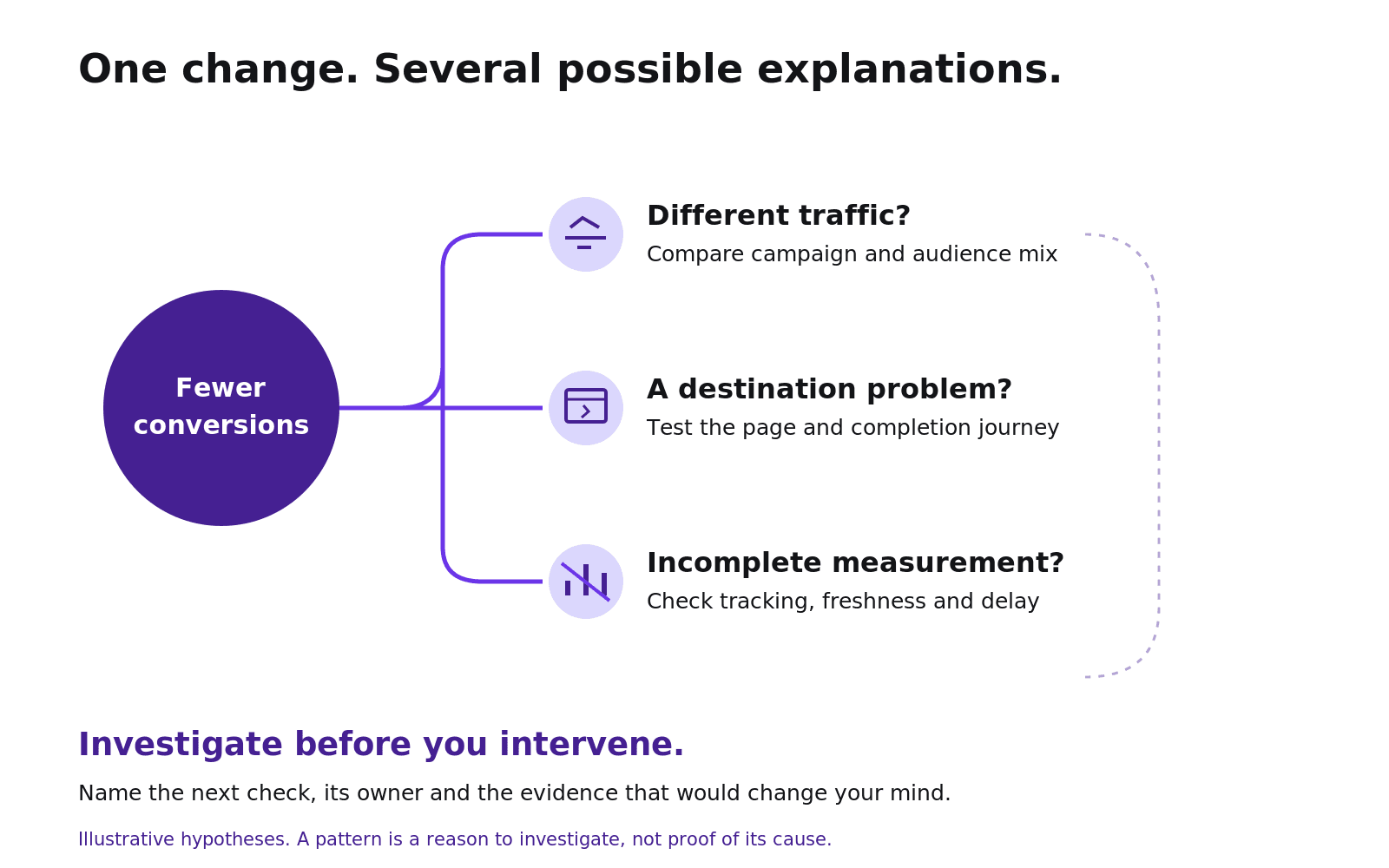
Why accurate reports can disagree
An ad platform can report an improvement while website analytics shows a decline. That does not automatically mean either system is broken.
They may count different conversion events. They may use different attribution windows or assign credit differently. A campaign might attract more visitors but fewer of the visitors who complete the intended action. Recent conversions may still be arriving.
A tool can be accurate within its own definitions while the combined conclusion remains wrong.
This is why adding platform-reported conversions across sources can create an impressive total without producing a reliable account of business outcomes. The definitions matter as much as the arithmetic.
The same caution applies to competitor research. A rival running more ads is an observable change. A rival taking your customers is an explanation that needs further evidence. Public creative does not tell you their spend, conversion rate or profitability.
Specialist tools remain useful precisely because they help investigate these details. The goal is not to flatten their differences into a single confident score.
Investigate a business question, not a channel
Consider an illustrative review for a brand whose acquisition performance has weakened. Google Ads reports more clicks. Meta spend is steady. Website conversion rate is lower. Someone proposes moving budget from one platform to the other.
That might be the right decision. The reports do not yet establish it.
Start by defining the problem. Are there fewer completed purchases, fewer enquiries or a higher cost for the outcome the business actually cares about? If the available data stops at form submissions, say so. Do not silently treat submissions as qualified leads.
Next, align the comparison. Use consistent date ranges and understand the account time zones. Check whether recent data is complete. Confirm that a tracking or website change has not altered what is being measured.
Then examine where the change concentrates. Is it associated with one campaign, device group or landing page? Is paid traffic behaving differently from other traffic reaching the same page? A site-wide issue calls for a different response from one weak campaign.
This is an investigation sequence, not a claim that every question has a perfect dataset behind it. Missing evidence is part of the answer.
For teams working through that first check, our GA4 measurement pre-flight guide is a useful place to separate a measurement issue from a performance issue.
Keep observations separate from explanations
Suppose the review finds that conversion rate declined on a particular landing page after a site update, across several traffic sources. That is stronger reason to inspect the page than to immediately replace every ad.
It is still not proof that the update caused the decline. The team needs to test the form, inspect the journey and consider other changes.
Now suppose competitor research shows a new promotional offer. That may help the team form a hypothesis about message relevance or market pressure. It does not establish that the offer caused the performance change.
A useful review keeps three things distinct: what was observed, what might explain it and what check would reduce the uncertainty.
AI is useful here when it helps organise competing explanations and retrieve the evidence. It is less useful when it compresses uncertainty into a tidy story. A fluent answer can still send a team towards an expensive mistake.
Where third i helps the investigation
third i brings supported paid media, organic social and website analytics connections into a marketing workspace. That gives the team a way to inspect connected performance without starting a new export for every question.
The third i MCP connector extends that access into supported assistants such as Claude. A marketer can ask about campaign performance, inspect GA4 channel and page metrics, and check whether a source has become stale. Available detail depends on the connected platform and data.
That is a practical complement to specialist research. Semrush or Ahrefs can continue supporting the team’s search and visibility work. Claude can remain its flexible analysis interface. third i supplies a connected marketing workspace and recurring account review rather than asking those products to disappear.
We are not claiming native import of every research tool, a universal attribution model or automatic proof of what caused a change. Those would be different promises.
The Morning Brief provides another entry point by surfacing changes that deserve attention. The investigation then moves beyond ‘this metric moved’ towards ‘what evidence should we inspect before responding?’
For competitor context, third i’s research workflow currently covers public Meta ads and Instagram organic content, with fortnightly watchlist refreshes. It can inform creative hypotheses. It cannot reveal a competitor’s private results or substitute for your own outcome data.
The useful difference is a shorter path from noticing a change to examining the relevant evidence. Whether that is enough to justify another tool should be demonstrated on a real task.
Turn the review into a decision record
The investigation should end with something more useful than a summary saved in a folder.
Record the business question, the evidence used, the unresolved uncertainty and the next step. Name the person responsible and the point at which the team will check again. This can be a simple shared note; it does not depend on buying a particular product.
If the evidence points towards a site problem, assign the site check. If it suggests creative fatigue, define a test and the result that would justify a change. If the data is incomplete, say what must arrive before the team can judge.
A brief should not turn every anomaly into a budget move. Sometimes the right decision is to wait for enough evidence. Sometimes it is to fix measurement before optimising anything.
For me, that is the difference between connected data and connected work. The first lets people see more. The second helps them make a decision they can explain and revisit.
You do not have to replace your marketing stack to improve that process. You do have to make someone responsible for the connections between its outputs.
Bring one unresolved cross-channel question to third i. We can examine what the connected data supports, what still needs another tool, and whether the workflow gives your team a useful next step.
See this on your own accounts
third i connects to the platforms you already run and does this work against your live numbers.
Read more
View all articles
Claude Marketing Briefings: Where third i Adds Context
Claude can schedule marketing reports. See how third i adds connected account data and a recurring marketing review alongside the assistant you use.

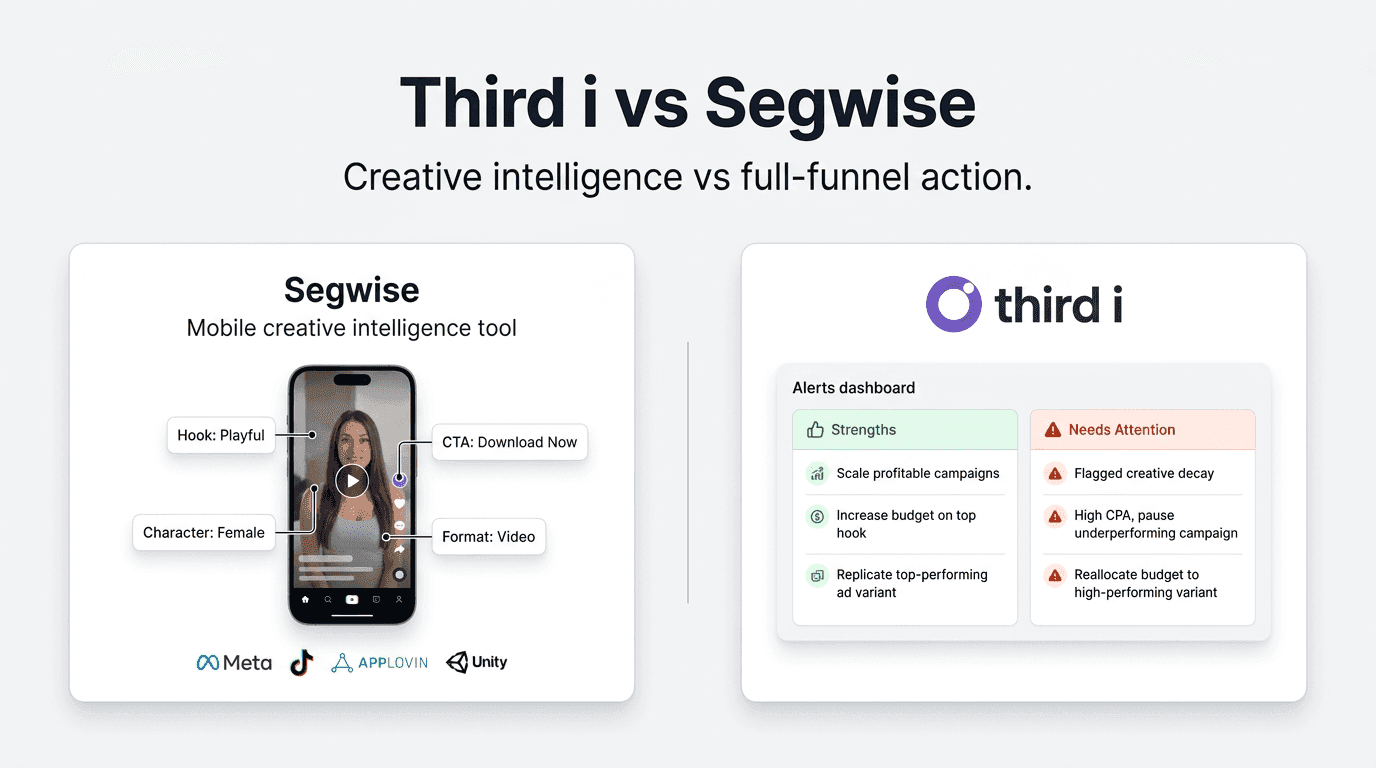
Third i vs Segwise: Creative Intelligence vs Full-Funnel Action Intelligence
Evaluating Segwise or looking for a Segwise alternative? Segwise is an AI-powered creative intelligence platform built specifically for mobile app and gaming advertisers. It automatically tags every element inside your ad creatives - video, audio, text, playable mechanics - and ties those elements…

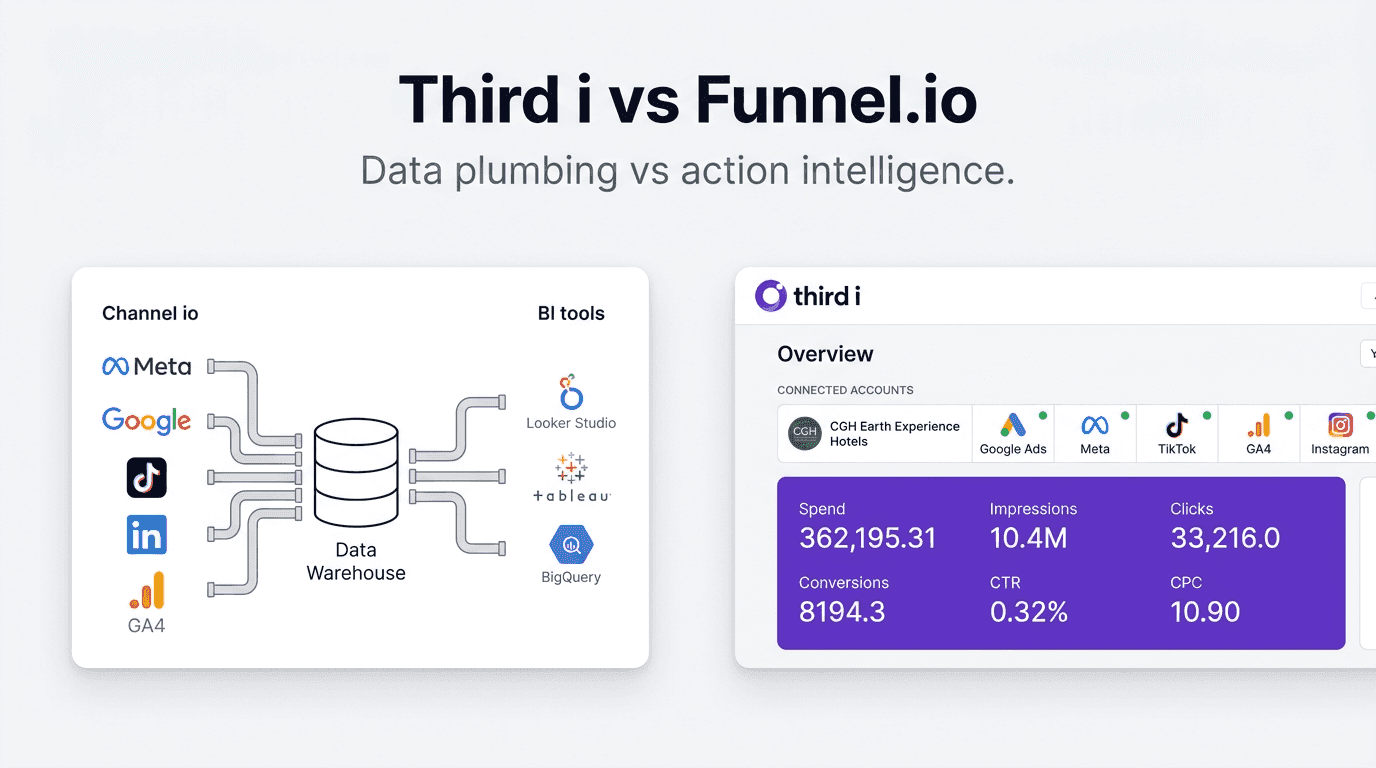
Third i vs Funnel.io: Data Pipeline vs Action Intelligence
Evaluating Funnel.io or looking for an alternative? Funnel.io is a marketing data hub that connects 600+ sources, normalizes your data, and pipes it into your BI tool, data warehouse, or reporting layer. It collects and cleans your data. Third i is an AI action platform that tells you what to do wi…