
Claude Marketing Briefings: Where third i Adds Context
Claude can schedule marketing reports. See how third i adds connected account data and a recurring marketing review alongside the assistant you use.

Claude can do more than wait for a question. It supports scheduled tasks, connected tools and recurring reports. If your team has built a useful daily marketing briefing in Claude, keep it. The question is not whether an AI assistant can send a summary. It is whether the workflow behind that summary keeps watching the right things.
That distinction matters to how we explain third i.
‘We deliver insights without you asking’ sounds like a clean differentiator. But a team can already arrange for an assistant to run on a schedule. Calling that impossible would make our pitch simpler and less accurate.
The more useful conversation is about the work that surrounds the prompt: data access, freshness, comparison periods, marketing context and what happens after a finding appears.
A scheduled answer is a useful starting point
Claude’s scheduled tasks can run recurring work using configured connectors, tools and instructions. Anthropic explicitly lists briefings, reports and recurring research among the uses. Availability and execution conditions depend on the relevant plan and setup.
This is valuable. A team can define its own review, connect the available sources and ask for an output in the format it prefers. The flexibility is part of the appeal.
For a marketing lead with a strong internal data setup, that may already be enough. There is no prize for adding another product to a workflow that works.
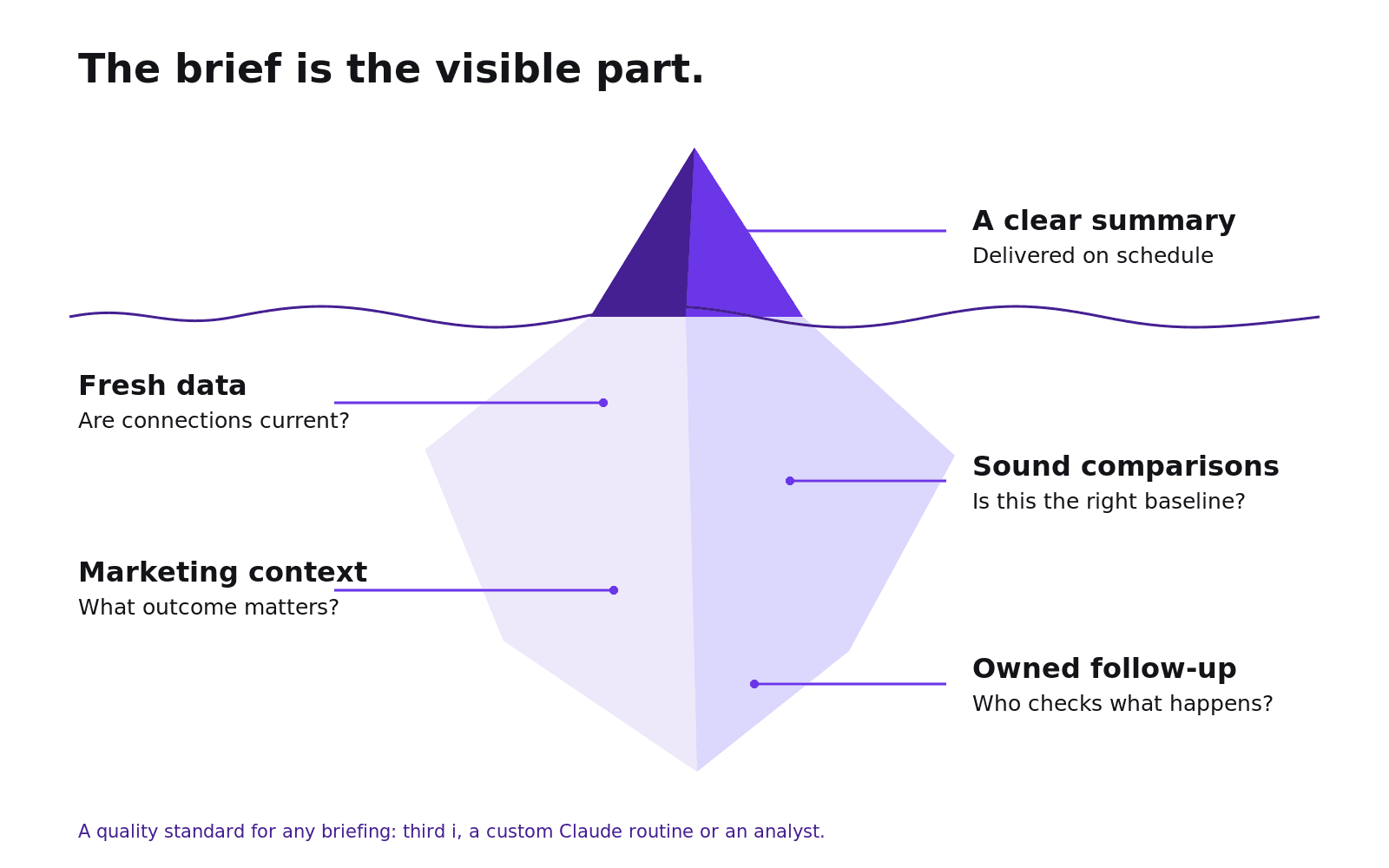
But scheduling solves when the task runs. It does not, by itself, decide whether the review is complete or whether the numbers deserve to be trusted. Those responsibilities still need an owner.
A briefing needs a dependable review behind it
A good morning brief is a small operating process expressed as an output.
First, it needs current data. A polished account summary can be misleading if a connection stopped refreshing. The reader needs to distinguish ‘nothing changed’ from ‘nothing new arrived’.
Second, the comparison needs to fit the question. Yesterday against last week is useful for triage. It is not always enough to diagnose a weekend effect, a promotion or a delayed conversion cycle. The brief should open an investigation, not pretend one comparison answers everything.
Third, significance needs context. A rise in cost per lead may be acceptable if the leads are better, but lead quality cannot be inferred from ad-platform metrics alone. If the relevant business outcome is not available, the limitation should be visible.
Finally, a finding needs somewhere to go. An alert that everyone reads and nobody owns is not much of an improvement over a dashboard that nobody opens.
These are not limitations unique to Claude. They apply equally to a third i brief, a custom reporting script and a human analyst’s update. The standard should be the same.
A practical example: investigate before you intervene
Consider an illustrative account review. Paid acquisition costs have risen. The immediate temptation is to ask for new ads or move budget.
Before doing that, the reviewer needs to separate several possibilities. Did the cost of getting a click change? Did the mix of traffic change? Did fewer visitors complete the intended action? Is the conversion data complete enough to judge?
The answer determines the work. A creative problem needs a different response from a broken form. A data problem needs a different response again.
This is where a useful brief earns its place. It helps identify the accounts and signals worth investigating, while keeping the evidence available for the next question.
It should not claim ‘the creative caused the decline’ simply because two metrics moved together. Nor should a daily fluctuation automatically become an instruction to change a campaign.
I would rather receive a short brief that identifies one important uncertainty than a confident paragraph that sends the team to fix the wrong thing.
How third i and Claude can work together
third i’s morning marketing briefing is built around a recurring account check. Its published Daily Pulse compares yesterday with the preceding week and highlights accounts that need attention.
The value is the supplied marketing workflow and connected account context, not exclusive ownership of scheduled analysis. A team can start from that review rather than design every check from a blank prompt. It still has to connect the relevant accounts, review the findings and judge whether the coverage fits its needs.
For deeper investigation, the third i MCP connector makes connected workspace data available inside supported assistants, including Claude. The user can keep reasoning in the interface they prefer rather than repeatedly assembling a fresh export.
The connector also exposes connection health, which helps users identify stale data before relying on an answer. It does not mean every source refreshes in real time. Cadence, access and account configuration still matter.
This gives the products complementary roles. third i supplies the connected marketing workspace and its recurring review. Claude provides a flexible place to ask follow-up questions, bring in additional authorised context and work through an explanation.
You might begin with: ‘Which campaigns explain the change in cost per result?’ Then ask: ‘What evidence would distinguish a traffic-quality problem from a landing-page problem?’
The second question is important. Useful analysis should help determine what to check next, not just produce a more fluent version of the first answer.
Teams that want this arrangement can follow the third i MCP setup guide. The connector uses a third i sign-in, with no API key to issue. Current access and plan requirements are documented there.
Choose the setup you can maintain
A custom Claude workflow gives you flexibility. A marketing-focused product can reduce the amount of recurring setup you own. Neither removes the need for someone to check that the process is working.
If your internal routine already has dependable data access, appropriate checks and clear ownership, build on it. Specialist tools such as Semrush and Ahrefs can continue to supply the research your team values, through whichever authorised routes your workflow supports.
If every new account means another set of prompts, exports and maintenance tasks, try a more standardised marketing workspace. Judge it by the difference in the work, not the novelty of the output.
For the next review cycle, ask three questions. Did the briefing surface something worth checking? Could the team inspect the evidence? Did someone take responsibility for the next step?
That is a stronger test than whether the email arrived on time.
See a third i morning brief on your connected accounts, then decide whether to read it in third i, investigate through Claude, or keep using a process that already serves you well.
See this on your own accounts
third i connects to the platforms you already run and does this work against your live numbers.
Read more
View all articles
Cross-Channel Marketing Analysis Without Replacing Your Stack
Separate reports can all be right and still leave the decision unresolved. Learn how to investigate across channels while keeping your specialist tools.

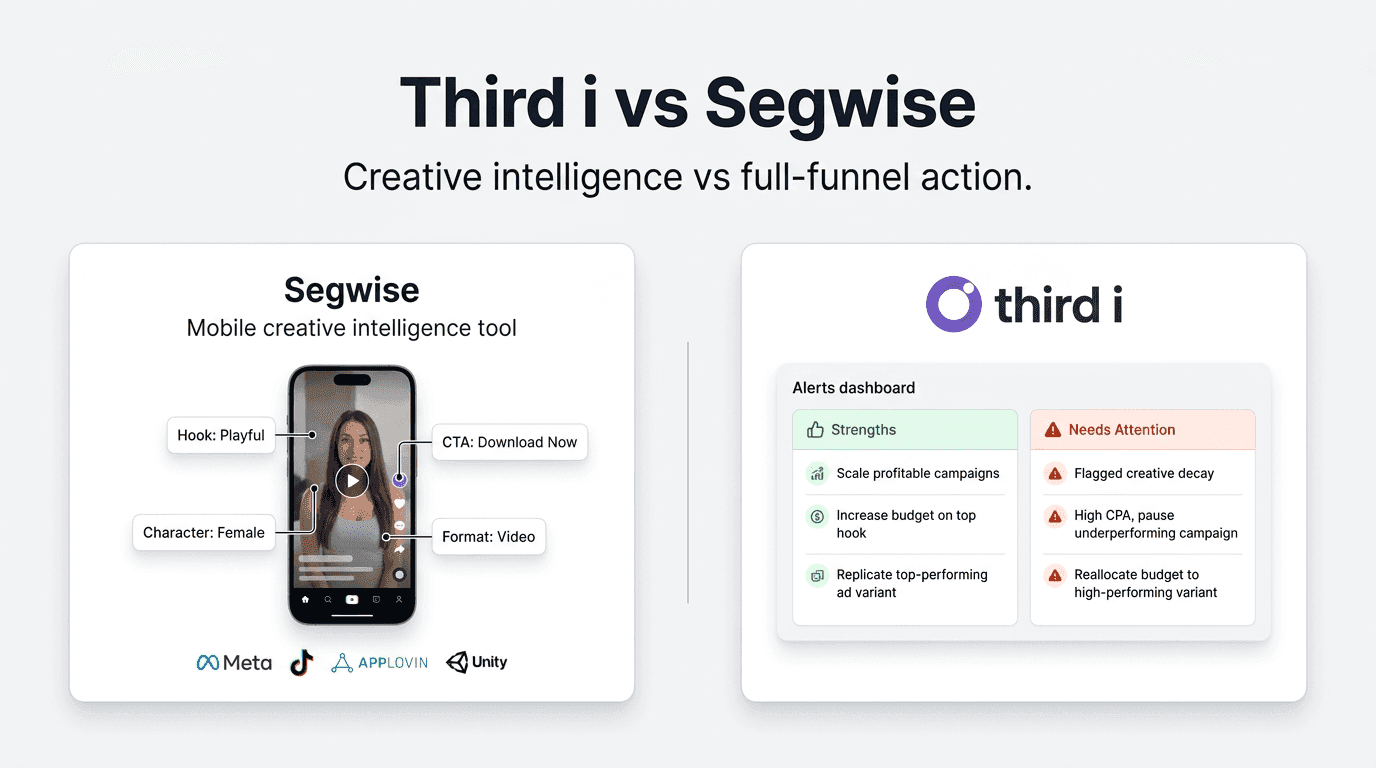
Third i vs Segwise: Creative Intelligence vs Full-Funnel Action Intelligence
Evaluating Segwise or looking for a Segwise alternative? Segwise is an AI-powered creative intelligence platform built specifically for mobile app and gaming advertisers. It automatically tags every element inside your ad creatives - video, audio, text, playable mechanics - and ties those elements…

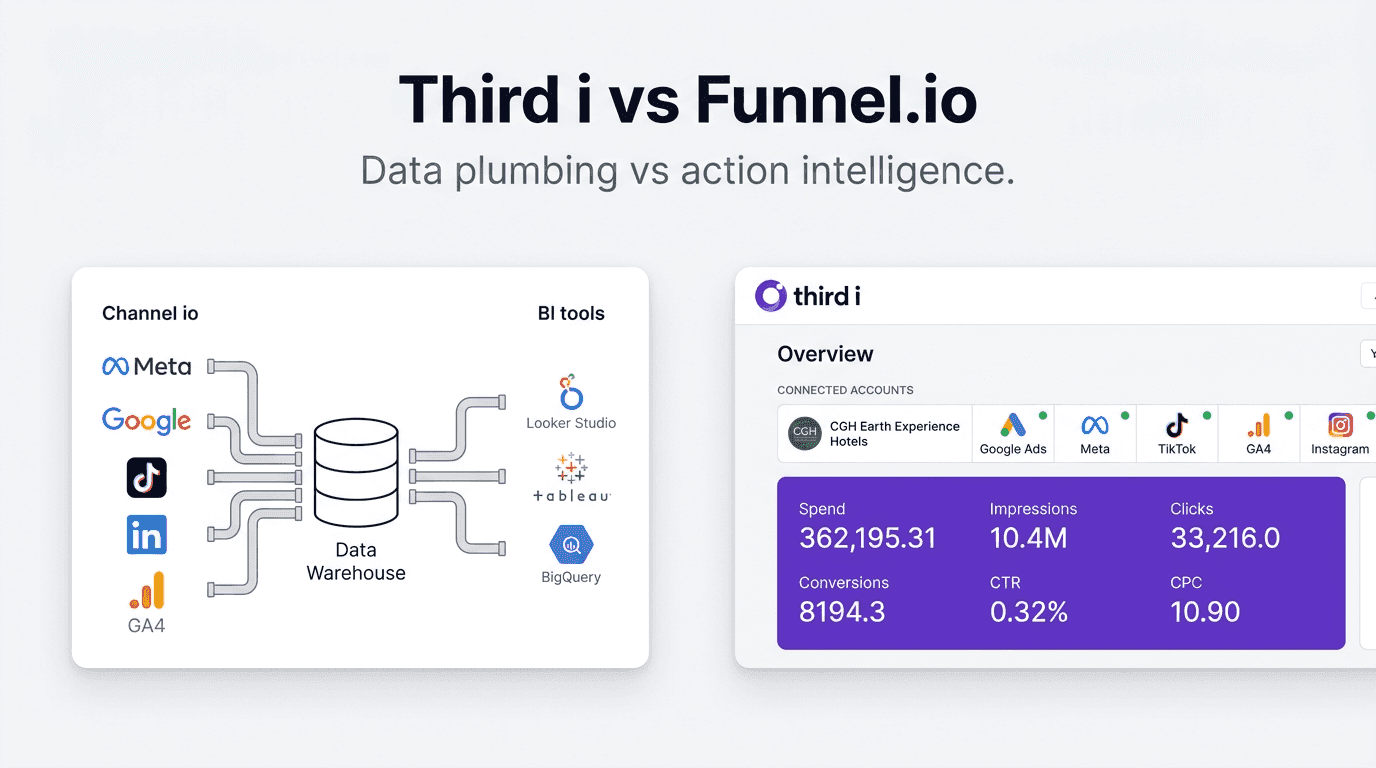
Third i vs Funnel.io: Data Pipeline vs Action Intelligence
Evaluating Funnel.io or looking for an alternative? Funnel.io is a marketing data hub that connects 600+ sources, normalizes your data, and pipes it into your BI tool, data warehouse, or reporting layer. It collects and cleans your data. Third i is an AI action platform that tells you what to do wi…