
GA4 Aggregate Identifiers: Why Measurement Must Become a Pre-Flight Check
Google Analytics now flags missing aggregate identifiers. Learn why campaign measurement should be a pre-flight check before launch.
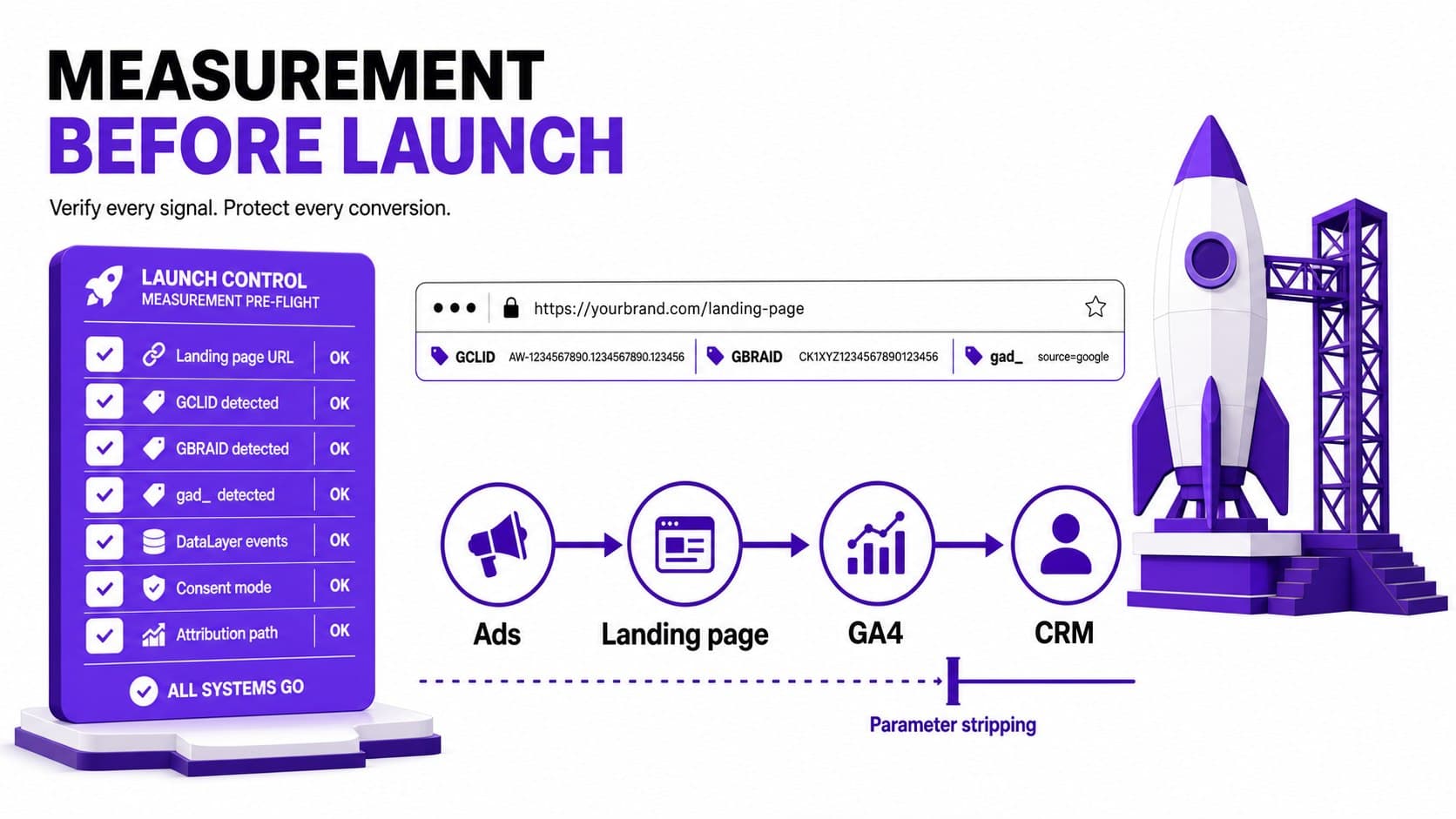
A campaign can be ready to launch and still be unmeasurable.
The media plan is signed off. The creative is approved. The landing page is live. The budget is loaded. Then, a few weeks later, the team is debating numbers that should never have been in doubt.
Revenue does not line up with the ad platform. A channel looks weak in GA4. Sales sees leads but cannot tie them back to the campaign. Someone asks whether the campaign worked. Nobody can answer with confidence.
This is not just a reporting problem. It is a launch problem.
Google Analytics has made that point more explicit. On 30 July 2026, Google announced a new GA4 diagnostic for campaign-data accuracy issues caused by missing aggregate identifiers. It can flag affected URLs where GBRAID and gad_ parameters are missing, then point users toward the URLs and fixes to investigate.
That sounds like a small technical update. I think it is a more useful operating signal. Measurement is moving upstream.
TABLE OF CONTENTS
1. What Google changed in GA4
2. Why reports arrive too late
3. The campaign measurement pre-flight check
4. A practical marketing scenario
5. What this changes for agencies
6. Where AI helps, and where it must not pretend
7. FAQ
What Google Changed in GA4
Google’s new diagnostic appears in the GA4 Data quality indicator when GBRAID or gad_ parameters are missing from URLs with a GCLID. All property users can view it. Editors and above can take the corrective action shown in the alert.
Aggregate identifiers are privacy-preserving URL parameters that help GA4 maintain campaign reporting accuracy when it cannot retrieve campaign information through the standard GCLID or DCLID. Google’s own guidance is direct: do not remove or block them from the landing-page URL.
That does not mean a marketer should manually manufacture these parameters. Google Ads adds the relevant gad_* parameters to eligible final URLs. The job for the marketing and web stack is to preserve what arrives at the landing page, especially through redirects, consent flows, tracking layers and cross-domain hand-offs.
The useful distinction is between two questions:
• What did this campaign achieve?
• Did we set up the campaign so its performance can be interpreted?
Most teams spend far more time on the first. The second determines whether the first has a meaningful answer.
Why Reports Arrive Too Late
Reporting is usually retrospective:
1. Launch the campaign.
2. Let it run.
3. Open the dashboard.
4. Explain the discrepancy.
5. Decide whether to act.
That sequence is backwards when the collection path is incomplete.
By the time a missing parameter or broken destination is discovered, spend has already been allocated. The clean comparison needed to understand a creative, audience or offer may be gone. The report was not wrong. It was incomplete.
A polished dashboard does not repair a broken measurement path. It only makes the gap easier to look at.
This is why measurement belongs beside creative QA, landing-page QA and budget approval. It is part of whether a campaign is ready to launch.
The Campaign Measurement Pre-Flight Check
A pre-flight check should be short. It should not turn into compliance theatre. Its purpose is to make avoidable ambiguity visible before money is spent.
Destination URL
Operating question: Does the final landing page preserve expected query parameters across every redirect and hand-off?
If missed: Google paid traffic can be harder to classify or reconcile.
Source identity
Operating question: Will the team recognise the traffic consistently in GA4, ad platforms and downstream reporting?
If missed: Channels split into messy variants or disappear into generic buckets.
Conversion event
Operating question: Does the live page send the event the team is actually optimising for?
If missed: A platform can optimise towards a proxy while the business watches a different outcome.
Consent behaviour
Operating question: Does the implementation behave as intended under the site’s consent setup?
If missed: Data can be incomplete or interpreted without the right caveats.
Cross-channel naming
Operating question: Do Google, Meta, the CRM and the reporting layer refer to the same campaign, offer and market clearly enough to reconcile?
If missed: Teams waste time matching records by hand.
Named owner
Operating question: Who confirms this is ready, and who owns a failure if the Data quality indicator flags it?
If missed: Everyone assumes someone else checked it.
The practical workflow is simple:
• In GA4, open the Data quality indicator and inspect any “Campaign data accuracy is affected by missing URL parameters” alert.
• Use View URLs to identify the affected paths.
• Trace a safe test journey through the landing page and every redirect or intermediary domain. Check that the complete query string is retained. Do not add or edit Google’s aggregate identifiers manually.
• Confirm the live conversion event and the naming that will be used in the ad platform, GA4 and CRM.
• Make the fix. Google says implementation changes can take 24 to 48 hours to take effect, so record the check rather than assuming an instant clean bill of health.
VISUAL 1: Featured image — “Measurement before launch”
Alt text: A launch-control measurement checklist shows GCLID, GBRAID and gad_ flowing from ads through a landing page, GA4 and CRM, while a guard stops parameter stripping.
Caption: A campaign readiness check protects the decision path, not just the dashboard.
A Practical Marketing Scenario
Imagine a retailer running three new creative routes across Google and Meta.
One route has a strong click-through rate. GA4 shows weak results. The ad platform shows more conversions. The CRM has leads, but the team cannot clearly tie them back to the creative route.
The instinct is to debate attribution models.
Start one step earlier.
Was the destination URL correct? Did the conversion event fire? Are the campaign names consistent? Were identifiers preserved through the redirect chain? Is the same offer represented clearly across the journey?
Sometimes the answer is still that attribution is hard. Different platforms will not agree perfectly. That is normal.
But sometimes the team is trying to make a strategic judgement from a preventable implementation error. There is a big difference.
What This Changes for Agencies
Agencies are especially exposed because a single campaign crosses multiple owners. A client may own the website. Another person owns analytics. The media team owns the campaign build. A different stakeholder exports the report.
By the time a discrepancy surfaces, it is no longer obvious who should investigate it.
A shared pre-flight check improves the hand-off. It gives the agency a credible point of view: we are not only responsible for launching ads. We are responsible for making sure the campaign can be judged fairly.
That also makes client conversations stronger. Instead of saying “the numbers do not match”, a team can say what has been verified, what is still uncertain, and which decision should wait for a cleaner signal.
Thirdi’s agency workflow is built around exactly this move from passive reporting to evidence-backed action. The point is not to make every platform report the same number. It is to connect the signals that matter, surface where the decision path is weak, and give a human owner the context to act.
Where AI Helps, and Where It Must Not Pretend
AI can make this process less manual. It can compare campaign names, scan destination URLs, flag inconsistent source labels, and surface a missing measurement condition before launch.
That is useful.
It should not turn uncertainty into a confident summary. A good marketing system shows what it checked, what it found, what remains unknown and what needs human review.
At Thirdi, we are trying to make that operating chain inspectable: connected advertising and GA4 data, a grounded diagnosis, an evidence-backed recommendation, then a human decision. The integration is useful because it connects ad performance with downstream site behaviour and conversion outcomes. The recommendation is useful only if the underlying signals deserve trust.
This is also why a connected assistant is more valuable than a pasted CSV. Thirdi’s MCP connector can let a supported AI assistant query the marketing context inside a connected Thirdi workspace, rather than working from an export that may already be stale. The assistant can help analyse and prepare. It does not make the decision boundary disappear.
A Better Launch Standard
The next step is not a grand attribution transformation.
It is a small change in operating discipline.
Before launch, ask:
• Can we identify where this traffic came from?
• Can we trust the event we are optimising towards?
• Can the media, analytics and CRM views be reconciled well enough for the decision we expect to make?
• Does somebody own final verification?
If the answer is no, a campaign may still launch. But the risk should be visible and deliberate.
That is the shift behind Google’s diagnostic. Measurement is no longer a report-card issue at the end of the month. It is part of campaign readiness.
VISUAL 2: Operating framework — “Campaign measurement pre-flight”
Alt text: A six-step campaign measurement pre-flight covering destination URL, source identity, conversion event, consent behaviour, cross-channel naming and a named owner.
Caption: The minimum evidence chain a campaign should clear before launch.
Frequently Asked Questions
What are GA4 aggregate identifiers?
Google describes GBRAID and gad_* parameters as aggregate identifiers that support more complete campaign reporting when GA4 cannot retrieve campaign information with the standard GCLID or DCLID. They are designed to provide aggregate campaign context without linking data to individual users or events.
Does this solve every attribution discrepancy?
No. Attribution still reflects different systems, models, consent states and customer journeys. The diagnostic helps reduce avoidable campaign-data gaps. It does not create a perfect source of truth.
Should marketers manually add GBRAID or gad_* parameters to campaign URLs?
No. Google Ads adds the relevant gad_* parameters to eligible final URLs. The practical responsibility is to make sure the web and tracking stack does not remove or block the parameters that Google adds.
What should an agency do first?
Put a short measurement pre-flight check into the campaign-launch process. Verify the final URL, redirect behaviour, conversion event, naming convention and named owner. Then use the GA4 diagnostic as a live control, not a post-mortem surprise.
Next Step
If your team spends more time arguing about numbers than acting on them, start by connecting the advertising, analytics and business signals that shape the decision. Explore Thirdi’s Google Analytics integration, read how teams move from attribution measurement to action intelligence, or book a working session.
See this on your own accounts
third i connects to the platforms you already run and does this work against your live numbers.
Read more
View all articles
Most AI content does not rank (here is the real problem)
The core issue with most AI-generated marketing content is that it is created without real search data, leading to a high volume of URLs that receive almost no organic impressions because they fail to match modern user intent and search behavior. The breaking traditional SEO model of picking a broa…


5 Strategies to Mastering FinTech SEO in 2025
SEO remains a cornerstone for FinTech growth, with 2025 demanding hyper-targeted strategies like voice search optimization, AI-driven content, and E-E-A-T compliance.