Do You Need to Hire a Marketing Engineer?
A marketing engineer makes sense when distinctive systems need continuing internal ownership. For repeatable work, your existing team and software may be enough. Start with the workflow, not the title.
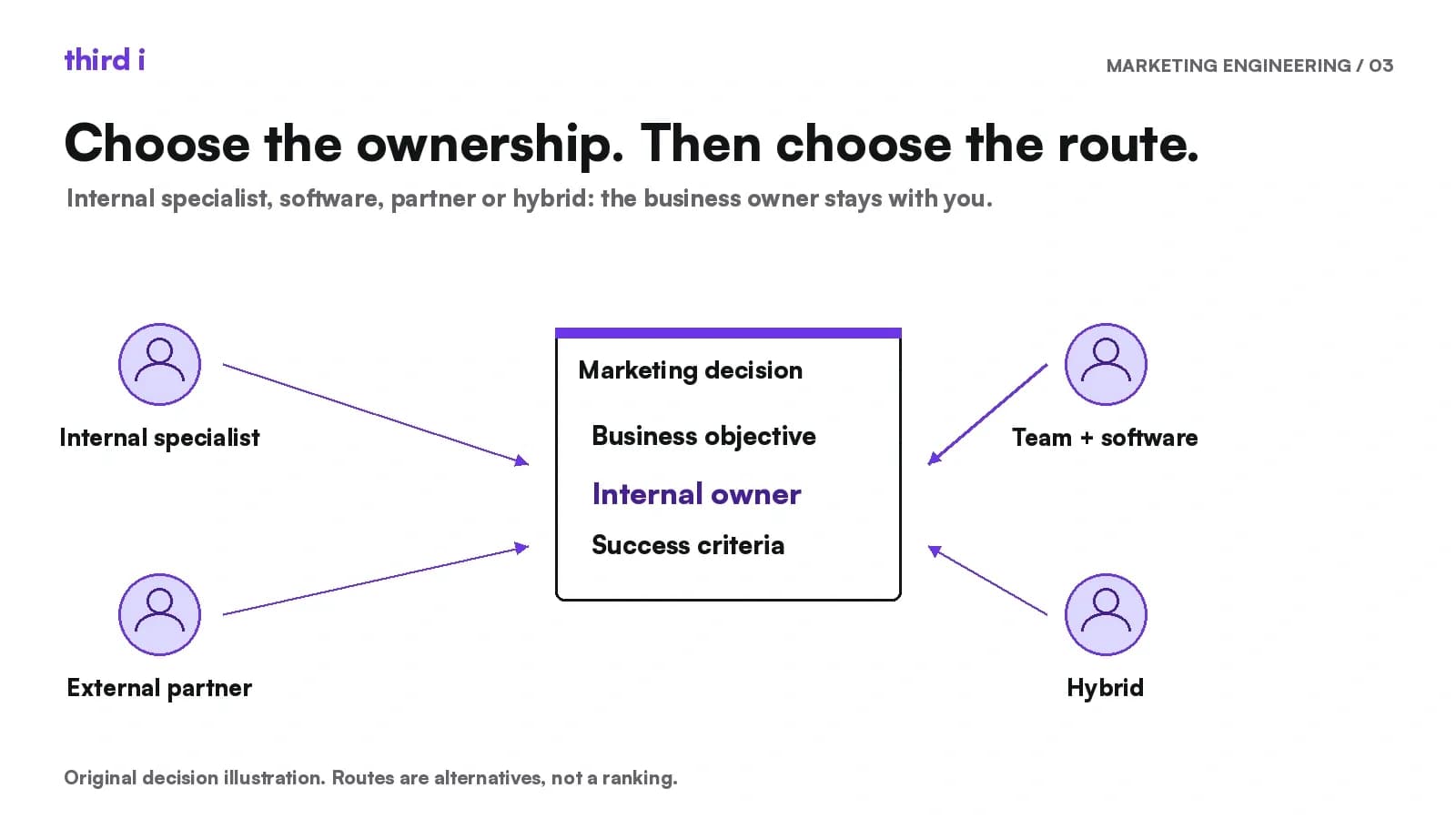
Start with the work, not the title
You need to hire a marketing engineer when building and maintaining distinctive marketing systems is a continuing internal job. You probably do not need one when the problem is a repeatable workflow that your existing team can run with suitable software. A partner or hybrid can fit between those cases.
I would not open a role because another company has found a compelling name for the work. I would first ask what keeps breaking, who understands it and whether fixing it requires a builder every week. Those answers can justify a hire. They can also save you from creating a job around a temporary implementation.
What should a marketing engineer actually own?
In Nick Lafferty's Zero Click New York 2026 presentation, the useful idea is someone who ships systems end to end, works across functions and brings taste and experience. That is a broader responsibility than writing prompts or connecting tools.
Profound's introduction to The Marketing Engineer podcast describes the combination of marketing judgement, creativity and technical ability. The important part is not the title's momentum. It is whether someone can turn a marketing need into a working system and keep it useful after launch.
That might mean taking an approved campaign brief through production, review, distribution and measurement. Each handoff needs business context. A technically successful workflow that publishes the wrong message is still a failed marketing system.
The constraints that should decide your model
Start with repeatability. Does the same job return with broadly stable inputs and outputs? Then examine custom complexity: are you joining familiar platforms, or accommodating proprietary data and unusual business rules? Software may fit the first and struggle with the second.
Sensitive data changes the access and deployment requirements, not automatically the hiring answer. An employee using an unsuitable external tool can create the same exposure as a partner. Ask where data travels and who is permitted to see it.
Then consider maintenance, strategic distinctiveness and internal capacity together. How often will the system change? Is its logic part of how you compete? Does someone have protected time to run it? A distinctive workflow without maintenance capacity is not an internal capability yet.
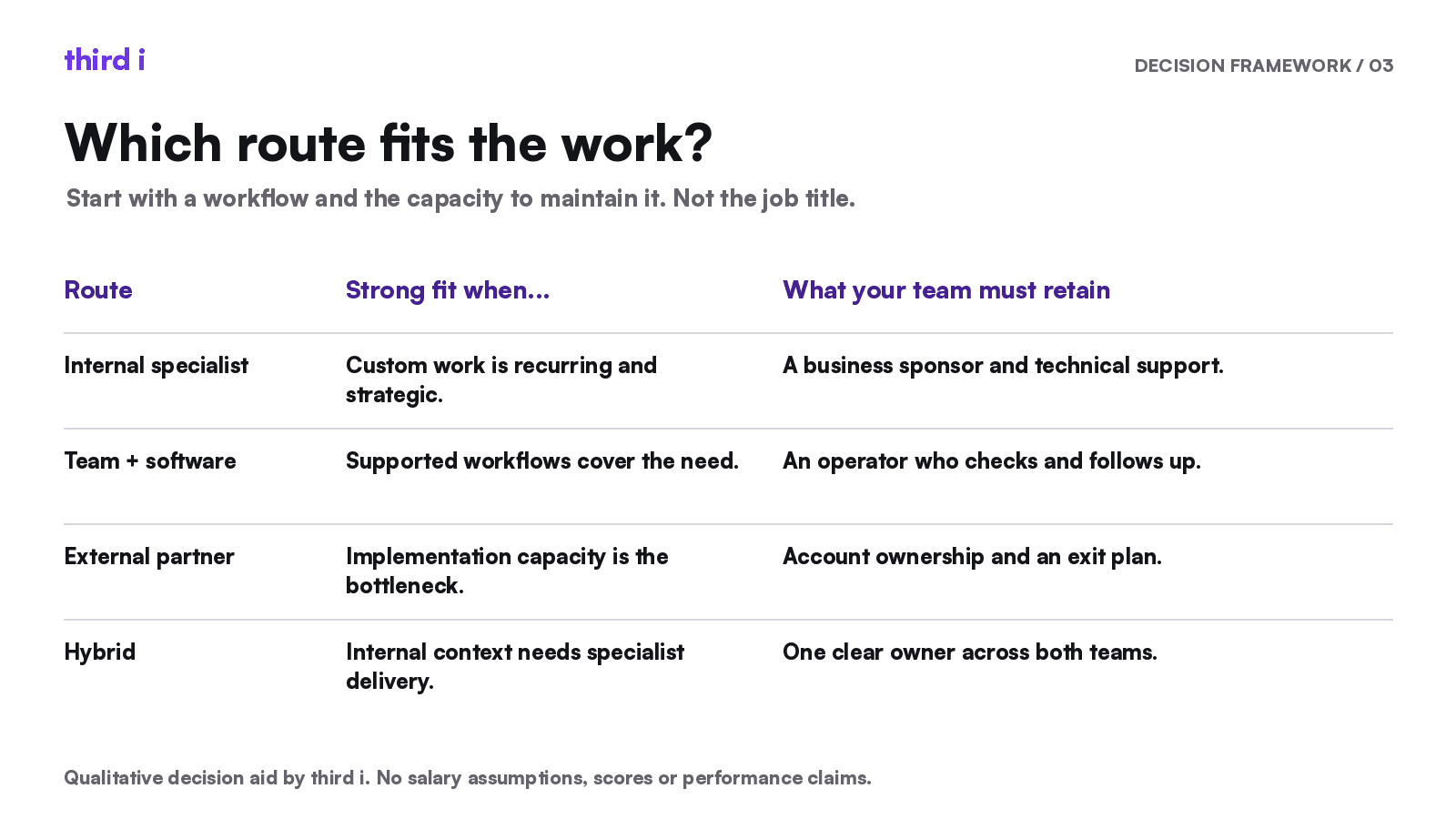
A qualitative comparison of internal specialists, team plus software, external partners and hybrid delivery. These are fit conditions, not scores or a vendor ranking.
Four ways to staff the same work
Internal specialist: best suited to recurring custom work that needs deep business context. You gain direct control over priorities and learning, but must provide a useful backlog, technical support and cover when that person is unavailable.
Existing team plus software: suitable for standard, repeatable jobs that current operators understand. You avoid maintaining every connection yourself. The trade-off is accepting product boundaries and giving the team time to configure, review and use it.
Partner: suitable for a bounded build or specialist gap when internal capacity is limited. You gain access to skills without creating a permanent role. You still need an internal decision-maker, agreed maintenance responsibilities and a workable handover.
Hybrid: suitable when business logic should stay close to your team but implementation needs extra help. Keep priorities and acceptance internally; allocate specific build and support work externally. This only helps if the boundary is explicit. Otherwise, both sides wait for the other.
When I would not hire
Consider an illustrative team assembling a weekly paid-media report. Its metrics are agreed, its sources are supported and the real frustration is copying numbers. Start by testing software with the existing team. A permanent engineering role is not the obvious answer to a familiar reporting task.
I would also pause a hire if the brief is 'make marketing use AI', nobody can prioritise the work, or the backlog consists of one migration. A partner may finish that migration. A marketing leader may need to resolve the priorities. Neither problem automatically becomes a full-time engineering job.
Software will not resolve a disagreement about what counts as a qualified lead. An engineer can encode a definition once it exists, but should not have to invent the business agreement.
When an internal hire is justified
Now consider a different illustration: campaign decisions depend on proprietary margin rules, account eligibility and changing sales feedback. The workflow evolves continually and crosses marketing, data and sales. Its logic helps the business compete, rather than merely making a report faster.
That is a stronger case for an internal specialist, especially when security requirements demand close control and the team can sustain a meaningful backlog. Hire for marketing judgement and production discipline, not just a convincing automation demo.
Ask how the candidate handles failed runs, tests changed logic, documents decisions and gets colleagues to adopt a system. Give the role access to engineering and security support. One marketing engineer should not quietly become your entire infrastructure team.
A documented example of the software route
The third i MCP connector is a public example of software covering part of this work. Its documentation describes cross-source marketing queries, report generation and connection-health checks. It also documents preparing Google Ads and Meta Ads changes that require user approval inside third i before application.
Authentication uses OAuth through third i. Ad-platform passwords are not shared with the AI provider, and platform tokens stay inside third i. That does not mean no marketing data reaches the assistant. Review the data flow and your assistant provider's terms.
This is evidence of shipped software capabilities, not a claim that third i supplies a complete managed marketing-engineering function. Agencies assessing portfolio workflows can examine third i for agencies. Security reviewers can start with third i's trust and security information, then confirm their specific requirements.
Keep an internal ownership map
Whatever model you choose, name an internal accountable marketing owner. That person owns the business objective, priorities and acceptance of the work. You can outsource implementation. You cannot outsource accountability for what marketing is trying to achieve.
Name the workflow operator who reviews outputs and handles exceptions; the builder who changes and documents the system; the platform administrator who controls accounts and permissions; and the security reviewer who approves data access. Specify who authorises consequential actions and who responds when something fails.
One person may hold several roles. Each responsibility still needs a name and a backup. This is a proposed operating model for your team, not a description of functions automatically supplied by a software subscription.
Run a pilot that can fail honestly
Choose one bounded workflow and record how it works today. Agree what success means before the demo: usable output, acceptable review effort and a clear path for exceptions. Use representative work, not only the cleanest example.
For a reporting pilot, check that totals reconcile to source accounts, date ranges and currencies are explicit, and stale or missing data is flagged. Ask the operator to trace a recommendation to its evidence. Record corrections and manual effort rather than assuming automation removed them.
If changes are in scope, verify that unauthorised actions are blocked and approvals are recorded. Test recovery from a failed run, revoked connection and absent operator. Have someone other than the builder follow the documentation. Stop or narrow the pilot if these checks fail.
Ask exit questions before you sign
For any partner, ask: can we export our data, configurations, prompts and workflow logic in usable formats? Who owns the ad accounts, cloud accounts, repositories and generated assets? Are credentials held in company-controlled accounts rather than someone's personal login?
What documentation and handover are included? Who maintains the system after delivery? Can another operator run it without the partner? How do we revoke access, rotate secrets and confirm deletion when the engagement ends? Ask software providers equivalent questions about exports, access and termination.
Choose the arrangement that leaves you able to operate the work. Sometimes that is an employee. Sometimes it is software, a partner or a hybrid. Write the workflow brief and ownership map first. The hiring decision becomes much easier when the job is no longer a slogan.
See this on your own accounts
third i connects to the platforms you already run and does this work against your live numbers.
Read more
View all articles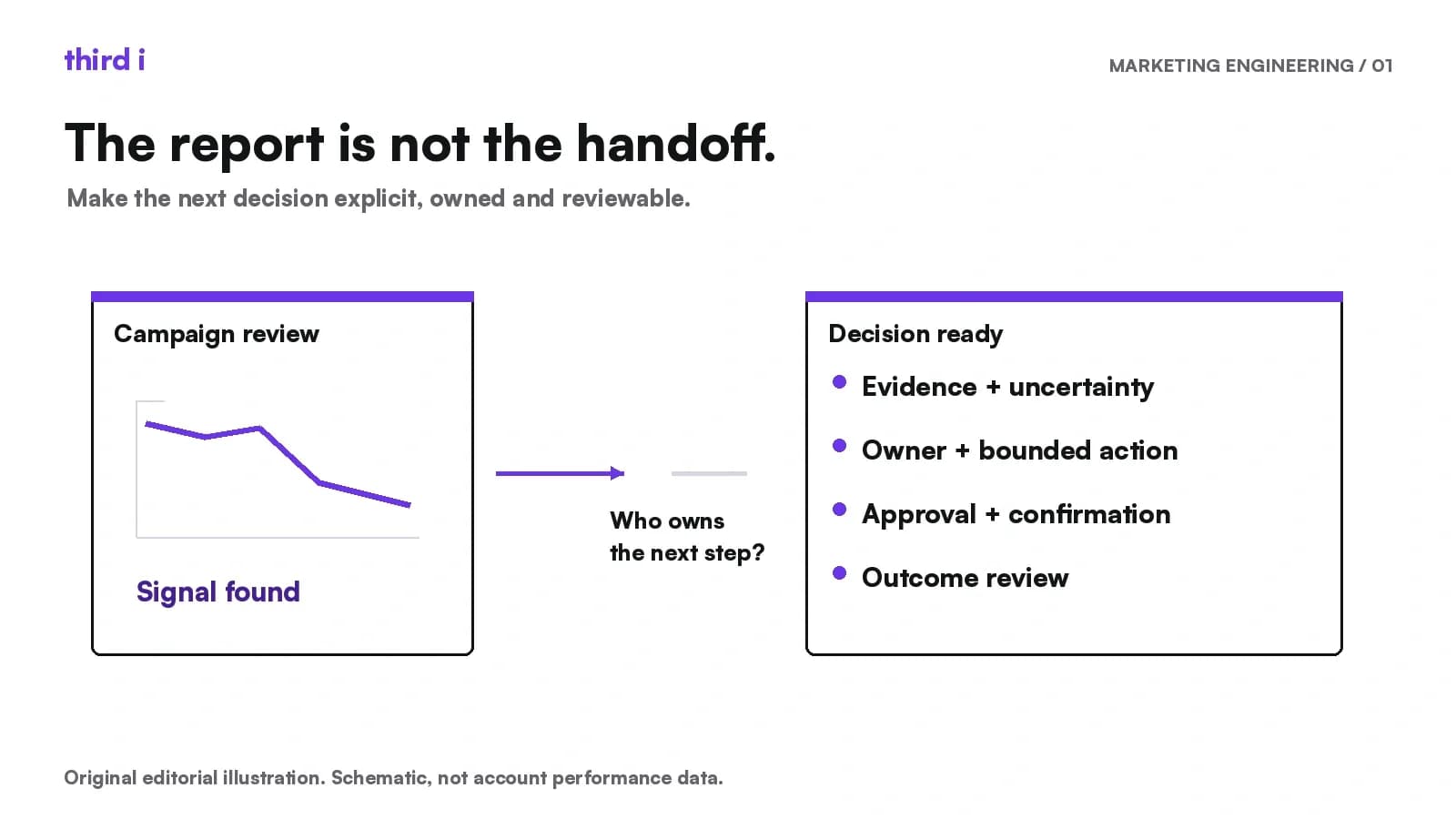
The Real Job of a Marketing Engineer Is Closing the Gap Between Insight and Action
The useful job of a Marketing Engineer begins where a recommendation can stall: a named owner, a bounded proposal, clear approval, confirmation of the change and an outcome review.


Using third i Alongside Semrush, Ahrefs and Claude
Keep the tools your team trusts. See where third i adds connected marketing context, competitor creative research and a shared route into Claude.

How to Connect Claude to Your Google Ads + Meta Ads Data (And What to Ask It)
A step-by-step guide to connecting Claude to your Google and Meta Ads data using MCP - with 5 copy-paste prompts for cross-channel insights.