
Using third i Alongside Semrush, Ahrefs and Claude
Keep the tools your team trusts. See where third i adds connected marketing context, competitor creative research and a shared route into Claude.

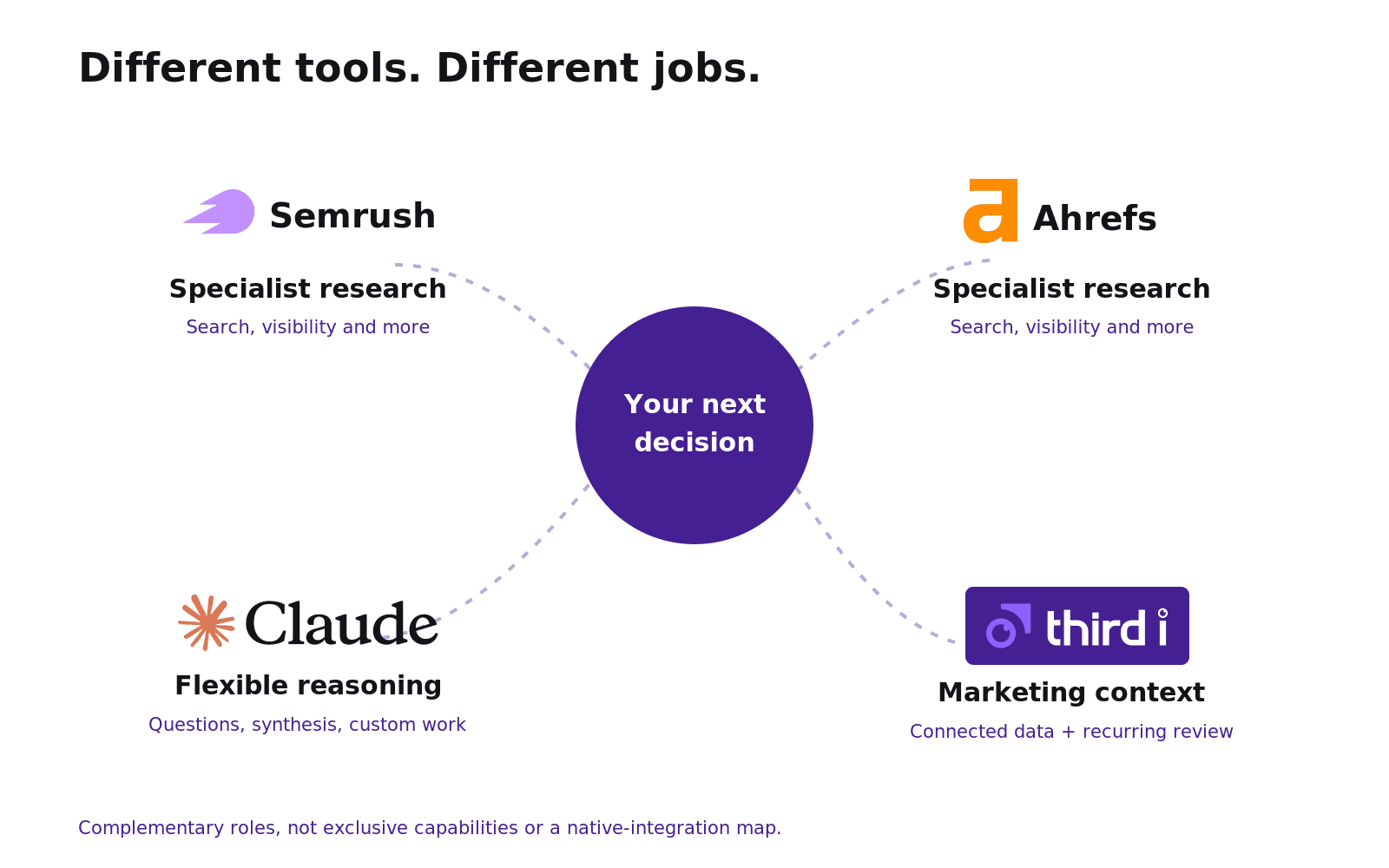
If your team already uses Semrush, Ahrefs and Claude, third i should not ask you to forget why you chose them. Search research, technical audits and an adaptable AI assistant are valuable capabilities. The question is whether third i adds enough to your daily marketing work to deserve a place beside them.
That is a harder question than comparing feature lists. It is also a more useful one.
In a recent positioning discussion at third i, we kept returning to the same issue: the phrase ‘competitor insights’ can mean several different jobs. One person means keywords and backlinks. Another means the offers appearing in a rival’s social ads. Both are doing competitor research. They are not looking for the same answer.
If we describe the category without explaining the job, the buyer has to guess. That is our problem to fix, not theirs.
Start with what your existing tools do well
Semrush and Ahrefs give marketers substantial research capabilities, particularly around search visibility, keywords, backlinks and website performance. They are not simply report generators. Their underlying datasets and specialist workflows matter.
Nor is it accurate to draw a neat line that says they do search while everyone else does social. Semrush documents social competitor analysis, and Ahrefs now describes a broader set of social, AI visibility and automation products. Their product ranges continue to develop.
Claude brings something different: a flexible place to reason, write, investigate and build workflows around the information a team supplies or connects. A well-maintained Claude setup can already do a meaningful amount of marketing work.
The sensible starting point is to keep the capabilities that earn their place. We are not proposing third i as a replacement for the depth of an SEO research platform, an AI visibility measurement tool or a general-purpose assistant.
Look for an unfinished job, not a missing feature
Consider an illustrative weekly creative review. The team wants to decide which message to test next.
Search research might show the language people use to describe their problem. Competitor social research might show how brands are presenting their offers. Your own campaign data can show which messages attract clicks and which lead to useful outcomes. An AI assistant can help organise the evidence into testable options.
These are complementary inputs. None becomes redundant because another exists.
But someone still has to gather the relevant material, align the periods and explain what the evidence does and does not support. They also need to distinguish a popular competitor post from a profitable competitor campaign. Public activity does not reveal the competitor’s return on spend.
The unfinished job is not ‘get more insights’. It is ‘make a defensible creative decision without rebuilding the research every time’.
That is the level at which another product should be evaluated.
Where third i fits alongside the stack
third i’s competitor research currently collects public Meta ads and Instagram organic content into a shared research view. The published workflow classifies creative by attributes including tone, funnel stage, call to action and format, with watchlists refreshed every fortnight.
Those limits matter. This is not a promise of real-time coverage of every social platform. It is not access to a competitor’s private performance data. And an AI classification is an interpretation to review, not privileged knowledge of the advertiser’s strategy.
The useful application is more concrete. A team can examine recurring offers, compare creative approaches and decide which patterns are worth exploring against its own campaign evidence. Search specialists can continue their deeper keyword and visibility research in the tools they trust.
Alongside that research, third i brings connected campaign and website performance into one working environment. The benefit is not that the numbers share a screen. It is that the next question can span the connected sources without starting a fresh collection exercise.
For example: is the issue weak response to the ad, or a problem after people arrive on the site? Those possibilities call for different work. Changing the creative before checking the landing-page evidence may solve the wrong problem.
third i can help inspect the available signals together. It does not make correlation proof of causation, or remove differences between platform and analytics attribution.
Keep the assistant your team already uses
The strongest version of this arrangement does not require every marketer to move their thinking into another chat window.
With the third i MCP connector, supported assistants such as Claude can query marketing data from a connected third i workspace. You authenticate with your third i account. You do not need to issue an API key for the connection.
That gives the tools different jobs. third i provides access to the connected marketing workspace. Claude remains the place where the user explores a question, challenges an explanation or drafts the next brief. Search and visibility tools retain their specialist research role.
This is not a claim that third i automatically imports Semrush or Ahrefs data. Any additional research must be supplied through an available, authorised route. A complementary workflow is not the same thing as a native integration.
For teams that have already built useful Claude projects and routines, the question becomes practical: does adding this marketing connection reduce work or improve the evidence available to the assistant? If it does not, there is little reason to add it.
How to decide whether another tool is worth it
Start with one recurring job, not the entire stack. A creative review, a cross-channel performance investigation or a morning account check is enough.
Run that job using your current process. Note where someone has to collect data again, reconcile definitions or reconstruct context. Then try the same job with third i alongside the existing tools.
Look for a useful difference: less preparation, clearer evidence, an earlier warning or a better-supported decision. Do not count the number of charts generated. Do not buy duplicate coverage simply because it comes with an AI label.
A team with a well-run data platform, strong monitoring and reliable research routines may find less incremental value. A team doing those connections manually may find more. The size of the organisation alone does not settle the question.
My view is that a marketing stack does not need one product to win every category. It needs the work between categories to stop falling through the gaps.
Keep what works. Ask us to demonstrate the additional job.
Bring one recurring marketing question to a third i walkthrough. We can look at where the current workflow ends, where third i might help, and where your existing tools should stay in charge.
See this on your own accounts
third i connects to the platforms you already run and does this work against your live numbers.
Read more
View all articles
How to Connect Claude to Your Google Ads + Meta Ads Data (And What to Ask It)
A step-by-step guide to connecting Claude to your Google and Meta Ads data using MCP - with 5 copy-paste prompts for cross-channel insights.

How does Growth Marketing differ from Growth Hacking?
Learn the crucial differences between growth marketing and growth hacking to choose the best strategy for your business's sustainable growth or rapid expansion.

What Makes Growth Marketing So Effective?
Discover how third i can help you up your ROAS! Learn about the latest trends in Performance Marketing & SEO.