
MiniMax H3 vs Seedance 2.5 vs Gemini Omni vs Kling vs Wan 3.0 vs FLUX 3 for Agencies
A practical guide for agencies comparing six leading AI video models by the production job, controls, review burden and client risk that actually matter.
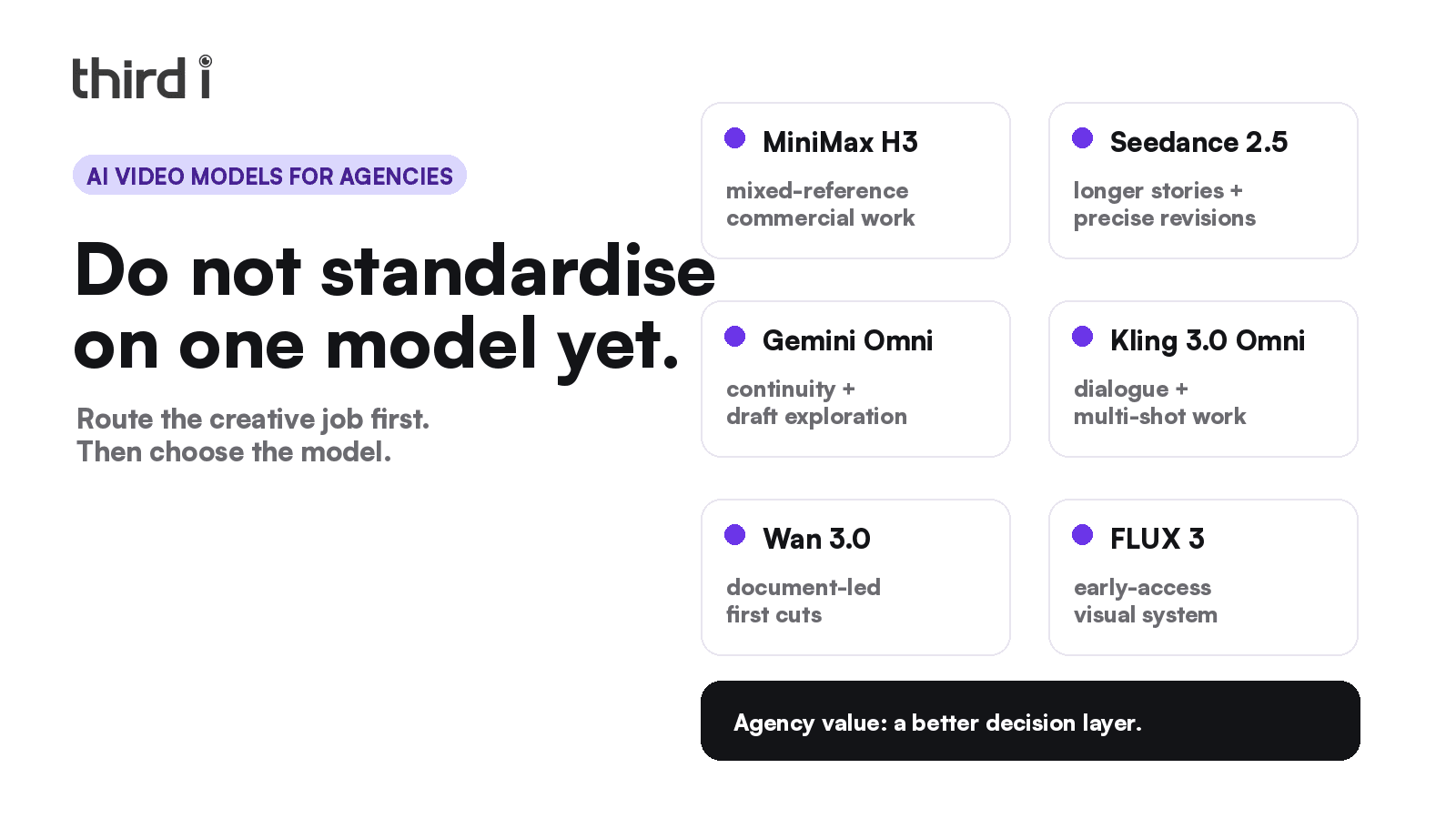
An agency can now buy access to six credible AI-video models and still have no answer to a client’s most basic question.
“Which one should we use for this campaign?”
The honest answer is not a model name.
It is: what has to remain stable, what needs to change, and how much risk can this asset carry?
That is less exciting than a leaderboard. It is much closer to the work.
MiniMax H3, Seedance 2.5, Gemini Omni 1.1 Flash, Kling VIDEO 3.0 Omni, Wan 3.0 and FLUX 3 are not one neat capability ladder. They represent different production workflows.
Some are built for a dense reference pack. Some are better suited to longer stories and targeted revisions. Some make continuity cheaper to explore. Some combine character, dialogue and multi-shot direction. One is an early-access system that deserves a controlled trial, not quiet standardisation.
The short answer
If the agency is working from a product packshot, a motion reference, an audio cue and a precise brand direction, start with MiniMax H3.
If the first cut is expected to survive several rounds of feedback, start with Seedance 2.5.
If the task is to direct a sequence, test transitions or generate cheap draft variations before committing, start with Gemini Omni 1.1 Flash.
If the asset has a person speaking, a product interaction and more than one shot, start with Kling VIDEO 3.0 Omni.
If the source material is a fuller brief, document or webpage, add Wan 3.0 to the trial.
If the agency wants to explore one system across stills, video and audio, keep FLUX 3 in an early-access exploration track.
That is a routing guide, not a buying recommendation. A good demo is evidence that a model can make one thing. It is not evidence that an agency can reliably ship client work with it.
Do not standardise before you know the jobs
The agency mistake would be to pick one winner, buy seats for everyone and ask the creative team to force every brief through it.
That turns model selection into another operating constraint.
The better approach is to define the small number of creative jobs that recur across accounts, then give each job a first-choice model and a fallback. Keep the decision visible. Update it after real work, not after a launch video.
1. Mixed-reference commercial development: MiniMax H3
A normal campaign brief does not arrive as a clean prompt.
It arrives as an approved product image, an old brand film, a sound cue, a creator example, a new offer and a warning not to make the work look synthetic.
MiniMax H3 is the relevant candidate for that kind of input. MiniMax says the model uses text, images, video and audio as unified context, produces up to 15 seconds of 2K video with native stereo sound, and is intended for use cases including advertising, branding and e-commerce.
That does not make H3 the best advertising model. It makes it the first model to test when the brief is a relationship between several approved inputs, not a text description of an imagined scene.
The useful agency test is straightforward. Give it a rights-cleared packshot, an approved motion reference, a sound direction and a factual product message. Then review whether the product stays recognisable, the movement supports the message and the audio belongs in the same world.
2. Longer story work that has to survive revision: Seedance 2.5
The costliest video workflow is not always the one with the highest generation price.
It is the workflow that forces a team to rebuild a strong sequence because a client changes the final line, product colour or end card.
Seedance 2.5 is positioned around that problem. ByteDance says it can generate up to 30 seconds of audio-video in one pass, accept a large multimodal reference pack, extend work over multiple rounds and make timestamp-level edits. It also explicitly positions the editing and reference controls for film and advertising work.
For an agency, the question is not whether the initial 30-second clip is impressive. It is whether the system can retain the useful work when feedback arrives.
Use Seedance first for an actual product story: tension, product proof and an ending that must change without the whole visual system collapsing.
3. Continuity and controlled exploration: Gemini Omni 1.1 Flash
A single attractive AI shot is no longer difficult to find.
The harder work is directing the next shot without losing the character, product or visual logic that made the first one usable.
Google’s Omni 1.1 Flash release is useful because it makes that workflow explicit. The model can extend a scene using up to 10 seconds of prior context, generate between specified first and last frames, accept short video references, create 360p drafts and upscale output to 1080p or 4K. Google says the 360p draft mode can be up to 60% faster and cost one-third of standard 720p generation.
This is the model to test when the agency has a visual direction but needs a low-cost working room before it asks a client to approve a final render.
Use it for defined transitions, scene continuation and structured iteration. Do not use the 4K label as a substitute for inspecting product accuracy, small text, claims or brand detail.
4. Dialogue and multi-shot creator work: Kling VIDEO 3.0 Omni
A credible creator-style asset is not only a visual task.
It asks a viewer to believe an expression, a product interaction, a spoken line and a sequence of shots at the same time.
Kling VIDEO 3.0 Omni is the appropriate model to test when those elements matter. Kling documents multimodal inputs, element consistency, character voice binding, native audio-visual output, multi-shot storyboarding and video generation up to 15 seconds.
The benchmark should not be “does the lip-sync look plausible?”
It should be “does the person make a credible advertising point, and can the agency defend every product, line and visual claim in the clip?”
That is a stricter test. It is the one clients will actually care about.
5. Information-rich briefs and document-to-video: Wan 3.0
Wan 3.0 should now be treated as a real contender, not an unverified placeholder.
Alibaba Cloud documents Wan 3.0 as an all-in-one video model that can generate up to 30 seconds, output dialogue, BGM and sound effects, accept multimodal references, use first or first-and-last-frame controls, edit and extend video, and parse a document or public webpage as input.
That gives it a distinct agency role. It may be the most relevant system to test when the creative team starts from a substantial content brief, a product document or a public landing page rather than a short prompt.
There is still a boundary to keep. A model turning a document into video does not make the document’s claims accurate, permitted or suitable for an ad. The agency still owns the source material, the claim hierarchy and the approval process.
6. A unified visual system, but with early-access discipline: FLUX 3
FLUX 3 is a different kind of bet.
Black Forest Labs describes it as a multimodal foundation model trained across images, video and audio. Its early-access video capability includes text-to-video, image-to-video, video-to-video, continuation, keyframe-to-video transitions, multilingual dialogue and clips up to 20 seconds.
This makes FLUX 3 interesting for a team that wants to begin from a still concept, bring it into motion and alter or extend the work without treating every output as a disconnected prompt.
It also makes its early-access status material. Run experiments. Use clear client boundaries. Do not make it the agency’s invisible default for paid work until the workflow, commercial terms and output quality are proven on the agency’s own briefs.
The agency routing rule
Do not ask: “Which model is best?”
Ask four questions before you open one.
- Does the work begin with a prompt or a reference pack?
For mixed inputs, H3 is the logical first test. For document or webpage-led work, Wan 3.0 is the logical first test. - Does the asset need to survive feedback?
If product details, language or the final frame will change, test Seedance 2.5 and FLUX 3. The job is not avoiding change. It is avoiding the loss of useful work every time a change arrives. - Does the asset need a sequence or a moment?
For controlled transitions, extensions and iteration, Gemini Omni makes sense. For a dialogue-led short sequence, Kling is more relevant. - What is the client’s risk profile?
Early access, regional availability, commercial rights, voice usage, product depiction and unapproved claims are not footnotes. They are part of the creative decision.
What a useful model test looks like
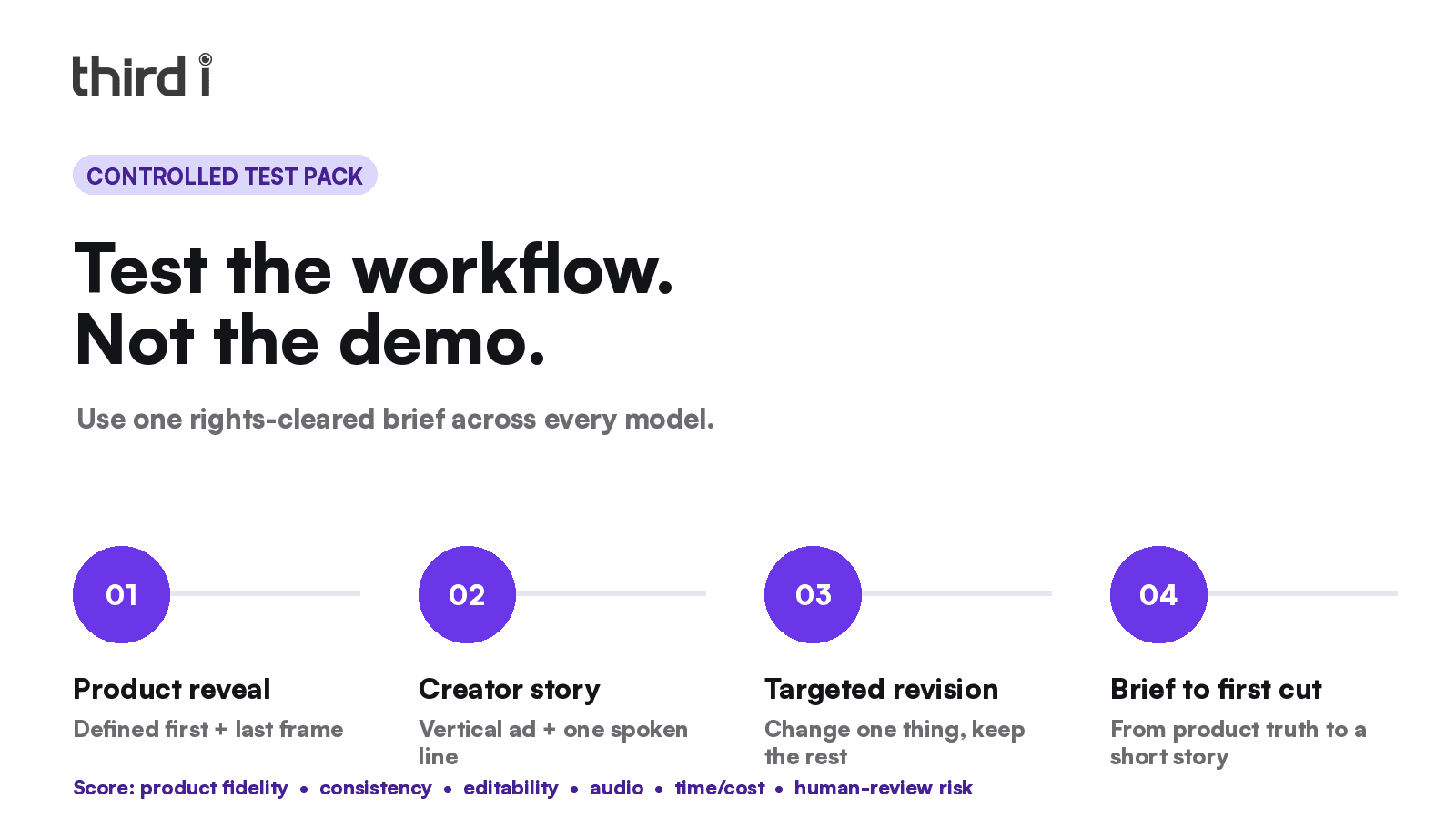
Do not test these models with a cinematic squirrel in a forest.
Test whether the agency can produce a reviewable campaign asset.
Use one fictional, rights-cleared product. Give every model the same product truth, image reference, required claim, aspect ratio, CTA and brand constraints.
Then run four short tasks.
- Product reveal: create a short reveal from defined first and last frames.
- Creator story: create a vertical creator-style video with one spoken product line.
- Targeted revision: change one approved element in the best output without destroying the rest.
- Brief to first cut: create a short story from a compact campaign brief.
Score each run on seven things:
- product fidelity
- subject and scene consistency
- message accuracy
- editability after feedback
- audio and dialogue quality
- time and cost to a usable draft
- human-review and brand-safety risk
The output is a routing sheet, not a trophy.
It may say:
- H3 for mixed-reference short-form development.
- Seedance 2.5 for longer story work and precise revisions.
- Gemini Omni for continuity and draft-room experimentation.
- Kling for dialogue and character-led social video.
- Wan 3.0 for document-led or information-rich starting points.
- FLUX 3 for controlled early-access exploration across visual modalities.
That is far more useful than announcing a universal winner.
More output does not make an agency more valuable
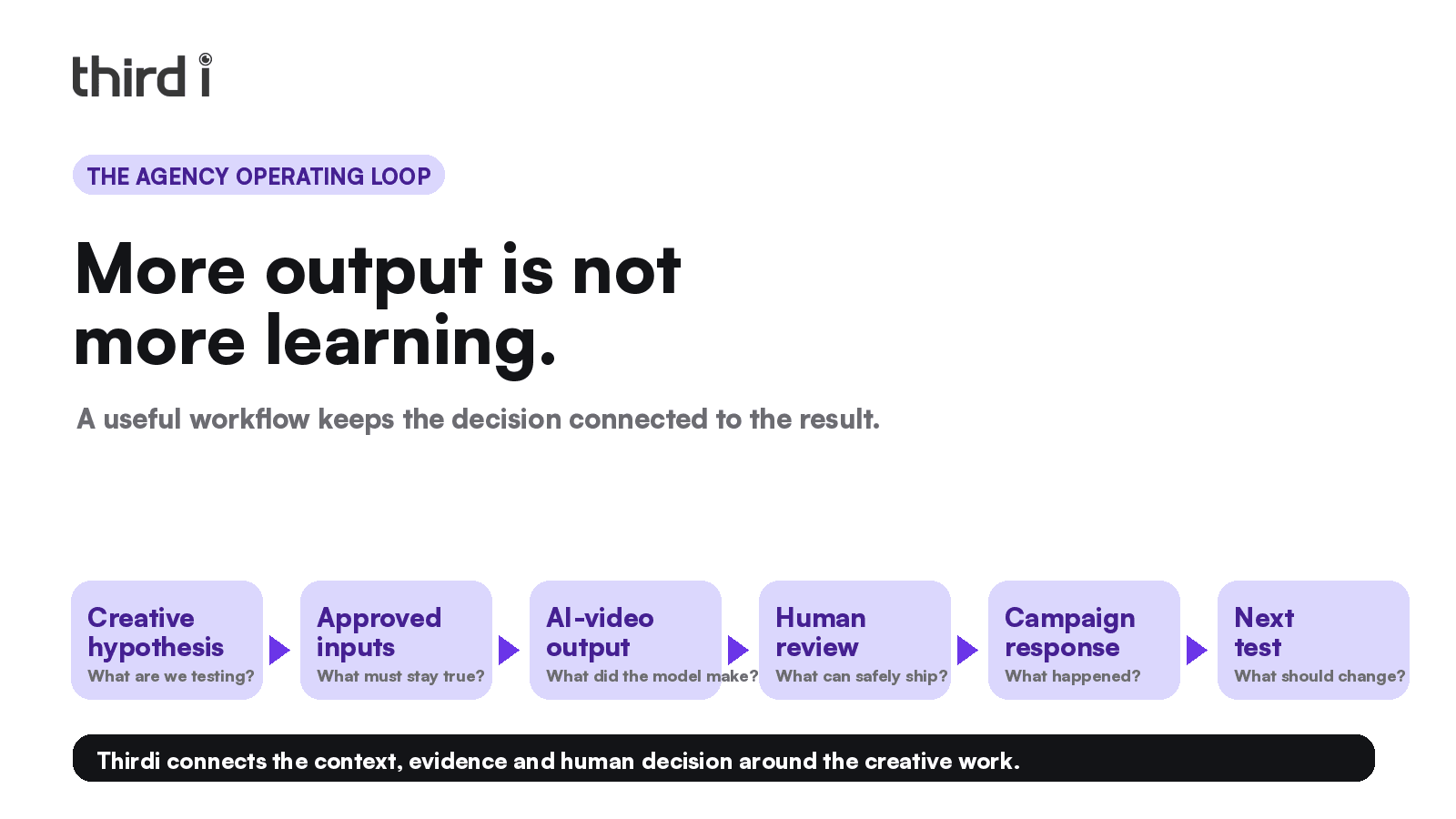
The weak version of AI-video adoption is easy to recognise.
The agency produces more concepts, more clips and more variations. It becomes faster at showing work. It is not necessarily faster at learning which work is worth spending behind.
The stronger version connects the original hypothesis to the asset, the audience, the product proof, the campaign response and the next decision.
That is where an agency earns its value.
A client will not keep paying because the agency has access to the newest model. Access becomes ordinary quickly.
It will pay for better judgment about what to make, what to approve, what to test and what the team learned from the result.
That is also where third i’s marketing operating layer fits. third i connects cross-channel marketing signals, campaign context and the work that needs a human decision. Its agency workflow is built for client-ready recommendations, not passive reporting. And for teams working inside their preferred AI assistant, the third i MCP connector can bring authenticated marketing context into that conversation without sharing ad-platform passwords with the AI provider.
The video generator can create a clip.
It cannot decide whether the clip answered the right business question.
See this on your own accounts
third i connects to the platforms you already run and does this work against your live numbers.
Read more
View all articles
Image Discovery Changes the Job of Brand Creative
Google’s new Images experience is a useful signal: creative is moving from something brands publish into something people browse, save and return to. That changes what marketers need to research before they make the next asset.

GPT-5.6 Sol vs Terra vs Luna for Marketing Teams and Agencies
A founder's practical guide to using GPT-5.6 Sol, Terra and Luna in marketing. Learn which model fits each job and why connected context matters more than raw capability.
Brand Marketing vs. Performance Marketing: Which is Right for Your Business?
Brand marketing and performance marketing serve distinct purposes: brand marketing focuses on long-term growth by building trust, loyalty, and emotional connections
