
GPT-5.6 Sol vs Terra vs Luna for Marketing Teams and Agencies
A founder's practical guide to using GPT-5.6 Sol, Terra and Luna in marketing. Learn which model fits each job and why connected context matters more than raw capability.
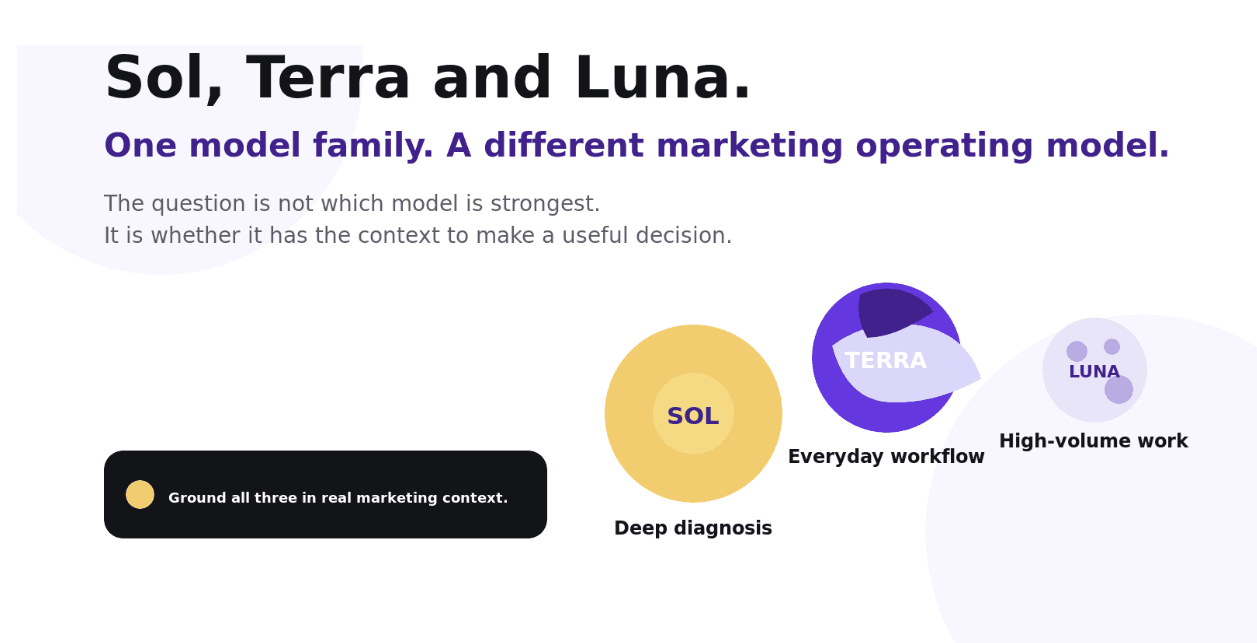
GPT-5.6 Sol, Terra and Luna will change how marketing teams work. They will not fix the reason most teams make poor decisions.
My first reaction to the launch was not, “Which model should I use?”
It was, “What happens when every marketing team can produce ten times more work?”
More ad variants. More reports. More landing-page copy. More campaign ideas. More confident answers in a chat window.
That sounds useful. It is useful.
But marketing teams do not usually suffer because they cannot produce enough work. They suffer because they cannot see the full picture quickly enough to decide what should happen next.
At third i, we see this in the questions teams ask when something moves in the wrong direction.
- “Why did our ROAS drop?
- “Should we pause this campaign?”
- “Is this a creative problem or an audience problem?”
- “Are we getting leads, or are we getting leads that sales can actually close?”
Those questions look simple. They rarely are.
The answer can sit across Meta, Google Ads, GA4, a CRM, a landing page, a creative brief and the context that lives in someone's head. A stronger model can help. But only if it has enough of that context.
That is why GPT-5.6 matters to marketers. Not because Sol, Terra and Luna are three new names to remember. It matters because model capability is becoming easier to access. Marketing judgment is not.
What is the difference between GPT-5.6 Sol, Terra and Luna?
Here is the short answer.
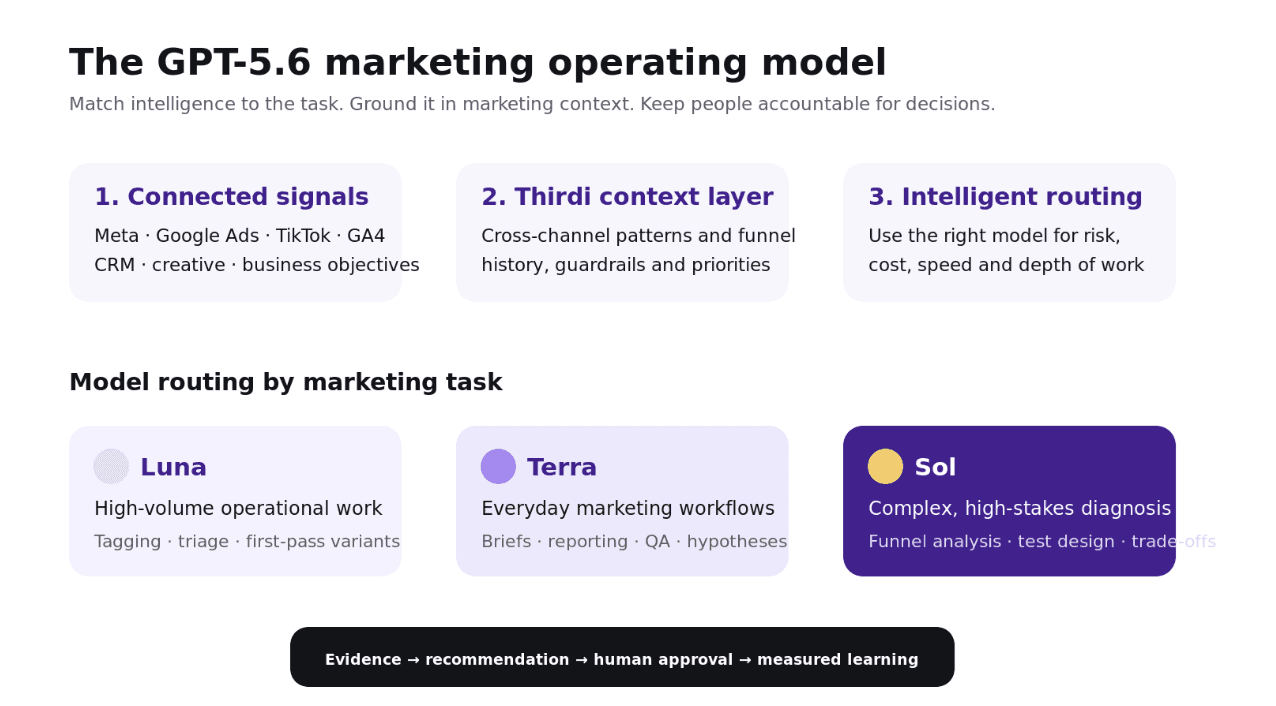
Luna is for fast, high-volume work. Terra is for the everyday work most marketing teams do. Sol is for complex questions where getting the answer wrong has a real cost.
OpenAI positions Sol as its flagship, Terra as the balanced everyday model and Luna as the cost-efficient option. Sol also has higher-effort settings for work that needs deeper investigation. In ultra mode, OpenAI says Sol can coordinate multiple agents in parallel.
For a marketing team, that creates a useful way to divide work.
Luna: clear the operational backlog
Use Luna for work that is frequent, structured and low-risk.
It can help with:
• First-pass ad-copy variants
• Tagging and classifying creative assets
• Sorting customer feedback into themes
• Triage of social comments
• Cleaning campaign naming conventions
Luna is not where I would ask for a budget reallocation, a major audience decision or a new brand direction. The cost of a quick but weak answer is too high.
Terra: run the normal marketing week better
Terra is likely where most teams will get the most value.
Use it for the work that happens every week:
• Turning performance data into a weekly narrative
• Drafting a creative brief from recent winners and losers
• Quality-checking campaign setup
• Preparing a test plan for a manager to review
• Finding patterns in routine account data
This is the work many teams still do in a mix of spreadsheets, screenshots and late-night Slack messages. Terra can make that work faster. It can give a marketer a better first draft. It should not replace the marketer's review.
Sol: investigate the problem that is worth losing sleep over
Sol earns its place when the question is bigger than one report.
Imagine CAC rises by 30%. Click-through rate is flat. Conversion rate is down. Sales says lead quality has changed. The creative team says the new work is performing well.
There is no useful answer in a single dashboard.
That is a Sol question. It needs someone, or something, to trace the issue across the funnel. It needs to compare explanations. It needs to say what it knows, what it does not know and what should be tested first.
Even then, I would not hand it the keys to the account.
A good answer is a recommendation with evidence. A good operating system still has a person accountable for the decision.
The part most model comparisons miss
It is easy to compare Sol, Terra and Luna as a capability ladder.
It is harder to ask whether the model understands the business it is advising.
I have seen polished marketing reports that completely missed the real problem. The campaign looked healthy. The clicks were there. The spend was going out. But sales follow-up was slow, lead quality had shifted or the landing page had started to lose people on mobile.
The report was not wrong. It was incomplete.
I am reminded of this when I look at our work with a luxury travel and hospitality brand in South India. The goal was not more clicks. It was more direct bookings and less dependence on OTAs. Over six months, the integrated Google and Meta programme delivered 5.57x ROAS. That result came from looking across the customer journey, not treating each channel as a separate report.
A model will have the same problem if it only sees a copied chart and a vague prompt.
This is where the conversation needs to move beyond prompting. A useful marketing system needs to know what good looks like for the business. It needs the objective, the funnel, the guardrails, the previous tests and the data that tells it whether a recommendation worked.
This is the work behind the phrase context, constraints and feedback loops. It is less flashy than a new model launch. It is also where reliable agent behaviour comes from.
What I would do on Monday morning
If I ran a marketing team using all three models, I would not start by giving each person a model and hoping for the best.
I would start with three simple rules.
1. Use Luna for speed, not judgment.
Let it handle repetitive preparation work. Make it easy for the team to check its output.
2. Use Terra for the normal operating rhythm.
Give it recurring jobs. Weekly performance stories. Campaign QA. Test summaries. Brief drafts. Keep a human review step in the workflow.
3. Reserve Sol for real decisions.
Use it when the answer needs multiple sources, competing explanations and a clear next step. Ask it to show its evidence. Ask it to flag uncertainty. Do not reward confidence when the data is thin.
This is also why the model choice is not the moat. Every company can change a model setting or swap an API. The work that compounds is the business context around it.
From a chat window to a marketing operating layer
Copying a CSV into ChatGPT can be helpful. I do not think it is enough.
The better version is a system where the AI can see the relevant marketing context without someone manually collecting it every time. That is why we built third i as a cross-channel marketing context layer.
third i connects the sources a team already uses. Meta. Google Ads. TikTok. GA4. CRM outcomes. Creative and performance signals.
It then helps answer the question behind the metric. Where is the leak? Which creative is fading? What should be tested? What deserves attention now?
For teams that want to work inside their preferred AI assistant, third i's MCP connector can bring that live marketing context into ChatGPT and other supported clients. You connect through your third i account. You do not need an API key. Your ad-platform passwords are not shared with the AI provider.
That does not make the model a media buyer.
It makes the conversation better. It reduces the gap between data, diagnosis and the person who has to make the call.
What this means for agencies
I understand why agencies are nervous about this moment. One agency partner recently told me that "our days as an agency are numbered. Surely these AI models will make us obsolete."
I hear them and I wonder about the same too. If an AI system can draft the monthly report, find obvious waste and produce first-pass creative ideas, a client will ask what it is paying the agency for.
That is a fair question.
Agencies that sell only production hours will feel the pressure first. Agencies that bring strong judgment will have more room to grow.
The good agency of the next few years will not win because it uses Sol before everyone else. It will win because it connects channel expertise, customer understanding, creative judgment and commercial accountability.
It will spend less time doing manual analysis. It will spend more time explaining what is changing in a client's funnel and what should happen next.
That is the agency operating layer we are building third i for. Not a black-box buyer. Not another dashboard. A system of ranked actions and human control.
The real question after GPT-5.6
Sol, Terra and Luna are useful. The model family makes it easier to match intelligence to the job.
But access to better models will not be the edge for long. It rarely is.
The edge will be whether the system understands your business well enough to make a useful recommendation.
That means real data. Clear goals. Human guardrails. A record of what worked before. And the willingness to say, “We do not have enough evidence yet.”
At third i, that is the part we care about.
If you are managing growth across channels but still stitching together exports, dashboards and instinct to decide what to do next, start a free trial or book a working session with us.
FAQ: GPT-5.6 Sol, Terra and Luna for marketing teams
Which GPT-5.6 model should a marketing team use?
Use Luna for high-volume, low-risk operational work. Use Terra for everyday marketing workflows. Use Sol for high-context questions where the answer needs deeper investigation. The right choice depends on the cost of being wrong and the business context the model can access.
Can I connect marketing data to ChatGPT with third i?
Yes. third i's MCP connector lets supported AI assistants, including ChatGPT, access live marketing data in a connected third i workspace. You authenticate with your third i account. No API key is needed and ad-platform passwords are not shared with the AI provider.
Will GPT-5.6 replace a marketing agency?
Not on its own. It can reduce repetitive production and reporting work. Agencies remain valuable when they bring judgment, creative quality, channel expertise and accountability for business outcomes.
See this on your own accounts
third i connects to the platforms you already run and does this work against your live numbers.
Read more
View all articles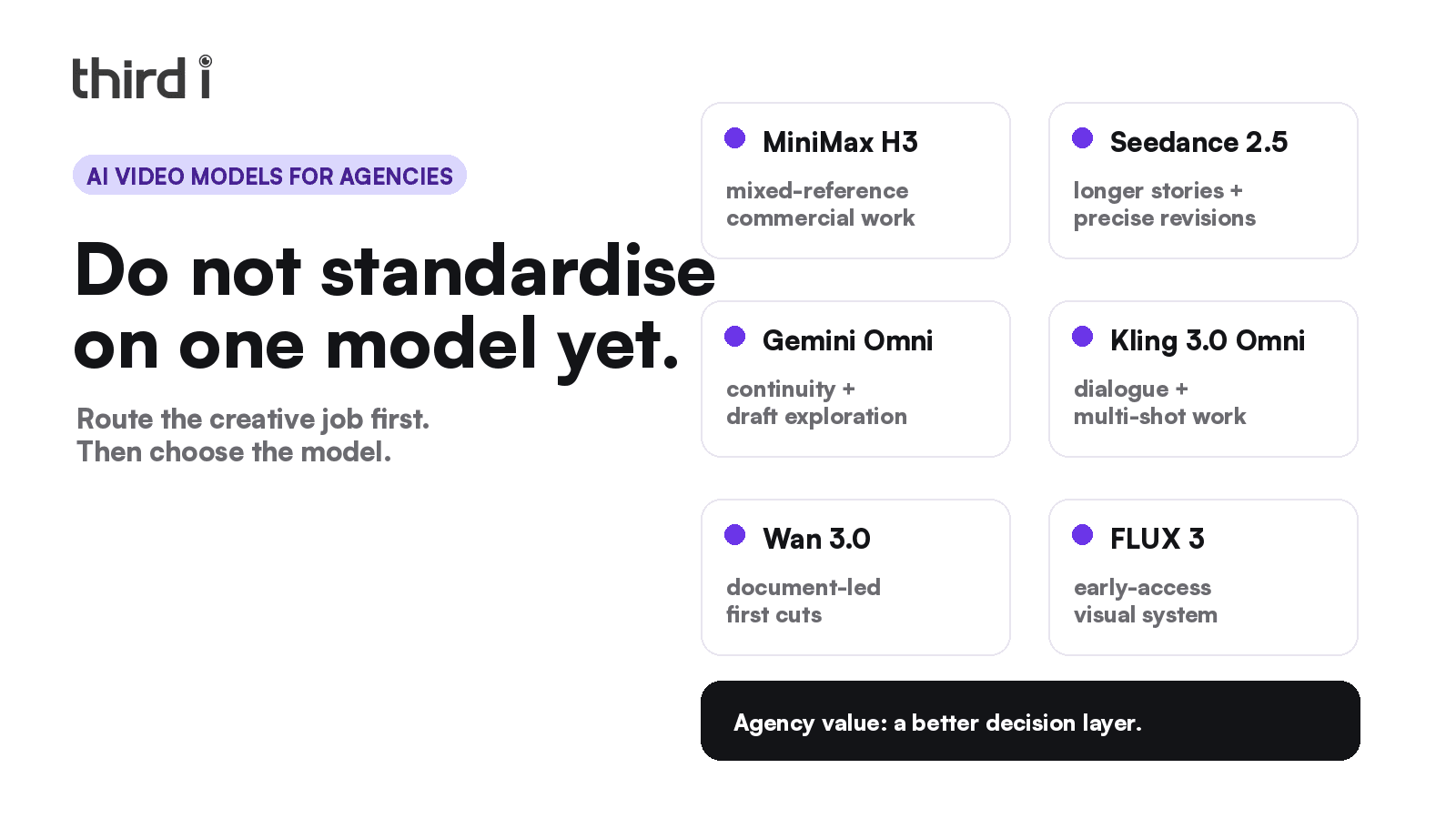
MiniMax H3 vs Seedance 2.5 vs Gemini Omni vs Kling vs Wan 3.0 vs FLUX 3 for Agencies
A practical guide for agencies comparing six leading AI video models by the production job, controls, review burden and client risk that actually matter.

Google Demand Gen Holiday Guide: Why Creator-Proof Creative Matters
Google’s July Demand Gen Drop is a cue for retail teams. Learn how to build creator-proof holiday creative systems that turn inspiration into action

Image Discovery Changes the Job of Brand Creative
Google’s new Images experience is a useful signal: creative is moving from something brands publish into something people browse, save and return to. That changes what marketers need to research before they make the next asset.