
Are Your AI Agents Just Fancy Alerts? How To Move From Automation To Real Recommendations
A key challenge in fintech marketing is optimizing campaigns based on the wrong metrics, treating platform-reported "approvals" as success when the true measure of performance is the "dispersal" of actual loans. Since ad platforms like Meta and Google only see up to the approval stage, campaigns ca…
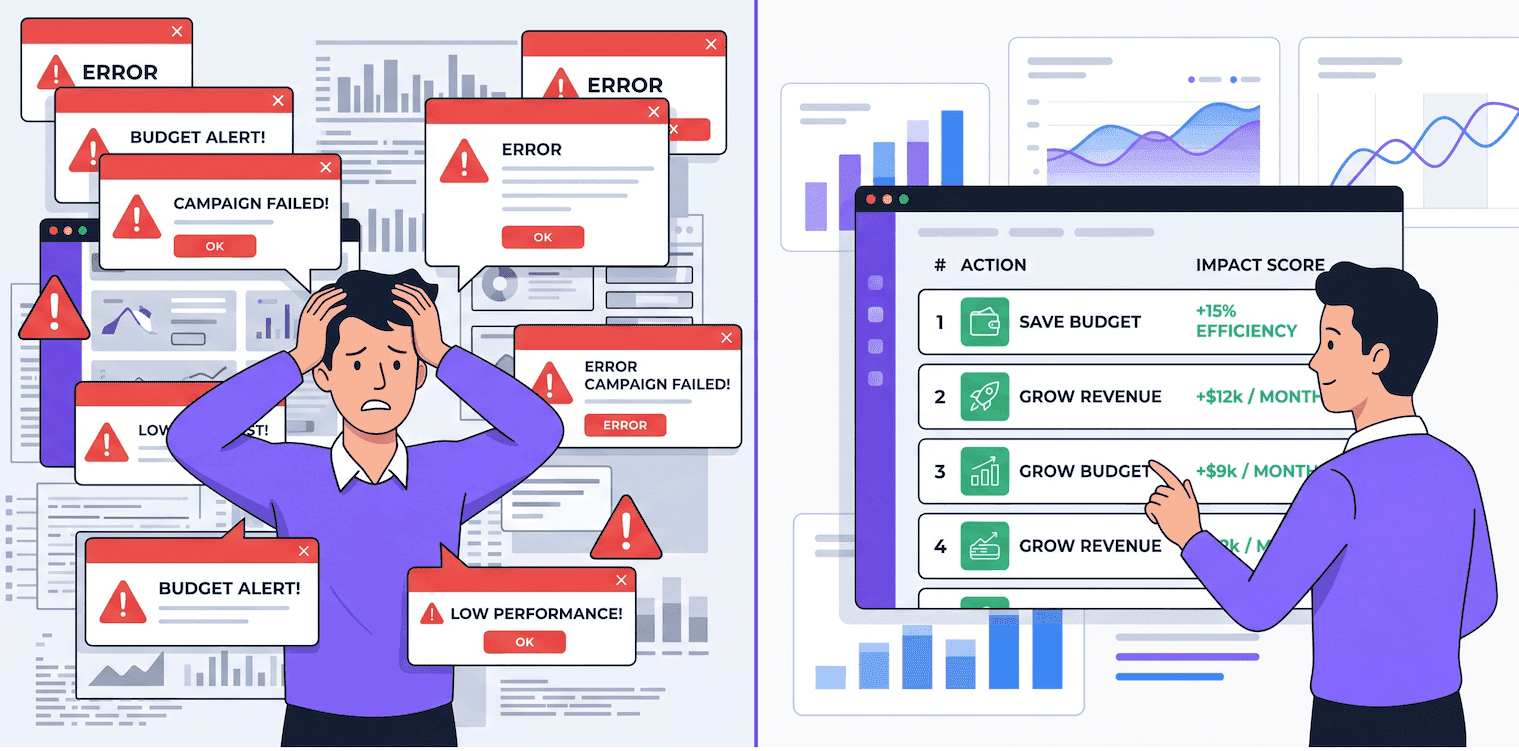
Are your “AI agents” doing more than sending alerts?
Many tools now call themselves “AI agents”, but a lot of them are still rule engines with a nicer interface.
If your so‑called agent only fires alerts like “ROAS below 2, reduce budget” based on static conditions you configured, you have automation, not real intelligence.
For performance marketers, the real test is simple: does this system help you decide better, or just shout louder when something crosses a line.
What is the difference between rules and real recommendations?
The core question is: “How is an AI recommendation engine different from the rules we have been using for years.”
Rules say “if X happens, do Y.” A recommendation agent learns from your actual data and context to suggest “here are the top actions you should take, ordered by estimated impact.”
In more detail:
- Rules use thresholds you hard‑code, like CPA greater than 20 dollars.
- Recommendations can adapt thresholds based on each campaign, audience, or product, because they have learned what “normal” looks like for your brand.
That means fewer false alarms, fewer missed opportunities, and a shorter path from insight to action.
Why do most rule‑based systems fall short in modern performance marketing?
Performance marketing used to be simpler. Fewer platforms, fewer formats, fewer signals. In that world, a handful of rules could cover a lot of ground.
Today, marketers juggle dozens of audiences, creative types, bidding strategies, and conversion events. A static rule sheet explodes in size and still misses edge cases.
Common failure modes include:
- Rules that are too tight, pausing good experiments before they have enough data.
- Rules that are too loose, allowing slow, steady waste that no one notices until month‑end.
- Conflicting rules across platforms that create unexpected behaviour.
As the environment gets more complex, it becomes harder for humans to maintain a rule set that is both safe and effective. That is where smarter agents help.
How can you tell if your AI agent is truly learning from your data?
Marketers often ask: “How do I know if this tool is just using my data for reporting, or actually learning from it.”
You can use a simple three‑question test:
- Does it propose thresholds instead of asking you to set them all?
A learning agent might say: “Based on the last 90 days, campaigns of this type start to underperform when CPA is above 26 dollars for more than 3 days and ROAS falls below 1.7. Here is a suggested guardrail for this campaign.” - Does it prioritize actions by business impact?
Instead of sending 20 separate alerts, a recommendation agent should say: “Fixing these three issues is likely to save or generate around X dollars this week; the others are minor.” - Can it explain its recommendations in plain language?
When you click into a suggestion, you should see context like “CTR dropped 35 percent week‑over‑week on this creative, while CPC rose 22 percent, leading to a 40 percent increase in CPA. That is why we suggest pausing this ad and reallocating budget to the top performer.”
If your tool cannot do these things, it is closer to a classic automation product than an AI‑driven recommendation system.
Why do better recommendations matter more than “more automation”?
It is tempting to measure progress by counting how many tasks you have automated with AI.
But your CFO, CMO, or client cares less about “automation coverage” and more about improved return on ad spend, lower cost per acquisition, and faster learning cycles.
Research on AI in marketing shows that teams who use AI for decision support and optimisation see higher conversion rates and lower acquisition costs compared to those who only use AI for content and reporting. The value comes from better decisions, not just more alerts.
For your team, good recommendations result in:
- More time spent on high‑leverage tests instead of low‑value changes.
- Fewer “why did no one catch this earlier” conversations.
- Clearer narratives in performance reviews and client calls.
What does a recommendation‑first workflow look like in practice?
Let us break down how a recommendation‑driven AI agent plugs into a performance marketer’s workflow.
Step 1: Observation
The agent ingests data across:
- Ad platforms (Meta, Google, TikTok, etc.).
- Analytics (GA4, attribution tools).
- Sometimes CRM or backend data for deeper revenue signals.
It learns patterns over time: typical ranges for CTR, CPA, ROAS, and lag between click and conversion for different campaigns and audiences.
Step 2: Interpretation
Instead of just checking if a metric crossed a fixed line, the agent asks:
- Is this change statistically meaningful or just noise.
- Has something similar happened before, and what was the outcome.
- How does this pattern compare to other campaigns and audiences.
This helps it ignore random spikes and focus on trends that matter.
Step 3: Recommendation
Finally, the agent ranks possible actions, such as:
- “Reduce budget by 15 percent on this campaign; performance has been consistently below target for 7 days.”
- “Increase budget by 20 percent on this ad set; it is beating your CPA goal by 25 percent with stable performance.”
- “Clone this winning creative into a new lookalike audience; similar segments respond well in your account history.”
Each recommendation includes context, expected impact, and a confidence level. You can accept, tweak, or reject, just like you would with a junior analyst’s proposal.
How do you gradually move from pure rules to recommendations?
If you already have a bunch of automated rules, you do not need to throw them out on day one.
A safer path is to layer recommendations on top of existing rules in three phases.
Phase 1: Overlay (no direct control)
In this phase, you:
- Keep all your current rules running as they are.
- Add a recommendation agent that watches the same accounts in read‑only mode.
- Compare what the agent would have suggested versus what your rules actually did.
This gives you a baseline sense of how “smart” the agent is, without risking your campaigns.
Phase 2: Co‑pilot (human approval)
Once you trust the agent’s judgment, move to:
- Letting the agent draft changes (bid adjustments, budget shifts, pausing underperformers).
- Requiring a human to approve or edit those changes in a queue.
- Tracking accept/modify/reject rates to see where the agent is strong or weak.
Your humans are still in control, but they start from a suggested plan instead of a blank slate.
Phase 3: Controlled autonomy (within guardrails)
Finally, you can grant limited autonomy:
- Allow the agent to execute changes within agreed bands (for example, bid changes under 20 percent, budget shifts under 15 percent day‑over‑day).
- Keep stricter rules or approvals for high‑risk actions like pausing entire product lines or launching new geos.
The goal is not full autopilot. It is to let the agent handle small, reversible decisions at speed, while humans stay in charge of big, strategic moves.
What metrics should you use to judge your recommendation agent?
Marketers often ask: “How do I know if these recommendations are actually worth it.”
You can track impact with a simple set of metrics over at least one quarter:
- Recommendation adoption rate
What percentage of agent suggestions do humans accept or use as a basis for action. - Performance lift on acted recommendations
For decisions made with agent input, are CPA, ROAS, or revenue changing in the right direction more often than not. - Regression to rules
How often do humans override the agent with a simple rule (“just cap this at X”). That can signal where you need more control or better training.
Over time, you should see:
- Fewer low‑impact tweaks and more meaningful changes.
- Fewer missed anomalies and less wasted spend.
- Stronger narratives in your monthly and quarterly reviews.
If your current “AI agent” is just shouting more alerts at you, it might be time to try a recommendation‑first approach. Connect your ad accounts to third i, let our agents learn from your data, and see how your next 30 days of decisions feel with a smarter co‑pilot by your side.
See this on your own accounts
third i connects to the platforms you already run and does this work against your live numbers.
Read more
View all articles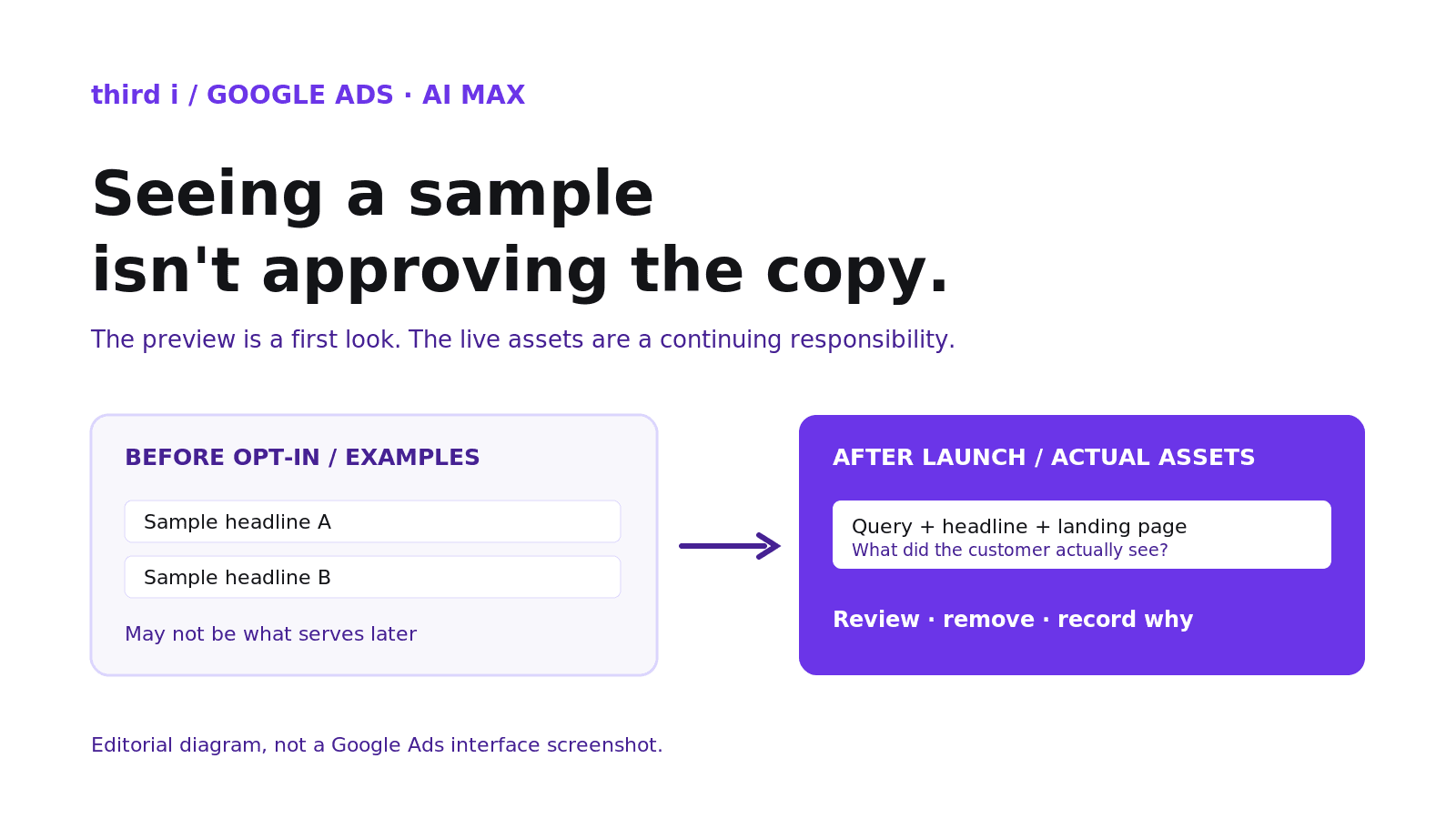
AI Max Copy Preview: Seeing a Sample Isn't Approving It
Google Ads now shows sample AI Max headlines before opt-in. Here is why previewing examples is useful, but does not replace reviewing the copy that actually serves.

How to Defend a 2027 Marketing Budget When the Numbers Disagree
Google, GA4 and the CRM disagree. What should an agency put in a 2027 marketing budget? An account review shows why the answer is not another dashboard.
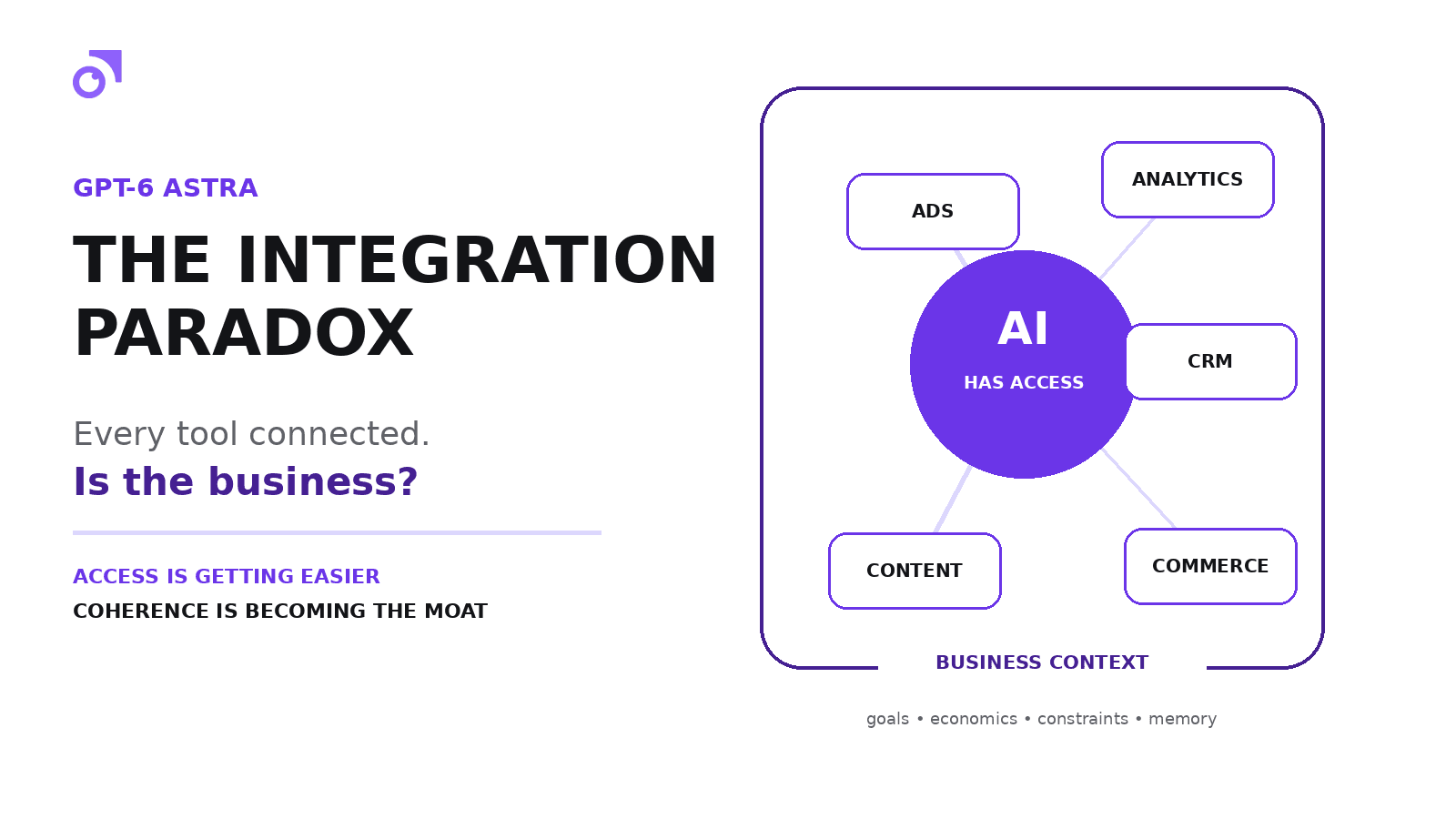
GPT-6 Astra and the Integration Paradox: When AI Can Use Every Tool, Business Context Becomes the Moat
GPT-6 Astra can operate more software, but useful marketing still depends on connected goals, economics, constraints, decision history and human approval.