Third i vs Triple Whale: Which Tool Actually Tells You What to Do?

Vishal Singh

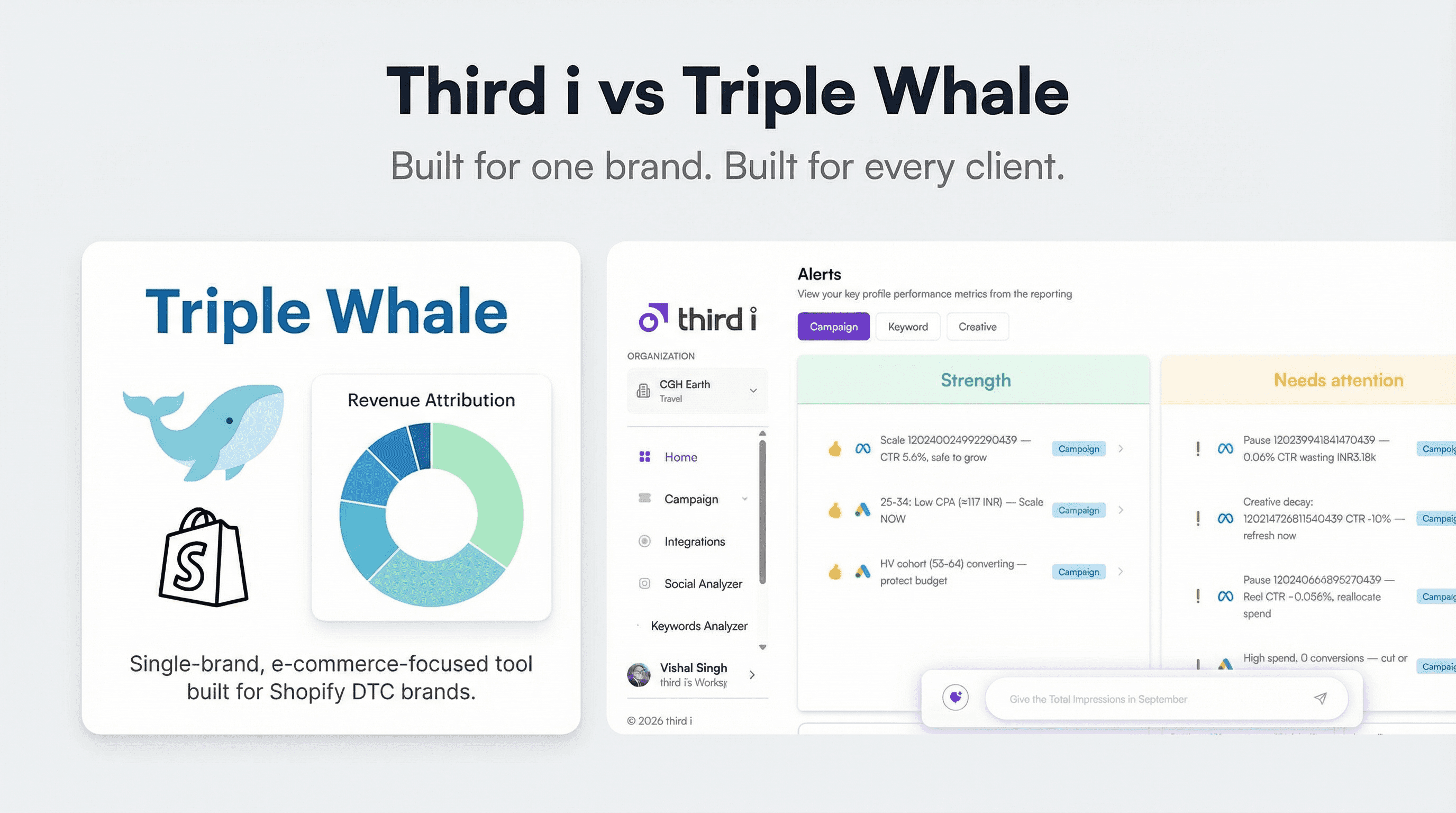
Triple Whale has earned a genuine reputation in the DTC world. Over 10,000 e-commerce brands use it to track attribution, understand customer acquisition costs, and see blended ROAS across channels. If you run a Shopify store and spend heavily on Meta and Google, Triple Whale gives you real clarity on what is working.
But agencies managing multiple clients across multiple platforms keep running into the same question: is Triple Whale actually built for us?
The honest answer is no. And that is not a knock on Triple Whale. It is just what the product was designed to do.
This post breaks down exactly what Triple Whale does well, where it falls short for agencies and multi-platform marketers, and why Third i takes a fundamentally different approach.
What Triple Whale Does Well
Triple Whale solves a genuinely hard problem. After iOS 14 broke Meta's attribution, DTC brands were flying blind. Triple Whale stepped in with their Triple Pixel, a first-party tracking solution that captures customer behavior more accurately than what Meta reports on its own.
That core value proposition is real. Their attribution dashboard gives Shopify brands a single place to see blended ROAS, new customer acquisition cost, customer lifetime value, and cohort-level performance. Their Moby AI assistant can suggest budget reallocations, generate creative briefs, and even push segments directly into Google Ads.
For a DTC brand doing $500K to $5M in annual revenue primarily on Shopify and Meta, Triple Whale is one of the best-built tools in the market. The dashboards are clean, the mobile app is solid, and the iOS 14 attribution workaround actually works.
But for agencies, the cracks appear quickly.
The Three Pain Points Agencies Keep Running Into
1. It Was Built for Brands, Not for Agencies
Triple Whale is fundamentally a single-brand tool. The entire product, the Shopify integration, the Triple Pixel, the blended ROAS dashboard, the LTV reporting, is designed around one brand, one store, one business.
Agencies managing 10 to 20 clients need a different architecture entirely. You need to switch between clients without losing context. You need to see which client accounts need attention today. You need cross-client benchmarking. You need one system that works whether a client is running primarily on Meta or splitting budget across Google, TikTok, and LinkedIn.
Triple Whale does not do any of that natively. Their Agency Partner Program connects agencies with e-commerce clients, but that is a partnership directory, not a multi-client management tool.
One performance marketer described the gap: "Triple Whale is great if you are running one DTC brand. But the moment you have 10 clients with different platforms and different verticals, you are managing 10 separate Triple Whale instances. There is no agency layer."
Third i is built agency-first from the ground up. Your Action Feed aggregates signals across all connected client accounts and all platforms. You see the highest-impact opportunities ranked by business impact, regardless of which client they belong to.
2. Attribution That Looks Precise But Is Not Always Accurate
This is the most common complaint from Triple Whale users across G2, Trustpilot, and Reddit, and it is worth addressing honestly because it strikes at the core value proposition.
Attribution is genuinely hard. Every tool, including Triple Whale, builds models around incomplete data. But the specific failure mode users describe is that Triple Whale's numbers frequently diverge from what ad platforms report, and not in a consistent, predictable way.
One verified Trustpilot reviewer wrote in November 2025: "Since day one, the data has been inaccurate. Daily revenue totals are wrong, entire order blocks are missing, and every week we have to open new support tickets just to get our numbers halfway close to what our channel actually reports. Completely fake data. Support is friendly but absolutely ineffective. No fix. No timeline. Just generic replies."
On G2, "data inaccuracy" is one of the top 5 listed cons of Triple Whale across hundreds of reviews. Another G2 reviewer noted: "The attribution system is consistently buggy and unreliable, causing more harm than good. Not worth the investment if you value accurate data."
A review on ppc.io captured the broader issue: "The algorithmic modeling is not perfect, but it is way more accurate than platform-native attribution. Setup takes time and requires technical integration."
Third i does not attempt to replace or override ad platform attribution. We pull actual performance data directly from Meta, TikTok, Google Ads, LinkedIn Ads, and GA4 via OAuth, combine it with conversion signals from GA4, and surface the patterns that require action. No proprietary pixel. No modeled attribution that diverges from source data. The diagnosis is based on what the platforms actually report, contextualized with cross-channel and full-funnel data from GA4.
3. Pricing Scales With Your Clients' Revenue
Triple Whale's pricing is tied to your Gross Merchandise Value (GMV). The more revenue your clients generate through their Shopify stores, the more you pay.
Here is how it works in practice:
Under $250K GMV: Growth starts at $129/mo, Pro at $199/mo, Enterprise at $279/mo
$250K to $500K GMV: Same plans, but pricing jumps
$500K to $1M GMV: Pricing scales up again
$1M+ GMV: Plans escalate further, and Compass (their enterprise tier) is custom pricing, contact sales
For an agency managing clients who collectively generate significant revenue, this creates a compounding cost problem. You are essentially being charged more because your clients are successful. One e-commerce review described this plainly: "The pricing a bit higher than they let on."
Worse, one Trustpilot reviewer described being charged a $7,000 annual fee in January 2026 after cancelling their contract in December 2025, with no cancellation confirmation received. Another described their dedicated support being downgraded to general support after Triple Whale introduced a more expensive tier, without any warning.
Third i is $199 per month. Flat. No GMV tiers. No revenue-based pricing. No annual contract traps. Whether your clients spend $50,000 or $5,000,000 per year, the price stays the same.
Feature Comparison
Feature | Third i | Triple Whale |
Prioritized Action Feed | Yes, ranked by business impact | No |
Creative Fatigue Detection | Yes, element-level | Partial (Creative Cockpit, Enterprise only) |
Budget Leak Identification | Automatic | Manual review required |
Cross-Channel Recommendations | Yes | Moby AI (DTC-focused) |
Multi-Client Agency View | Yes | No |
Attribution Model | GA4-based, ad platform data | Proprietary Triple Pixel (Shopify-native) |
Meta Ads | Yes | Yes |
Google Ads | Yes | Yes |
TikTok Ads | Yes | Yes |
LinkedIn Ads | Yes | No |
Shopify Integration | No | Yes (core requirement) |
GA4 Integration | Yes (full-funnel attribution) | Partial |
LTV / Cohort Analysis | No | Yes |
Post-Purchase Surveys | No | Yes |
Moby AI (ad creation, budgets) | No | Yes (Pro+) |
Requires Shopify | No | Yes (core functionality) |
GMV-Based Pricing | No | Yes |
Pricing | Flat $199/mo | $129-$279+/mo (scales with GMV) |
Annual Contract Required | No | Starter and Advanced plans |
Free Plan | No (7-day trial) | Yes (Founders Dash) |
Best For | Agencies, multi-platform marketers | DTC e-commerce brands on Shopify |
The Core Difference: Attribution vs Action
Triple Whale and Third i are solving different problems for different buyers.
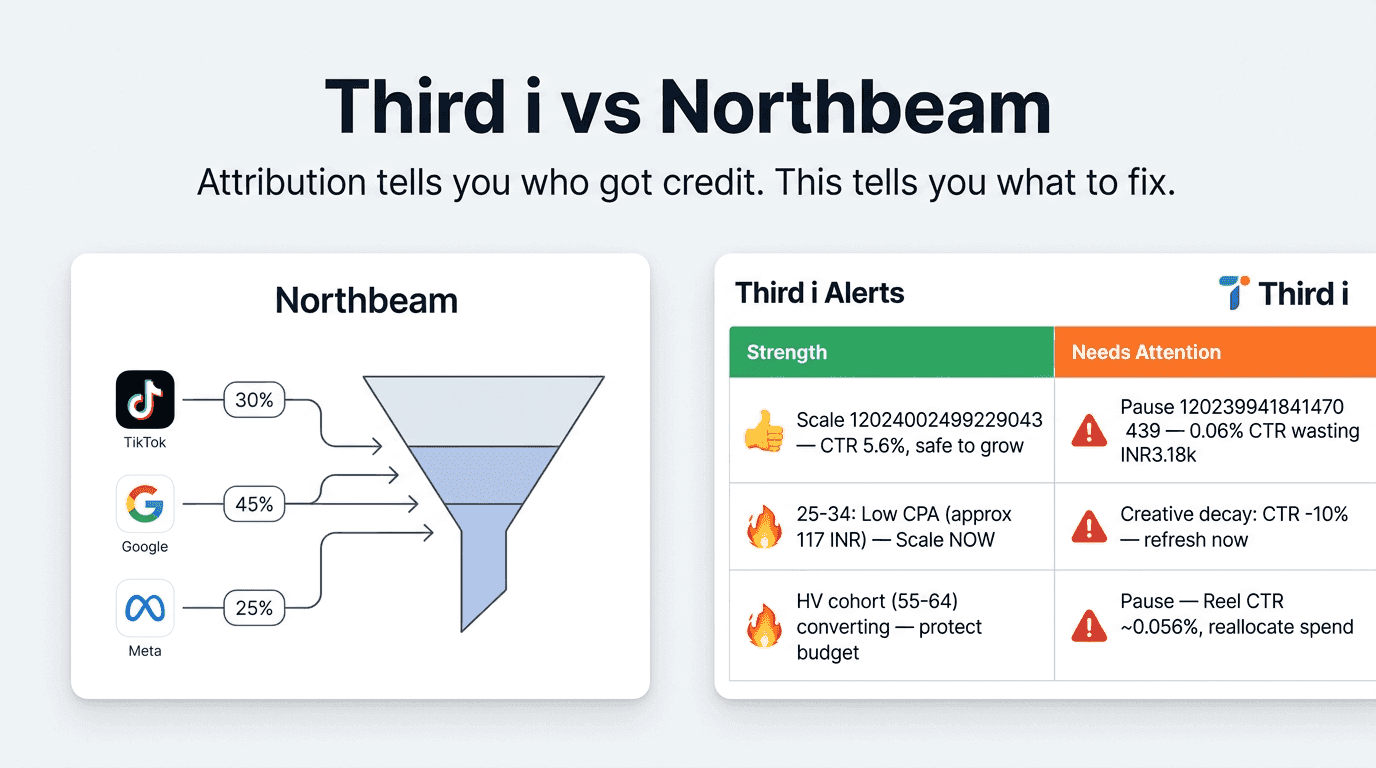
Triple Whale answers: "What happened, and which channel gets credit for it?"
Third i answers: "What is broken right now, and what should I do about it?"
If you are a Shopify DTC brand trying to understand attribution in a post-iOS 14 world, Triple Whale's Triple Pixel is a legitimate solution. Their cohort analysis and LTV dashboards are genuinely useful for understanding customer behavior over time.
If you are a performance marketing agency running campaigns across Meta, TikTok, Google Ads, and LinkedIn for a portfolio of clients, and you need to know which ad sets to pause before your Monday morning standup, Triple Whale is not the right tool. It was not built for that workflow.
Third i connects to your platforms directly via OAuth, analyzes cross-channel performance against GA4 conversion data, and delivers a prioritized Action Feed that tells you exactly what to fix, why it matters, and what the estimated impact of fixing it is.
Real Results from Third i Users
Outthinking (mobile gaming, 300M+ downloads) achieved a 40% lower cost per install using Third i's AI-led audience and creative insights. Their CEO, Pavan, said: "Thirdi's AI and expert driven capabilities have proven to be effective, as we acquired new users at 40% lower costs."
Kraftwork Solar (renewable energy) saw a 400% increase in lead volume in 45 days and a 48% lower lead acquisition cost. Their Co-founder said: "Third i's expertise has been pivotal in transitioning Kraftwork Solar from traditional marketing to a high-performing lead generation engine."
A FinTech platform achieved 6x improvement in lead quality through targeted audience segmentation and channel optimization.
Sadhana Tablet achieved 3.2x ROAS within 3 months across US and India markets.
These are documented case studies available on our website.
When Triple Whale Might Still Be the Right Choice
Choose Triple Whale if you are a DTC e-commerce brand built on Shopify spending primarily on Meta and Google, and attribution clarity is your top priority. If you need post-purchase survey integration, cohort analysis, and LTV reporting to understand customer behavior over time, Triple Whale is purpose-built for that workflow. Their Moby AI feature also offers creative brief generation and segment syncing with Google Ads that Third i does not.
Choose Third i if you are a performance marketing agency managing multiple clients across channels. If your clients include B2B companies, SaaS businesses, or service brands that do not run on Shopify. If you need LinkedIn Ads support. If you want a platform that proactively surfaces what to fix without requiring you to dig through attribution dashboards manually. And if you want flat, predictable pricing that does not scale with your clients' revenue.
.
Frequently Asked Questions
What is the best alternative to Triple Whale in 2026?
The best alternative depends on your use case. For Shopify DTC brands, Northbeam and Rockerbox are strong alternatives. For performance marketing agencies that need proactive campaign diagnosis rather than attribution reporting, Third i is a strong alternative. It connects to Meta, TikTok, Google Ads, LinkedIn Ads, and GA4 with a prioritized Action Feed and flat $199 per month pricing.
How much does Triple Whale cost compared to Third i?
Triple Whale's Growth plan starts at $129 per month and scales based on your GMV. Pro starts at $199 per month and Enterprise at $279 per month, both before GMV-based pricing increases. Annual contracts are required for Starter and Advanced plans. Third i is a flat $199 per month with no GMV tiers, no annual contract requirement, and all features included.
Does Triple Whale work for agencies?
Triple Whale has an Agency Partner Program, but it is designed to connect agencies with DTC clients, not to provide multi-client campaign management. The core platform is built around individual brand accounts. Agencies managing multiple clients across different platforms and verticals will find the architecture limiting for day-to-day campaign management.
Does Triple Whale support LinkedIn Ads?
As of March 2026, Triple Whale does not offer LinkedIn Ads integration. Their platform focuses on Meta, Google Ads, TikTok, and Shopify. Third i includes full LinkedIn Ads support alongside Meta, TikTok, Google Ads, and GA4.
How is Third i different from Triple Whale?
The core difference is purpose. Triple Whale is an attribution and analytics platform that tells you where revenue came from. Third i is an action-first AI platform that tells you what to do with your ad budget right now. Third i does not replace attribution tools, it adds a diagnosis and action layer on top of real ad platform and GA4 data.
Can Third i work without Shopify?
Yes. Third i does not require Shopify and is not built around e-commerce attribution. It connects directly to Meta Ads, TikTok Ads, Google Ads, LinkedIn Ads, and GA4 via OAuth. It is built for performance marketing agencies managing any type of client, whether e-commerce, SaaS, B2B, or lead generation.
Getting Started
If you are an agency or performance marketer spending hours decoding attribution dashboards to figure out which campaigns to pause, there is a faster way.
Connect your ad accounts to Third i. Meta, TikTok, Google, LinkedIn, GA4, or all of them. In about 60 seconds, you will have a prioritized list of actions with estimated impact for each one.
No credit card required. No sales call. No commitment.
Your free audit includes the last 30 days of data. The longer you wait, the more budget leaks go undetected.
Also read:
Third i vs Madgicx
|
Third i vs Supermetrics
|
Third i vs GoMarble
Third i is not affiliated with or endorsed by Triple Whale. All product names, logos, and brands are property of their respective owners. Pricing and feature information is based on publicly available data as of March 2026. Visit triplewhale.com for their latest offerings.
Triple Whale has earned a genuine reputation in the DTC world. Over 10,000 e-commerce brands use it to track attribution, understand customer acquisition costs, and see blended ROAS across channels. If you run a Shopify store and spend heavily on Meta and Google, Triple Whale gives you real clarity on what is working.
But agencies managing multiple clients across multiple platforms keep running into the same question: is Triple Whale actually built for us?
The honest answer is no. And that is not a knock on Triple Whale. It is just what the product was designed to do.
This post breaks down exactly what Triple Whale does well, where it falls short for agencies and multi-platform marketers, and why Third i takes a fundamentally different approach.
What Triple Whale Does Well
Triple Whale solves a genuinely hard problem. After iOS 14 broke Meta's attribution, DTC brands were flying blind. Triple Whale stepped in with their Triple Pixel, a first-party tracking solution that captures customer behavior more accurately than what Meta reports on its own.
That core value proposition is real. Their attribution dashboard gives Shopify brands a single place to see blended ROAS, new customer acquisition cost, customer lifetime value, and cohort-level performance. Their Moby AI assistant can suggest budget reallocations, generate creative briefs, and even push segments directly into Google Ads.
For a DTC brand doing $500K to $5M in annual revenue primarily on Shopify and Meta, Triple Whale is one of the best-built tools in the market. The dashboards are clean, the mobile app is solid, and the iOS 14 attribution workaround actually works.
But for agencies, the cracks appear quickly.
The Three Pain Points Agencies Keep Running Into
1. It Was Built for Brands, Not for Agencies
Triple Whale is fundamentally a single-brand tool. The entire product, the Shopify integration, the Triple Pixel, the blended ROAS dashboard, the LTV reporting, is designed around one brand, one store, one business.
Agencies managing 10 to 20 clients need a different architecture entirely. You need to switch between clients without losing context. You need to see which client accounts need attention today. You need cross-client benchmarking. You need one system that works whether a client is running primarily on Meta or splitting budget across Google, TikTok, and LinkedIn.
Triple Whale does not do any of that natively. Their Agency Partner Program connects agencies with e-commerce clients, but that is a partnership directory, not a multi-client management tool.
One performance marketer described the gap: "Triple Whale is great if you are running one DTC brand. But the moment you have 10 clients with different platforms and different verticals, you are managing 10 separate Triple Whale instances. There is no agency layer."
Third i is built agency-first from the ground up. Your Action Feed aggregates signals across all connected client accounts and all platforms. You see the highest-impact opportunities ranked by business impact, regardless of which client they belong to.
2. Attribution That Looks Precise But Is Not Always Accurate
This is the most common complaint from Triple Whale users across G2, Trustpilot, and Reddit, and it is worth addressing honestly because it strikes at the core value proposition.
Attribution is genuinely hard. Every tool, including Triple Whale, builds models around incomplete data. But the specific failure mode users describe is that Triple Whale's numbers frequently diverge from what ad platforms report, and not in a consistent, predictable way.
One verified Trustpilot reviewer wrote in November 2025: "Since day one, the data has been inaccurate. Daily revenue totals are wrong, entire order blocks are missing, and every week we have to open new support tickets just to get our numbers halfway close to what our channel actually reports. Completely fake data. Support is friendly but absolutely ineffective. No fix. No timeline. Just generic replies."
On G2, "data inaccuracy" is one of the top 5 listed cons of Triple Whale across hundreds of reviews. Another G2 reviewer noted: "The attribution system is consistently buggy and unreliable, causing more harm than good. Not worth the investment if you value accurate data."
A review on ppc.io captured the broader issue: "The algorithmic modeling is not perfect, but it is way more accurate than platform-native attribution. Setup takes time and requires technical integration."
Third i does not attempt to replace or override ad platform attribution. We pull actual performance data directly from Meta, TikTok, Google Ads, LinkedIn Ads, and GA4 via OAuth, combine it with conversion signals from GA4, and surface the patterns that require action. No proprietary pixel. No modeled attribution that diverges from source data. The diagnosis is based on what the platforms actually report, contextualized with cross-channel and full-funnel data from GA4.
3. Pricing Scales With Your Clients' Revenue
Triple Whale's pricing is tied to your Gross Merchandise Value (GMV). The more revenue your clients generate through their Shopify stores, the more you pay.
Here is how it works in practice:
Under $250K GMV: Growth starts at $129/mo, Pro at $199/mo, Enterprise at $279/mo
$250K to $500K GMV: Same plans, but pricing jumps
$500K to $1M GMV: Pricing scales up again
$1M+ GMV: Plans escalate further, and Compass (their enterprise tier) is custom pricing, contact sales
For an agency managing clients who collectively generate significant revenue, this creates a compounding cost problem. You are essentially being charged more because your clients are successful. One e-commerce review described this plainly: "The pricing a bit higher than they let on."
Worse, one Trustpilot reviewer described being charged a $7,000 annual fee in January 2026 after cancelling their contract in December 2025, with no cancellation confirmation received. Another described their dedicated support being downgraded to general support after Triple Whale introduced a more expensive tier, without any warning.
Third i is $199 per month. Flat. No GMV tiers. No revenue-based pricing. No annual contract traps. Whether your clients spend $50,000 or $5,000,000 per year, the price stays the same.
Feature Comparison
Feature | Third i | Triple Whale |
Prioritized Action Feed | Yes, ranked by business impact | No |
Creative Fatigue Detection | Yes, element-level | Partial (Creative Cockpit, Enterprise only) |
Budget Leak Identification | Automatic | Manual review required |
Cross-Channel Recommendations | Yes | Moby AI (DTC-focused) |
Multi-Client Agency View | Yes | No |
Attribution Model | GA4-based, ad platform data | Proprietary Triple Pixel (Shopify-native) |
Meta Ads | Yes | Yes |
Google Ads | Yes | Yes |
TikTok Ads | Yes | Yes |
LinkedIn Ads | Yes | No |
Shopify Integration | No | Yes (core requirement) |
GA4 Integration | Yes (full-funnel attribution) | Partial |
LTV / Cohort Analysis | No | Yes |
Post-Purchase Surveys | No | Yes |
Moby AI (ad creation, budgets) | No | Yes (Pro+) |
Requires Shopify | No | Yes (core functionality) |
GMV-Based Pricing | No | Yes |
Pricing | Flat $199/mo | $129-$279+/mo (scales with GMV) |
Annual Contract Required | No | Starter and Advanced plans |
Free Plan | No (7-day trial) | Yes (Founders Dash) |
Best For | Agencies, multi-platform marketers | DTC e-commerce brands on Shopify |
The Core Difference: Attribution vs Action
Triple Whale and Third i are solving different problems for different buyers.
Triple Whale answers: "What happened, and which channel gets credit for it?"
Third i answers: "What is broken right now, and what should I do about it?"
If you are a Shopify DTC brand trying to understand attribution in a post-iOS 14 world, Triple Whale's Triple Pixel is a legitimate solution. Their cohort analysis and LTV dashboards are genuinely useful for understanding customer behavior over time.
If you are a performance marketing agency running campaigns across Meta, TikTok, Google Ads, and LinkedIn for a portfolio of clients, and you need to know which ad sets to pause before your Monday morning standup, Triple Whale is not the right tool. It was not built for that workflow.
Third i connects to your platforms directly via OAuth, analyzes cross-channel performance against GA4 conversion data, and delivers a prioritized Action Feed that tells you exactly what to fix, why it matters, and what the estimated impact of fixing it is.
Real Results from Third i Users
Outthinking (mobile gaming, 300M+ downloads) achieved a 40% lower cost per install using Third i's AI-led audience and creative insights. Their CEO, Pavan, said: "Thirdi's AI and expert driven capabilities have proven to be effective, as we acquired new users at 40% lower costs."
Kraftwork Solar (renewable energy) saw a 400% increase in lead volume in 45 days and a 48% lower lead acquisition cost. Their Co-founder said: "Third i's expertise has been pivotal in transitioning Kraftwork Solar from traditional marketing to a high-performing lead generation engine."
A FinTech platform achieved 6x improvement in lead quality through targeted audience segmentation and channel optimization.
Sadhana Tablet achieved 3.2x ROAS within 3 months across US and India markets.
These are documented case studies available on our website.
When Triple Whale Might Still Be the Right Choice
Choose Triple Whale if you are a DTC e-commerce brand built on Shopify spending primarily on Meta and Google, and attribution clarity is your top priority. If you need post-purchase survey integration, cohort analysis, and LTV reporting to understand customer behavior over time, Triple Whale is purpose-built for that workflow. Their Moby AI feature also offers creative brief generation and segment syncing with Google Ads that Third i does not.
Choose Third i if you are a performance marketing agency managing multiple clients across channels. If your clients include B2B companies, SaaS businesses, or service brands that do not run on Shopify. If you need LinkedIn Ads support. If you want a platform that proactively surfaces what to fix without requiring you to dig through attribution dashboards manually. And if you want flat, predictable pricing that does not scale with your clients' revenue.
.
Frequently Asked Questions
What is the best alternative to Triple Whale in 2026?
The best alternative depends on your use case. For Shopify DTC brands, Northbeam and Rockerbox are strong alternatives. For performance marketing agencies that need proactive campaign diagnosis rather than attribution reporting, Third i is a strong alternative. It connects to Meta, TikTok, Google Ads, LinkedIn Ads, and GA4 with a prioritized Action Feed and flat $199 per month pricing.
How much does Triple Whale cost compared to Third i?
Triple Whale's Growth plan starts at $129 per month and scales based on your GMV. Pro starts at $199 per month and Enterprise at $279 per month, both before GMV-based pricing increases. Annual contracts are required for Starter and Advanced plans. Third i is a flat $199 per month with no GMV tiers, no annual contract requirement, and all features included.
Does Triple Whale work for agencies?
Triple Whale has an Agency Partner Program, but it is designed to connect agencies with DTC clients, not to provide multi-client campaign management. The core platform is built around individual brand accounts. Agencies managing multiple clients across different platforms and verticals will find the architecture limiting for day-to-day campaign management.
Does Triple Whale support LinkedIn Ads?
As of March 2026, Triple Whale does not offer LinkedIn Ads integration. Their platform focuses on Meta, Google Ads, TikTok, and Shopify. Third i includes full LinkedIn Ads support alongside Meta, TikTok, Google Ads, and GA4.
How is Third i different from Triple Whale?
The core difference is purpose. Triple Whale is an attribution and analytics platform that tells you where revenue came from. Third i is an action-first AI platform that tells you what to do with your ad budget right now. Third i does not replace attribution tools, it adds a diagnosis and action layer on top of real ad platform and GA4 data.
Can Third i work without Shopify?
Yes. Third i does not require Shopify and is not built around e-commerce attribution. It connects directly to Meta Ads, TikTok Ads, Google Ads, LinkedIn Ads, and GA4 via OAuth. It is built for performance marketing agencies managing any type of client, whether e-commerce, SaaS, B2B, or lead generation.
Getting Started
If you are an agency or performance marketer spending hours decoding attribution dashboards to figure out which campaigns to pause, there is a faster way.
Connect your ad accounts to Third i. Meta, TikTok, Google, LinkedIn, GA4, or all of them. In about 60 seconds, you will have a prioritized list of actions with estimated impact for each one.
No credit card required. No sales call. No commitment.
Your free audit includes the last 30 days of data. The longer you wait, the more budget leaks go undetected.
Also read:
Third i vs Madgicx
|
Third i vs Supermetrics
|
Third i vs GoMarble
Third i is not affiliated with or endorsed by Triple Whale. All product names, logos, and brands are property of their respective owners. Pricing and feature information is based on publicly available data as of March 2026. Visit triplewhale.com for their latest offerings.
Read more

Paid Marketing
Meta Says 200 Purchases, Google Analytics Says 80: Why Your Ads Are Flying Blind And How To Fix It In 24 Hours

Neeraj Kushwaha
Mar 20, 2026

compare
Third i vs Revealbot (Birch): Rules vs Intelligence
Evaluating Revealbot or its rebranded version Birch? Revealbot (now Birch) is a rule-based ad automation tool. You write conditions like "if ROAS drops below 2.0, pause this ad set" and the platform executes them. Third i is an AI-powered action platform that tells you what those conditions should be in the first place. No rules to write. No thresholds to set manually. Connect Meta, TikTok, Google Ads, LinkedIn Ads, and GA4, and get a prioritized Action Feed telling you exactly what to fix, ranked by business impact. Flat $199 per month regardless of ad spend.

Vishal Singh
Mar 20, 2026

compare
Third i vs Triple Whale: Which Tool Actually Tells You What to Do?
Looking for a Triple Whale alternative? Triple Whale is a Shopify-first attribution and analytics platform built for DTC e-commerce brands. Third i is an action-first AI platform built for performance marketing agencies. If you run ads across Meta, TikTok, Google Ads, and LinkedIn for multiple clients, and you need to know what to fix, not just what happened, Third i generates a prioritized Action Feed with specific recommendations. No Shopify dependency. No GMV-based pricing. Flat $199 per month.

Vishal Singh
Mar 20, 2026

Paid Marketing
Meta Says 200 Purchases, Google Analytics Says 80: Why Your Ads Are Flying Blind And How To Fix It In 24 Hours

Neeraj Kushwaha
Mar 20, 2026

compare
Third i vs Revealbot (Birch): Rules vs Intelligence
Evaluating Revealbot or its rebranded version Birch? Revealbot (now Birch) is a rule-based ad automation tool. You write conditions like "if ROAS drops below 2.0, pause this ad set" and the platform executes them. Third i is an AI-powered action platform that tells you what those conditions should be in the first place. No rules to write. No thresholds to set manually. Connect Meta, TikTok, Google Ads, LinkedIn Ads, and GA4, and get a prioritized Action Feed telling you exactly what to fix, ranked by business impact. Flat $199 per month regardless of ad spend.

Vishal Singh
Mar 20, 2026