
Sonnet 5 vs Opus 4.8 vs Fable 5: A Practical Guide for Marketing Teams
Compare Claude Sonnet 5, Opus 4.8 and Fable 5 by marketing task, cost, context, risk and approval requirements.
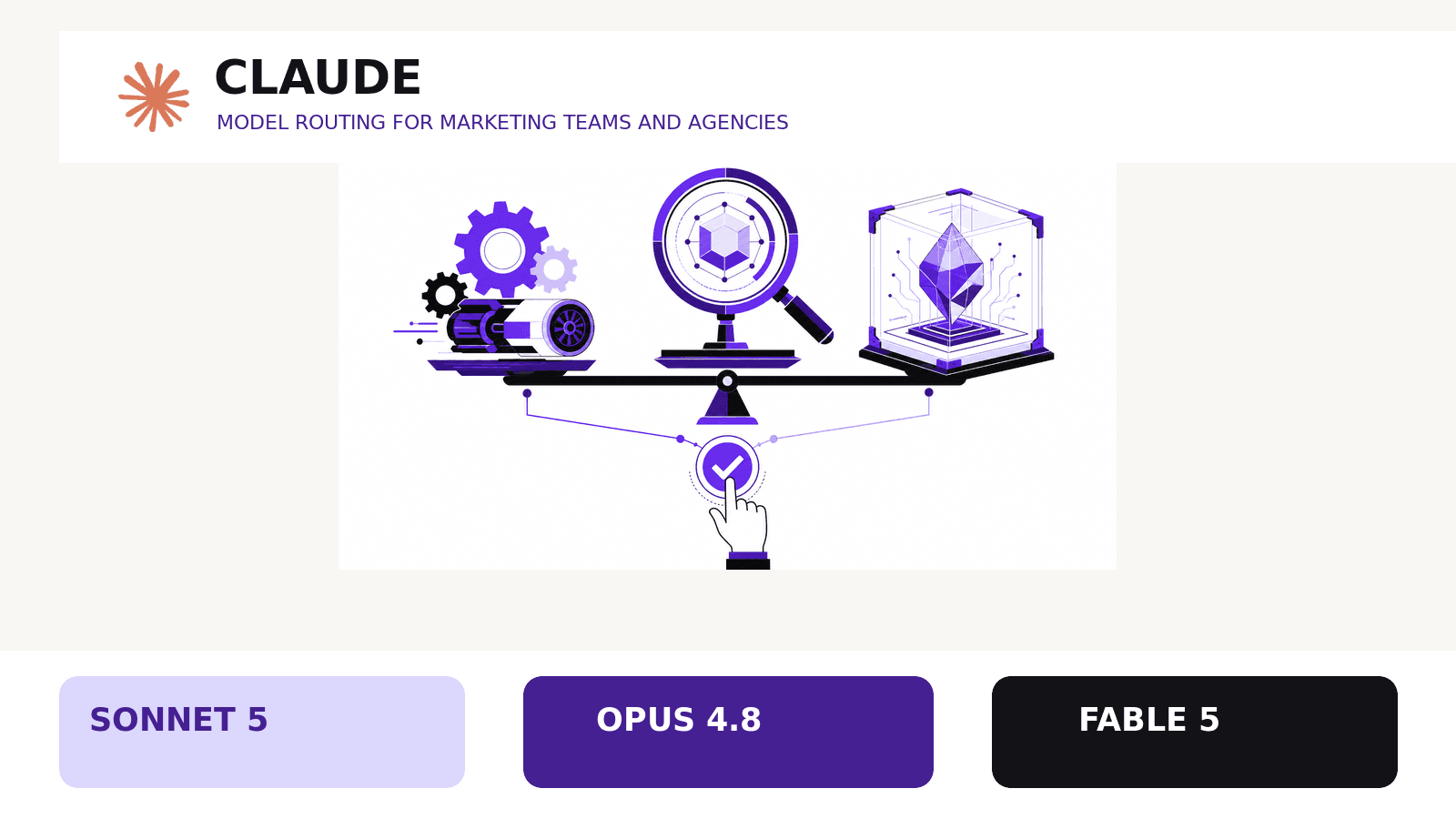
People keep asking which Claude model is best. For a marketing team, that is the wrong starting point.
Sonnet 5 is the practical default for bounded, reviewable work. Opus 4.8 is the better route when the evidence is messy and the cost of a bad conclusion is high. Fable 5 should be used only with a tighter operating contract: clear scope, narrow access, a fallback and human review.
The useful decision is not “Which model wins?” It is “Which model should do this job, with this evidence, behind this approval boundary?”
I keep coming back to this because the questions I hear from marketing teams are rarely about raw intelligence. They are about whether the weekly report can be trusted, whether a recommendation has enough evidence behind it, and who owns the decision when the data does not agree.
At a glance
• Choose Sonnet 5 for the everyday work: reporting drafts, structured research, classification and first-pass recommendations.
• Escalate to Opus 4.8 when a decision depends on conflicting signals, long context or explicit uncertainty.
• Use Fable 5 only for bounded, high-value work where the permissions, safeguards, fallback and review path are written down before the task begins.
Sonnet 5 vs Opus 4.8 vs Fable 5 at a glance
Start with the job, not the prestige of the model.
Sonnet 5: the execution default
Anthropic describes Sonnet 5 as its most agentic Sonnet model so far. It can plan, use tools and complete multi-step work that would recently have required a larger, more expensive model. Anthropic also says Sonnet 5 can match Opus 4.8 on some tasks at higher effort levels, while giving teams a broader cost-performance range.
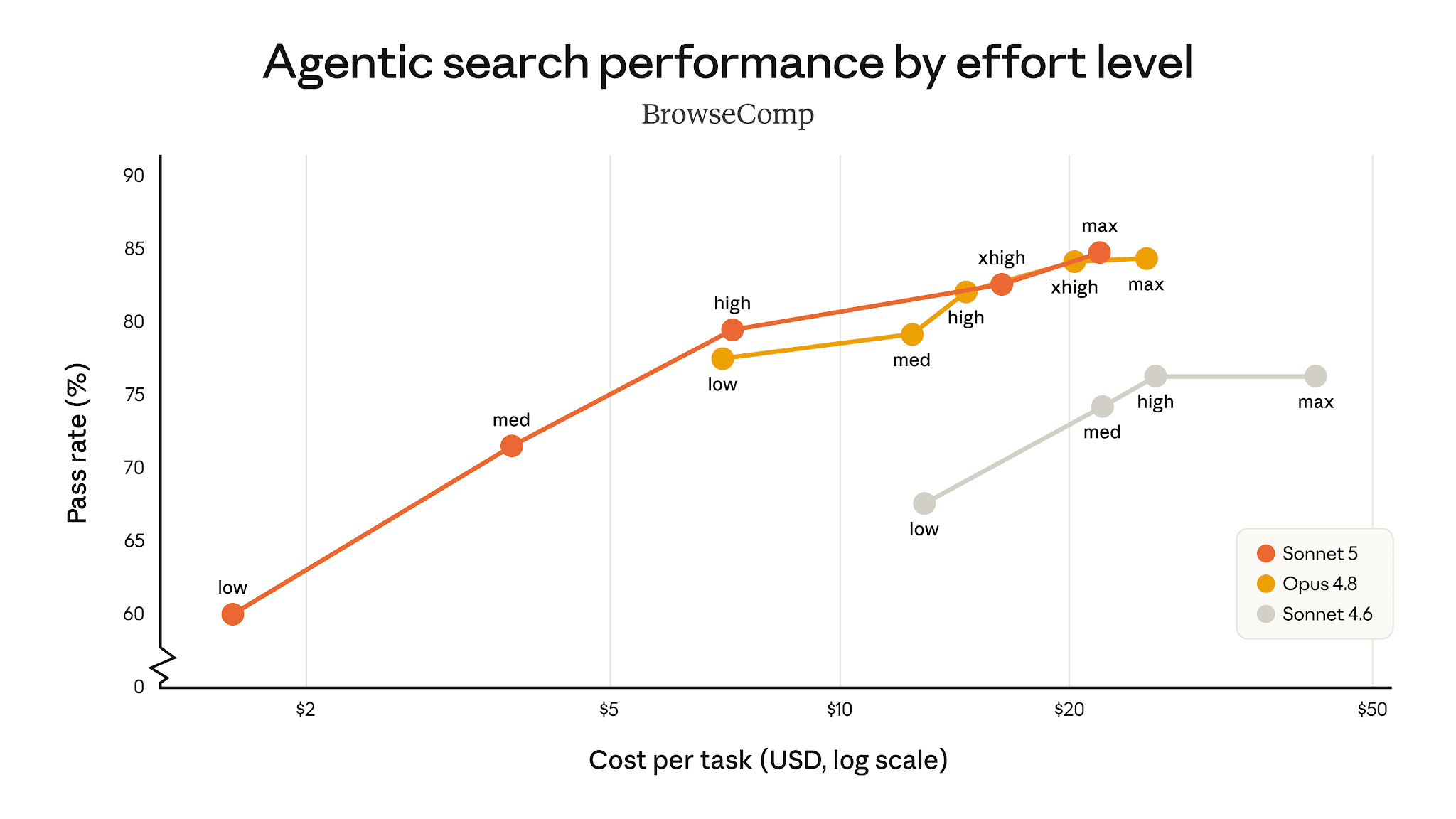
Figure 1. Anthropic’s Sonnet 5 launch chart compares cost and performance across effort levels. Read the original Sonnet 5 announcement for methodology and current pricing.
For marketing teams, that makes Sonnet 5 the sensible first route when the work is well specified and easy to review: a weekly performance narrative, a structured creative brief, a theme classification pass or a first investigation across known data sources.
Its job is to do useful groundwork. Its output should still be a reviewable recommendation, not an unreviewed commercial decision.
Opus 4.8: the high-judgment route
Use Opus 4.8 when the question has competing explanations and the answer will influence a meaningful decision. Anthropic positions it as a stronger collaborator for complex work, and launch feedback repeatedly points to better judgment, self-checking and a greater tendency to flag uncertainty.
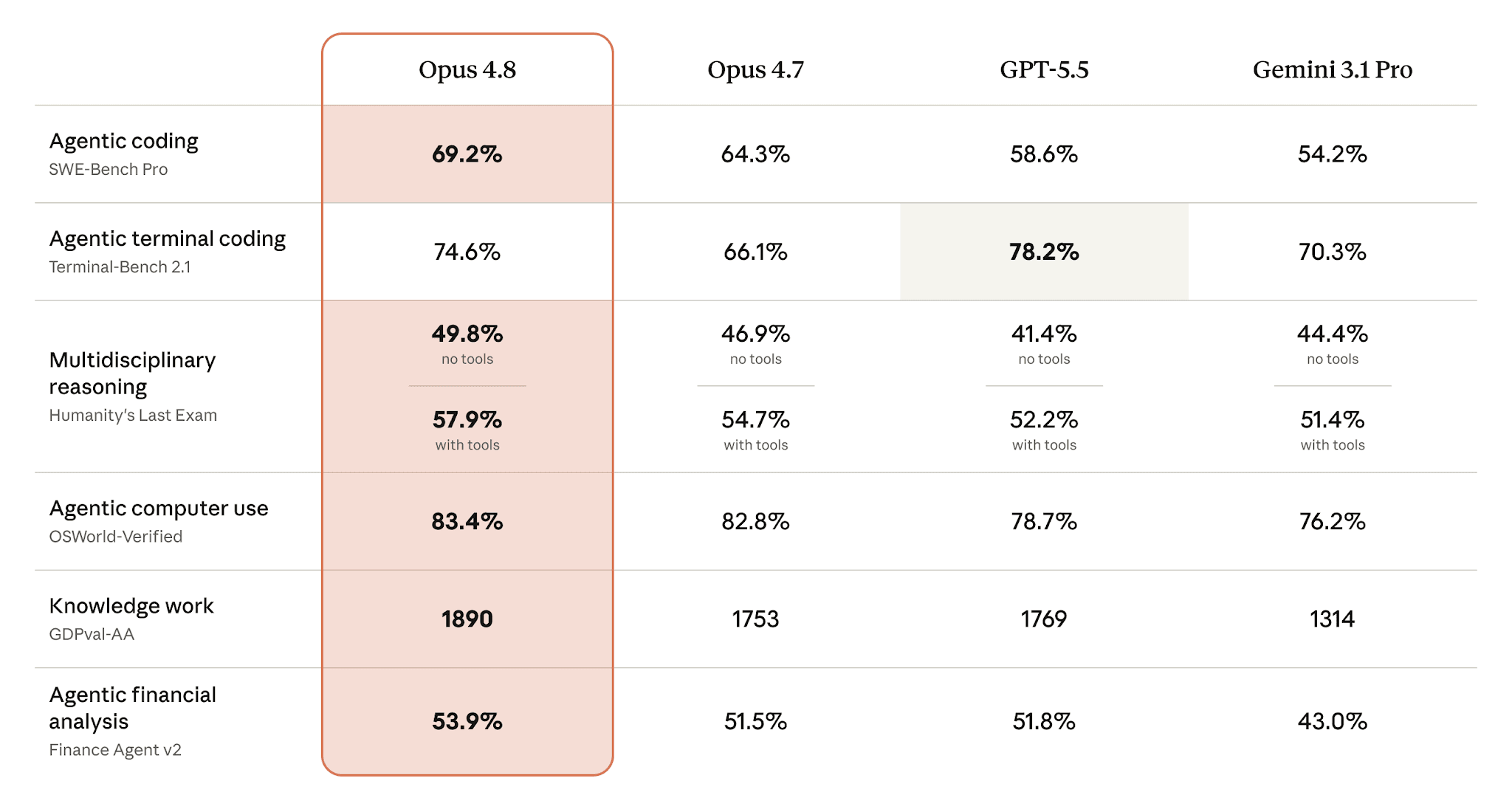
Figure 2. Anthropic’s Opus 4.8 launch comparison. Read the original Opus 4.8 announcement and system card for the full evaluation context.
That matters when the evidence does not agree. A good investigation should not just produce the most coherent story. It should show what it cannot prove.
I have seen polished performance narratives miss the real issue because they were built from one clean-looking dashboard. The campaign numbers were fine. The business was not. A sales follow-up problem, a changed offer or a broken landing page sat outside the model’s view.
Route work to Opus 4.8 when you need to reconcile paid-media data, CRM signals, landing-page changes and sales feedback; pressure-test a client narrative; or turn a messy problem into a testable set of hypotheses.
Fable 5: a capability route with stronger operating requirements
Fable 5 is not simply “the strongest Claude.” Anthropic’s launch and redeployment history make the governance question part of the product choice. Fable 5 and Mythos 5 share an underlying model, but Fable 5 was released with stronger safeguards for general use. Anthropic says it later added a classifier response to a reported safeguard bypass, with blocked requests routed to Opus 4.8.
The marketing lesson is straightforward. Capability, availability and safeguards are not implementation details to discuss after an agent receives tool access. They are part of the routing decision.
Use Fable 5 only for a defined, high-value workflow. Write down the task, permitted tools and data, approval point, audit trail and fallback before it runs.
A practical comparison for marketing work
Sonnet 5 is the best default when the task has clear inputs, a known output format and a quick human review. It is the execution layer.
Opus 4.8 is the better choice when the task needs investigation, trade-offs or a careful account of uncertainty. It is the high-judgment layer.
Fable 5 is a specialised route for bounded work where the value justifies more control. It is not a default execution layer and it is not a reason to remove a human approval boundary.
Do not make the comparison only on benchmark scores. Consider the cost of error, the evidence available, the level of access, the reversibility of the action and the ease of review.
A marketing scenario: route the investigation, not just the prompt
Consider a familiar request: “Meta leads are up, but sales quality is down. What should we do?”
A weak system uses a single model to write a plausible answer from Meta reporting. It may sound confident. It may still be wrong.
A stronger system routes the work. Sonnet 5 gathers a structured view of Meta, Google, CRM and landing-page changes, then identifies gaps in the evidence. Opus 4.8 investigates competing explanations: targeting drift, offer change, source-mix change, conversion friction or sales follow-up. The team receives an evidence-backed recommendation and a limited test plan.
A marketing owner then approves the test, budget cap and success metric. The result becomes part of the next decision.
At third i, this is the working standard I care about: the system should make the evidence easier to inspect and the next test easier to approve. It should not hide the trade-off behind a fluent answer.
For an example of why cross-channel evidence matters, see third i’s luxury travel and hospitality case study. It connects Google and Meta activity to the business outcome that mattered: direct bookings.
Fable 5 is not automatically needed in this flow. It may be useful for a tightly bounded high-value workstream. But the quality comes from the routing and decision loop, not from sending every request to the largest available model.
That sounds slower. In practice, it avoids a different kind of slow: discovering two weeks later that a persuasive answer was built on incomplete context.
What agencies should standardise
Agencies do not win by becoming a conduit for one model. Clients will increasingly have access to Sonnet, Opus, Fable, GPT, Kimi and whatever comes next. Raw access and first-draft output will become the commodity layer.
The durable layer is the account context, the test history, the commercial constraints and the ability to distinguish platform reporting from business reality. It is also the judgment to explain a trade-off to a client and the operating cadence that turns learning into better decisions.
For a practical agency view, see how third i is built for agencies managing multiple client accounts, channels and decisions.
This is why a comparison of GPT-5.6 model tiers for marketing teams reaches the same conclusion from a different model family. A model can be upgraded. Context and operating craft have to be built.
That is the core argument in third i’s guide to winning with AI agents: durable performance comes from context, constraints, feedback loops and human accountability, not the model name alone.
At third i’s marketing co-pilot, the goal is not to make a black-box media buyer. It is to connect cross-channel performance and business signals, make the evidence behind a recommendation visible, and keep an accountable person in control.
For teams that want to work inside their preferred AI assistant, third i’s MCP connector can bring connected marketing context into ChatGPT, Claude, Gemini and Grok. The user authenticates with third i, no API key is needed, and ad-platform passwords are not shared with the AI provider.
A simple model-routing policy to adopt this week
You do not need a large platform programme to start. Write down five rules.
1. Default to Sonnet 5 for bounded work. Require clear inputs, a known format and an easy review step.
2. Escalate to Opus 4.8 for ambiguity. Use it when the team needs investigation, trade-offs or a clear account of uncertainty.
3. Use Fable 5 only with an explicit contract. Define scope, permissions, fallback and review before the work begins.
4. Do not give any model broad execution rights by default. Let models read, analyse and prepare. Let a named owner approve material budget, targeting, catalogue or brand decisions.
5. Evaluate outcomes, not model theatre. Track correction rate, evidence quality, turnaround time, cost and commercial impact.
This turns model selection into a visible, revisable operating policy. That is what a healthy agent system should have.
The same principle sits behind third i’s guide to AI-led recommendations: models can surface evidence and prepare actions, but an accountable marketer still decides what moves forward.
The real answer
Sonnet 5 makes capable agentic work more practical as a default. Opus 4.8 is the route for deeper judgment and better handling of uncertainty. Fable 5 makes the governance question impossible to ignore.
All three can have a place in a marketing system. None should replace the connected context, constraints, feedback loop and accountable human decision that make marketing work trustworthy.
The model will keep improving. Your marketing operating system should get wiser.
That is the real operator test. Can the team explain what changed, why the recommendation exists, what could disprove it and who is accountable for the next move? If not, the model may be impressive, but the system is not ready.
FAQ
Is Sonnet 5 good enough for marketing work?
Yes, for many bounded and reviewable workflows. It is a strong default for reporting drafts, structured research, classification, creative analysis and first-pass recommendations. Put an approval step before anything becomes client-facing or commercially consequential.
When should I use Opus 4.8 instead of Sonnet 5?
Use Opus 4.8 when the task involves conflicting evidence, long context, high-value strategy, ambiguous causality or a need to identify uncertainty clearly. Treat it as a high-judgment collaborator, not the default for every routine task.
What makes Fable 5 different from Opus 4.8?
Fable 5 comes with a stronger safeguard and availability context. Anthropic’s public rollout information is a reason to define permissions, fallbacks, logging and review before using it in an agentic workflow.
Can an AI model make budget changes by itself?
A model can prepare a recommendation. Material budget, targeting, catalogue or brand decisions should remain behind an explicit human approval boundary, with a clear owner and measurement plan.
See this on your own accounts
third i connects to the platforms you already run and does this work against your live numbers.
Read more
View all articles
Kimi K3: What an Open Frontier Model Means for Marketing AI Systems
Kimi K3 is close to the frontier. The bigger shift is that teams now need to route AI work by context, risk, cost and control.

AI in Performance Marketing: A Comprehensive Beginner’s Guide
Discover the basics of AI-powered performance marketing and enhance your digital marketing strategies with AI marketing techniques for beginners.

How are AI-Driven Strategies Increasing ROI for Performance Marketing Campaigns?
From data analytics and personalization to creating ad creatives, AI does it all. But how does AI boost the ROI for performance marketing campaigns? Find out here.
