
Kimi K3: What an Open Frontier Model Means for Marketing AI Systems
Kimi K3 is close to the frontier. The bigger shift is that teams now need to route AI work by context, risk, cost and control.
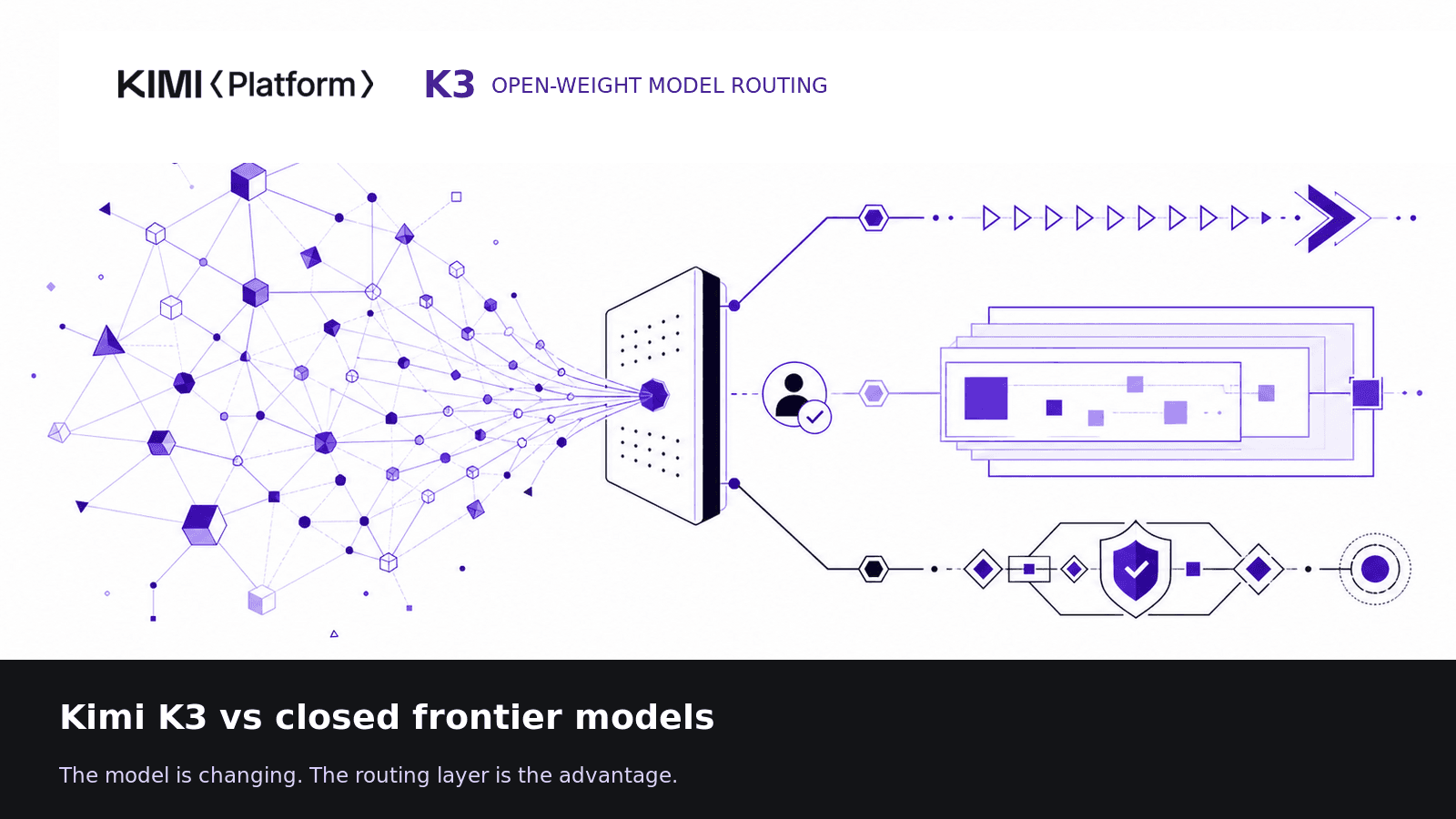
Kimi K3 is the kind of model launch that creates a familiar internet argument.
Did it beat Fable 5? Did it beat GPT-5.6 Sol? Is this the open-model breakthrough people have been waiting for?
Those are fair questions. They are also too small.
My first reaction was not about whether K3 had won a leaderboard. I kept coming back to a more practical question: what changes when a marketing team can choose a credible open model for more of its stack? At third i, I have seen the hard part arrive after the model choice. The answer still has to survive the messy path from platform metrics to a business decision.
Kimi’s own launch material says K3 still trails Claude Fable 5 and GPT-5.6 Sol on overall performance, while showing frontier-level results across its evaluation suite. It is a 2.8-trillion-parameter, open 3T-class model with native vision and a one-million-token context window. The full weights are scheduled for release by 27 July.
That is a serious development.
But the useful question for a marketing team is not “Which lab won the week?”
It is this:
"What work should move to a model like K3, what needs a different model, and what should never be delegated without context and approval?"
That is a routing question.
What Kimi K3 actually changes
The open-weight conversation is moving closer to the frontier.
K3 is designed for long-horizon coding, knowledge work and reasoning. Kimi reports strong performance on complex agentic workflows, visual reasoning and long-context tasks. It also publishes limitations that should matter to anyone building production systems: K3 can be sensitive to incomplete thinking history, can become overly proactive in ambiguous situations, and still has a noticeable user-experience gap versus Fable 5 and GPT-5.6 Sol.
That combination is the story.
The capability gap is narrowing. The operating gap is not.
An open model that is credible for more frontier work gives teams more choices around deployment, model access, data handling, cost and customisation. It does not remove the work of defining the job, restricting the action space, checking evidence, and assigning accountability.
Benchmark wins are not a deployment strategy
One benchmark can show that a model is excellent at a specific task under a specific harness.
That matters. But it does not answer whether the model should:
- interpret a sudden CPA increase;
- write a client-facing recommendation;
- propose a budget test;
- touch a live product catalog;
- make a decision when revenue data, platform reporting and sales feedback conflict.
Those are not only intelligence questions. They are questions of business context and risk.
A model can be strong enough to find the right pattern and still be the wrong choice to act on it without guardrails.
This is why the K3 conversation should not become another benchmark leaderboard recap. The more useful implication is that model selection is becoming a system-design decision.
That is the same argument in third i’s guide to winning with AI agents: reliable behaviour comes from context, constraints, routing and human checkpoints, not just a better underlying model.
The three decisions behind model routing
There are three things to decide before selecting a model.
1. How much reasoning and context does the job need?
A simple classification task and an ambiguous cross-channel diagnosis are not the same workload.
Use a lower-latency or lower-cost route for repetitive, bounded work. Use a high-context model when the task requires pulling together contradictory evidence, long history or several tools.
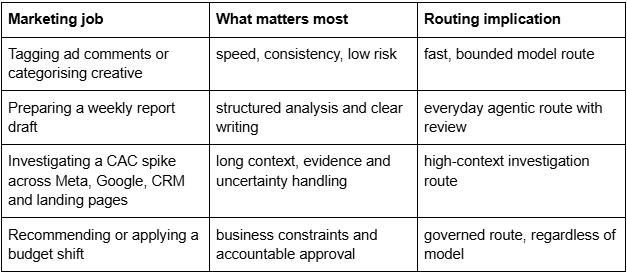
The goal is not to use the strongest model everywhere. It is to use enough intelligence for the decision, without pretending that intelligence alone makes a decision safe.
2. What data and deployment constraints apply?
K3’s open-weight direction matters because it expands the set of deployment conversations teams can have.
For some organisations, the question will be whether a model can sit closer to their stack. For others, the deciding factor will be inference cost, vendor access, latency, regional requirements or an existing agent harness.
That is real value. It is not a reason to move blindly.
The architecture still needs clear boundaries around what data is available to the model, what tools it can call, what it can retain, and what requires an accountable person to sign off.
3. What happens if the model is wrong?
This is the question too many model comparisons skip.
If a model misclassifies a thousand comments, a team can correct the batch. If it confidently misdiagnoses a sales-quality problem as a Meta creative problem, the team may cut the wrong campaign. If it changes a budget or catalog without approval, the error is no longer theoretical.
Risk should change the routing rule.
Higher-risk work deserves more evidence, more explicit constraints, and a human checkpoint. That is true whether the underlying model is Kimi, Claude, GPT or anything that arrives next month.
For the operating principle behind that boundary, see third i’s guide to AI-led recommendations and human review.
A practical marketing scenario
Imagine a paid-media lead asks:
“Why did revenue fall while Meta ROAS stayed healthy?”
A weak system gives one platform answer. It might say that the best ads should receive more budget.
A stronger system investigates:
- Did branded search volume fall?
- Did landing-page conversion change after the offer update?
- Did CRM lead quality deteriorate?
- Did returning-customer revenue decline?
- Is Meta claiming credit for demand created elsewhere?
- Does the evidence support a budget decision, or only a hypothesis?
A model like K3 may contribute well to parts of that investigation, especially where long context, tools and visual or structured inputs matter.
But the work only becomes useful when the system connects the evidence and knows when to stop.
For an example of why cross-channel evidence matters, see third i’s luxury travel and hospitality case study. It connects Google and Meta activity to the business outcome that mattered: direct bookings.
The report was not wrong. It was incomplete.
I have seen this pattern in real marketing work. A report can be polished, internally consistent and still miss the reason a business is underperforming. Sales follow-up may have changed. A landing page may have broken on mobile. Demand may have softened before the platform dashboard catches up. That is why I care more about the evidence chain than a model’s headline score.
Why the marketing context layer matters more as models converge
At Thirdi, we see the model as a capability layer, not the whole product.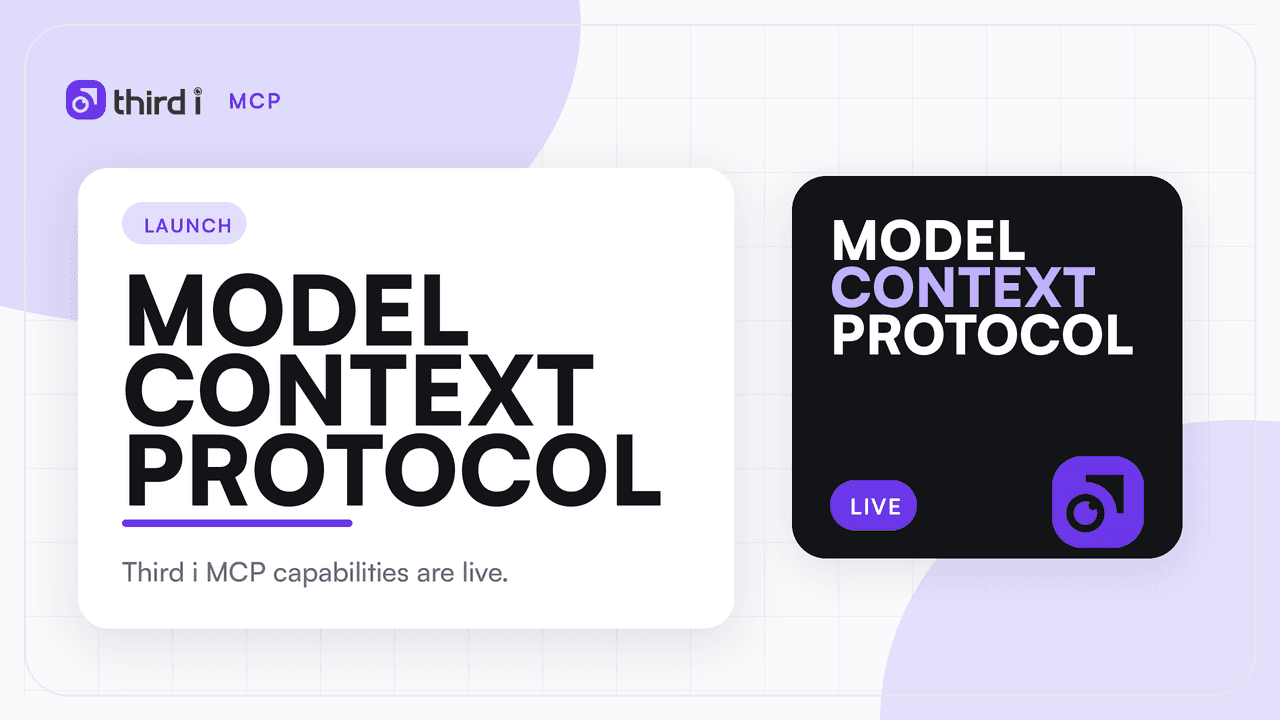
Figure 1. third i MCP connects a supported AI assistant to authenticated marketing context. Read the third i MCP setup guide for the practical workflow.
The marketing system still needs a shared view of performance, creative, funnel behaviour, historical learning, commercial constraints and past decisions. It needs an action path that shows why a recommendation exists, who owns it, and what will be measured after it is approved.
That is why winning with AI agents has very little to do with the model you pick.
The model will improve. It should be swappable.
The durable advantage is the operating system around it.
For teams that want to ask these questions inside their preferred AI assistant, third i’s MCP connector brings connected marketing context into ChatGPT, Claude, Gemini and Grok without sharing ad-platform passwords with the AI provider.
That distinction is not theoretical for us. At third i, the recurring question is rarely “Can the model write this?” It is “Can it see the relevant context, explain why it reached a conclusion and stop before a person needs to make the call?”
For an agency, this is especially important. The opportunity is not to replace every junior task with a frontier model. It is to give every account team a better evidence base, a clearer test backlog, and more time to exercise senior judgement. Thirdi’s agency operating layer is designed around that shift.
For a practical agency view, see how third i is built for agencies managing multiple client accounts, channels and decisions.
The better outcome is not fewer people thinking. It is less time spent stitching screenshots and exports together, and more time spent on the judgement a client is actually paying for.
What to test before adopting Kimi K3
Treat K3 as a candidate in your routing layer, not as an all-or-nothing platform bet.
Start with a small, explicit evaluation set:
1. Choose three bounded jobs. For example, creative categorisation, weekly performance-summary drafts and research synthesis.
2. Run the same jobs through your current route and K3. Keep the data, harness and review criteria consistent.
3. Score more than output quality. Measure completion, accuracy, evidence use, latency, cost, instruction-following and the number of human corrections required.
4. Test the failure case. Give the system incomplete or conflicting inputs. Does it ask, flag uncertainty or improvise?
5. Keep execution off. Let the model analyse and draft before it can propose or trigger any live action.
The last test matters most. Kimi itself flags that K3 can make unexpected decisions on a user’s behalf when the request is ambiguous. That is a useful reminder for every agent builder: capability needs a boundary.
The point is not to pick a winner
Kimi K3 is a meaningful open-model milestone.
It increases the number of serious choices available to teams building AI systems. It raises the pressure on every closed model provider. And it gives builders another credible option for work that would have required a proprietary frontier model not long ago.
But it does not make benchmark rankings the operating model.
The right model can change by task. The right context, guardrails and approval rules should not.
That is the real shift.
FAQ
Does Kimi K3 beat Claude Fable 5 and GPT-5.6 Sol?
Not overall, according to Kimi’s own technical blog. Kimi says K3 trails Fable 5 and GPT-5.6 Sol on overall performance while performing at a frontier level across its evaluation suite. It reports competitive or stronger results in selected tasks, so comparisons need to state the exact evaluation and harness.
Why does Kimi K3 matter for marketing AI?
K3 makes open-weight models more credible for complex, long-context and agentic work. That expands the model-routing choices available to marketing systems, but does not replace the need for cross-channel context, guardrails and human approval.
Should agencies switch all work to an open model?
No. Agencies should evaluate specific workflows against consistent criteria: output quality, evidence use, latency, cost, data constraints, failure handling and required human review. A mixed routing layer is usually more useful than a one-model rule.
What should a model never decide on its own in marketing?
Material budget changes, brand-sensitive creative publication, customer-impacting catalog changes and decisions based on incomplete or contradictory business evidence should remain behind explicit human approval.
See this on your own accounts
third i connects to the platforms you already run and does this work against your live numbers.
Read more
View all articles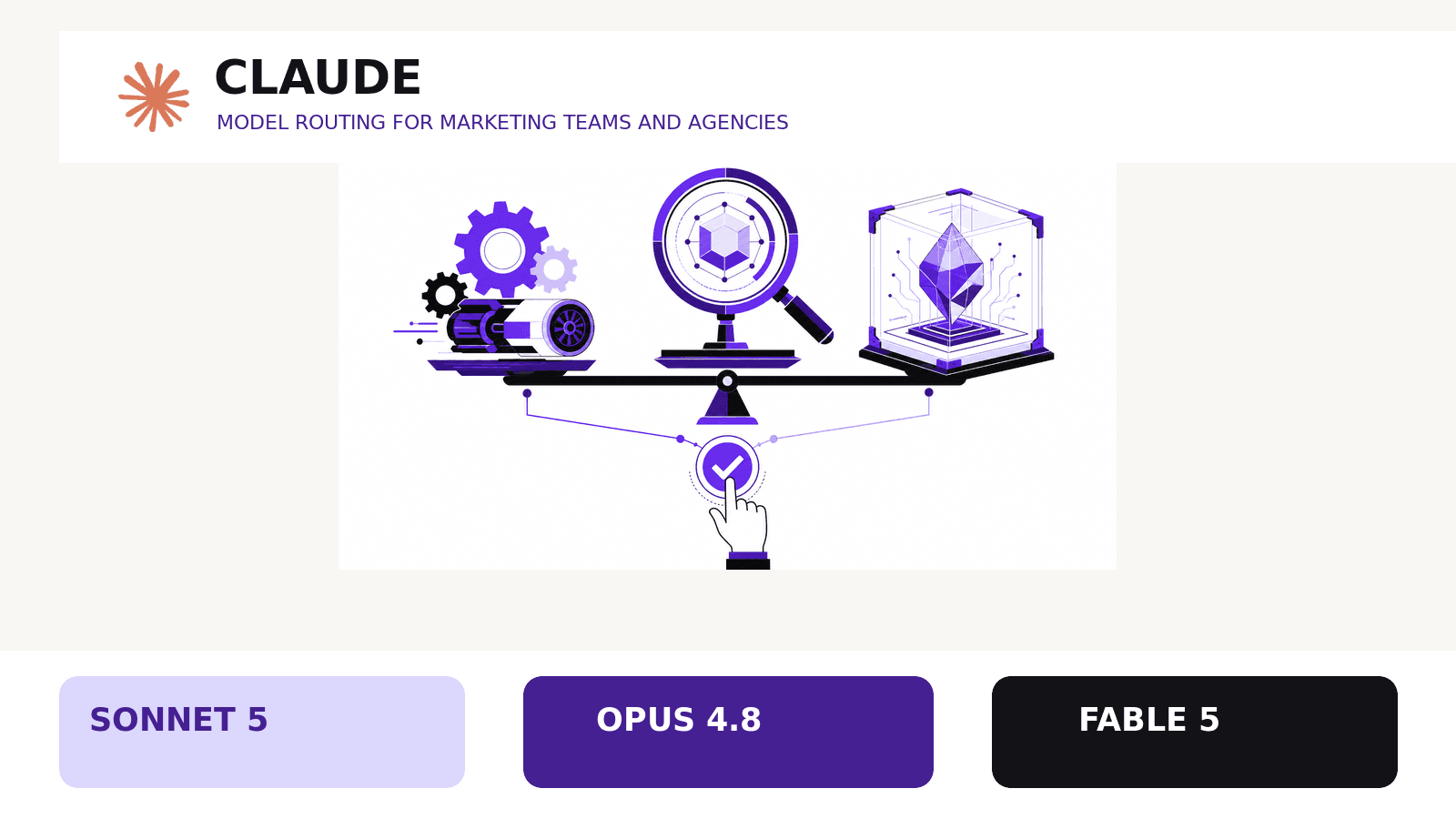
Sonnet 5 vs Opus 4.8 vs Fable 5: A Practical Guide for Marketing Teams
Compare Claude Sonnet 5, Opus 4.8 and Fable 5 by marketing task, cost, context, risk and approval requirements.

AI in Performance Marketing: A Comprehensive Beginner’s Guide
Discover the basics of AI-powered performance marketing and enhance your digital marketing strategies with AI marketing techniques for beginners.
How are AI-Driven Strategies Increasing ROI for Performance Marketing Campaigns?
From data analytics and personalization to creating ad creatives, AI does it all. But how does AI boost the ROI for performance marketing campaigns? Find out here.
