
GPT-6 Astra and the Integration Paradox: When AI Can Use Every Tool, Business Context Becomes the Moat
GPT-6 Astra can operate more software, but useful marketing still depends on connected goals, economics, constraints, decision history and human approval.
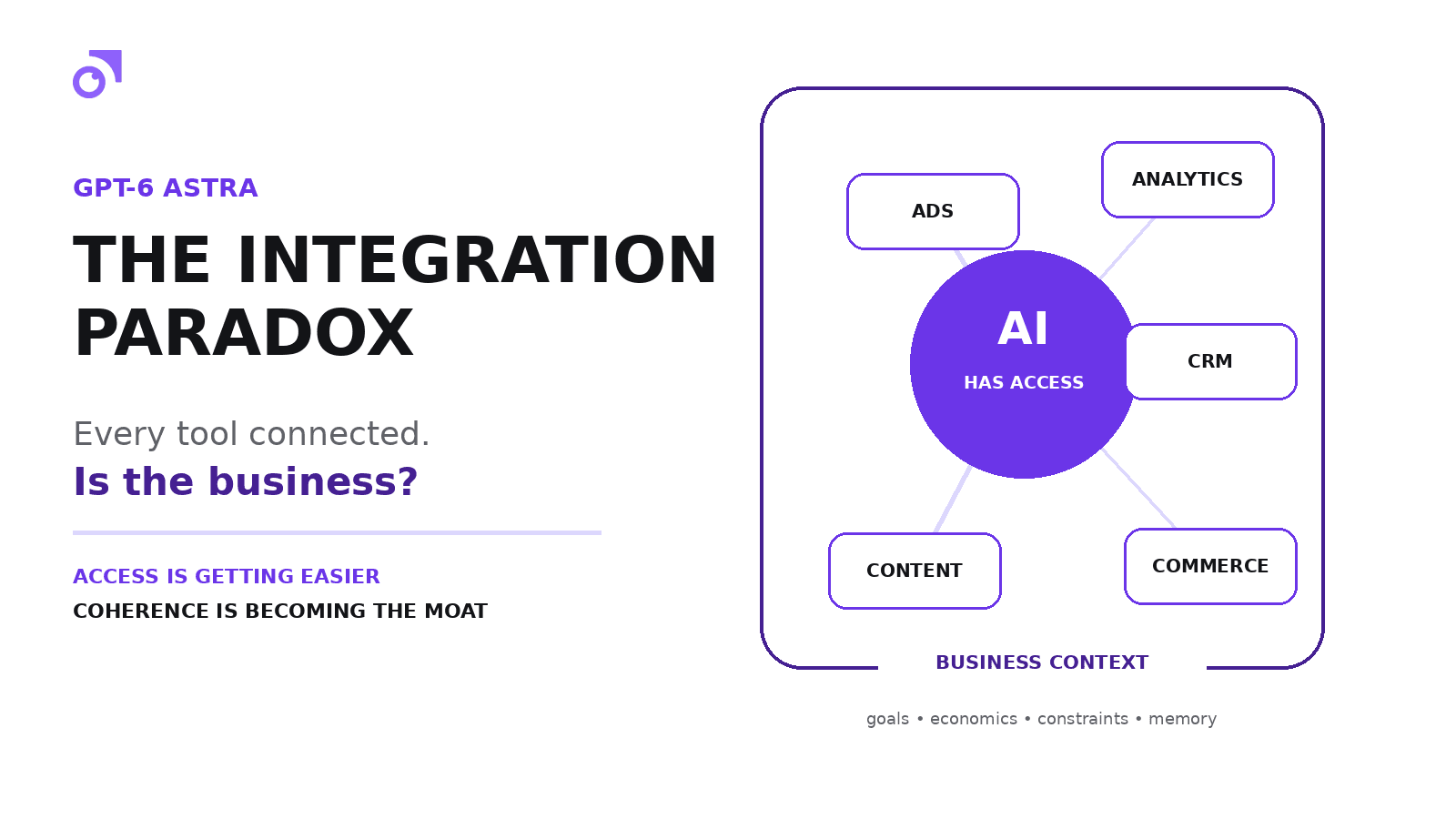
For years, we treated integration as one of the biggest obstacles to useful AI.
The model could analyse a report or suggest what to do next. But before it could do much real work, someone had to connect the CRM, analytics, advertising platforms, spreadsheets and internal tools around it.
GPT-6 Astra suggests that obstacle is beginning to move.
OpenAI says Astra can navigate software, update customer records, conduct online research and create finished documents, spreadsheets and presentations. It can also carry out longer, multi-step professional workflows rather than stopping at an answer in a chat window.[1]
At first glance, this looks like the integration problem getting smaller.
One part of it is.
The more interesting part is about to become impossible to ignore.
An AI may be able to open every application your team uses. That does not mean it understands how your business fits together.
The next moat is not access to the model. It is not access to the software either.
It is connected business context.
The integration problem is splitting in two
There are now two very different problems hiding behind the word “integration”.
The first is access integration.
Can the AI reach the right application? Can it retrieve the information? Can it move between tools and complete a task?
This is where computer use matters. If an agent can operate the same interfaces people already use, some workflows may no longer need a purpose-built connector before the agent can become useful.
The second is business integration.
Does the agent know what the information means inside this company? Does it understand the commercial objective, the constraints around it, what has already been tried and who has the authority to act?
Computer use helps with the first problem.
It does not solve the second.
A simpler interface does not create a simpler business. It can hide the complexity, but the complexity is still there.
The pipes can be connected while the business remains fragmented
Most marketing stacks already contain a lot of connected software.
Meta sends traffic to a website. GA4 records behaviour. A CRM tracks leads. A commerce platform records purchases. Reports pull parts of this information together.
Yet the people using those systems can still hold completely different versions of the truth.
Meta may count a form submission as a result. Sales may only count a qualified conversation. Finance may care about collected revenue. The growth team may be working towards contribution margin rather than top-line sales.
All four views can be valid.
An agent needs to know which view matters for the decision in front of it.
This is why data integration, while necessary, is not the same as business understanding. Sending five data sources into one model can give it more evidence. It can also give it five definitions of the same customer.
More access does not automatically create more truth.
A marketing decision needs five connected answers
A useful agent needs more than a complete set of dashboards. It needs enough context to answer five different questions.
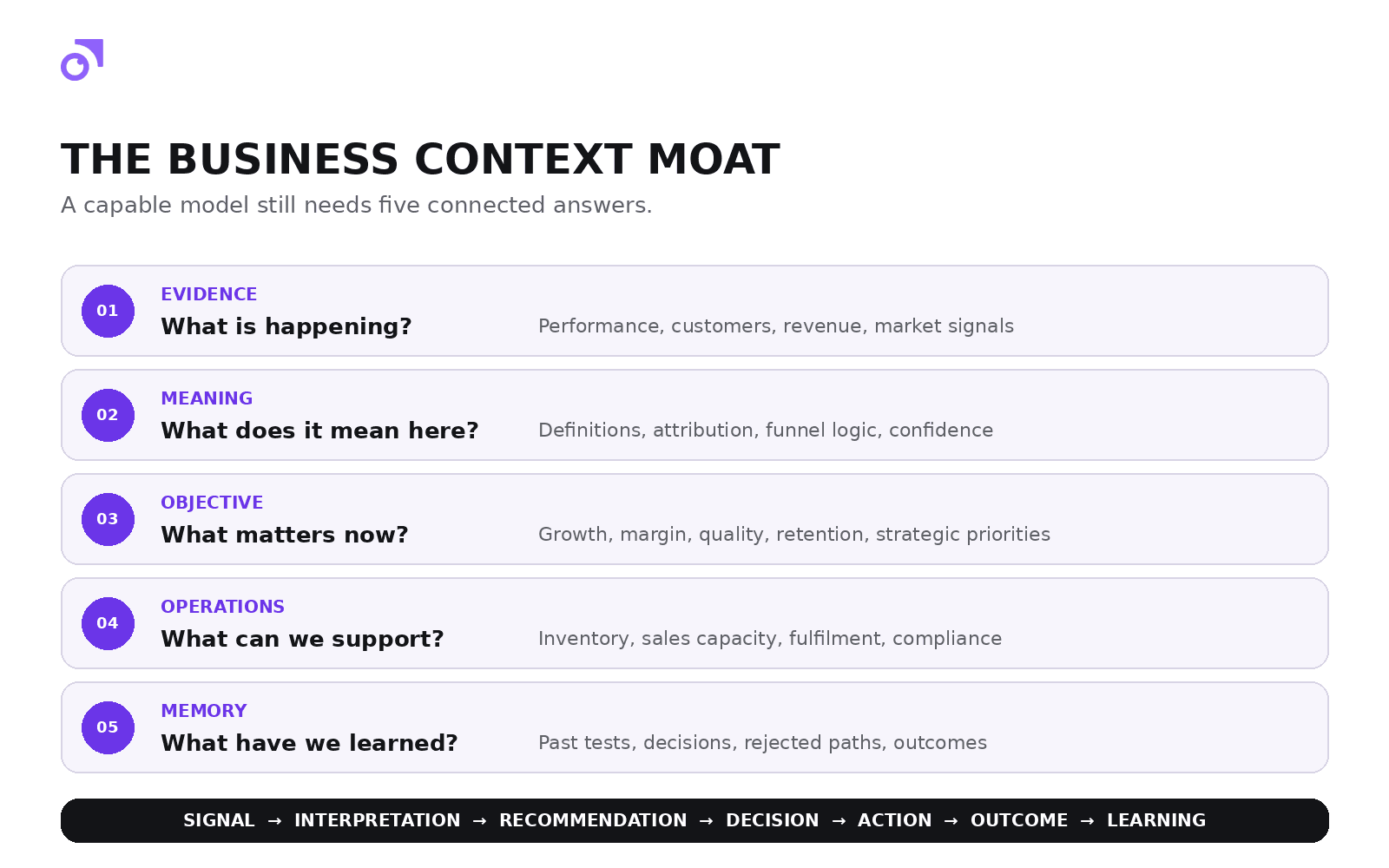
1. What is happening?
This is the evidence layer.
It includes campaign performance, website behaviour, customer records, revenue, creative results and market signals. It should also include where the evidence came from, how fresh it is and where measurement is incomplete.
This is the part most people mean when they talk about connecting data.
It matters. But it is only the start.
2. What does it mean here?
The same number can carry different meanings in different businesses.
A lead can be a form submission, a booked appointment or an opportunity accepted by sales. ROAS can be platform-reported revenue, attributed ecommerce revenue or a much narrower measure that accounts for cancellations and returns.
An AI should not quietly choose one definition because it happens to be available.
It needs the company’s metric definitions, funnel logic, attribution assumptions and confidence rules. Otherwise, it can produce an accurate answer to the wrong question.
3. What matters now?
Marketing platforms optimise for the objectives they can observe.
Businesses make choices across objectives that often conflict.
Growth may matter more than efficiency this quarter. A company may choose qualified pipeline over lead volume, contribution margin over revenue, retention over acquisition, or a strategic product over the current bestseller.
These are not settings a general model arrives with.
A model can optimise a metric. The business still has to tell it what is worth optimising for.
4. What can the business support?
Marketing does not end at a click, lead or purchase.
A recommendation can be correct inside an advertising account and wrong everywhere else.
Inventory may be running low. The sales team may already be overloaded. Fulfilment may be slipping. A promotion may increase revenue while damaging margin. A product may not be ready for the demand that marketing can create.
This context often lives outside the marketing stack. Sometimes it does not live in a system at all. It sits in a planning meeting, a sales conversation or a decision someone made three months ago.
If the agent cannot see that reality, it cannot reliably recommend what the business should do next.
5. What has the business already learned?
Most systems preserve outcomes. Far fewer preserve the reasoning behind them.
The data may show that a campaign was paused. It rarely explains why.
Was the hypothesis disproved? Did inventory disappear? Did the team stop the test too early? Was the result commercially strong but wrong for the brand? Did another change happen at the same time?
An AI remembering its current task is not the same as a business preserving its decision memory.
The useful record is not only what happened. It is:
signal → interpretation → recommendation → decision → action → outcome → learning
That is the loop that makes the next recommendation better.
Consider the campaign every dashboard says to scale
Imagine a campaign with improving return on ad spend. Conversion is healthy. The creative continues to perform. The advertising account has room to increase its budget.
An agent looking at the account could reasonably recommend scaling it.
Now connect the rest of the business.
The winning product is being sold through a heavy discount. Returns are rising. Inventory is low. The fulfilment team is already stretched. The company wants to shift demand towards a higher-margin range. A previous attempt to scale the same offer produced plenty of first purchases but weak repeat behaviour.
None of this makes the advertising data wrong.
It changes what the data means.
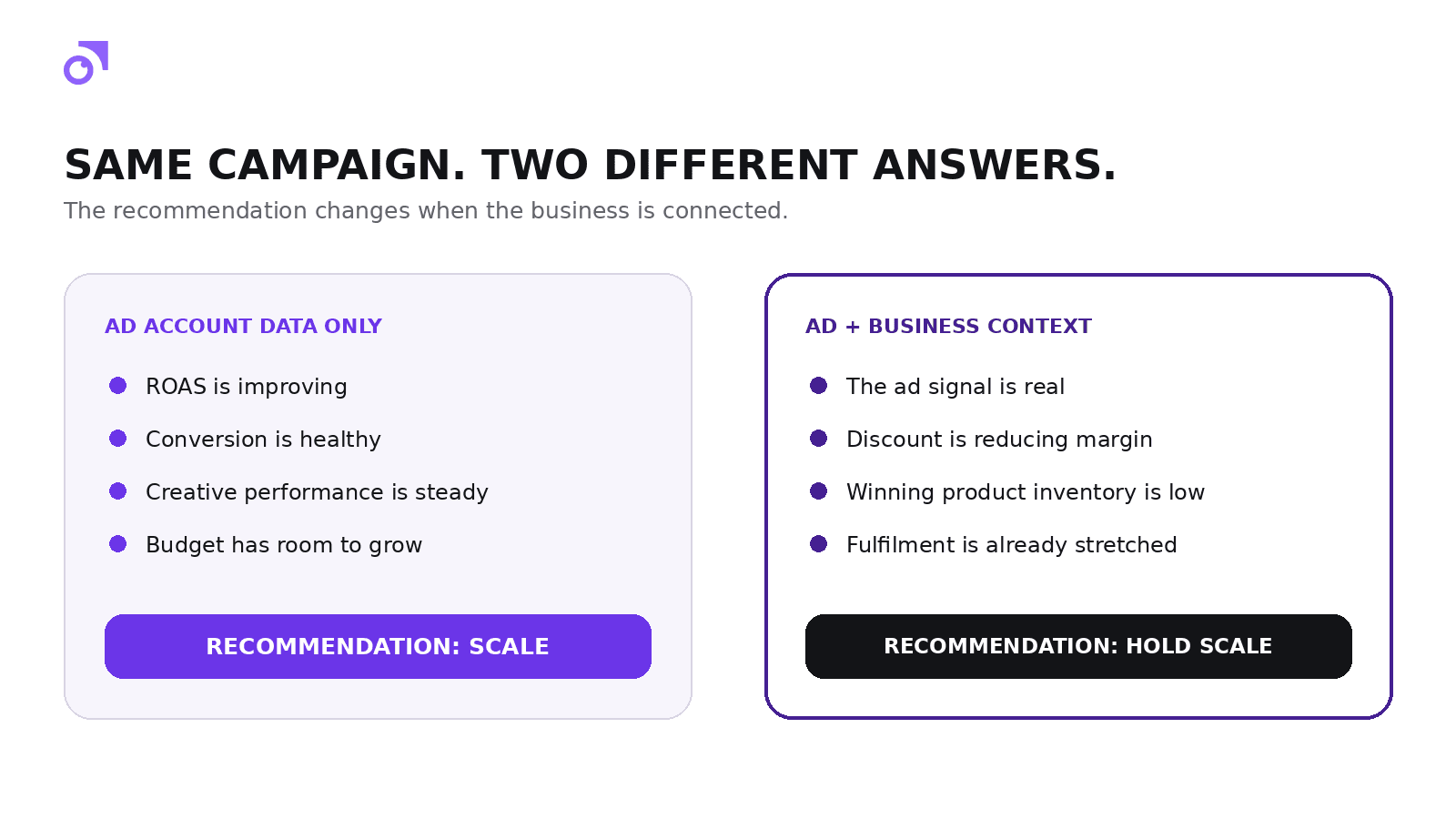
The better recommendation may be to hold the increase until inventory recovers. It may be to change the offer, move the creative towards another product or run a smaller test with a margin constraint.
It may still be right to scale.
But that is now a business decision supported by marketing evidence, not a platform recommendation mistaken for strategy.
The first answer came from a connected advertising account.
The better answer came from a connected business.
Business context is more than proprietary data
It is tempting to reduce this argument to “your data is the moat”.
I do not think that goes far enough.
Many businesses already own years of customer, campaign and revenue data. They still struggle to decide what to do next because the information is fragmented, the definitions are disputed and the reasons behind previous decisions have disappeared.
Data becomes more defensible when it is connected to meaning.
Meaning becomes useful when it is connected to an objective.
An objective becomes actionable when it is connected to operational reality, decision ownership and a learning loop.
That combination is much harder to copy than a prompt or a model choice.
Every competitor can gain access to the same frontier model. Most can connect the same major advertising and analytics platforms. They cannot download your company’s accumulated understanding of what works, why it works, when it fails and what the business refuses to compromise.
Models will keep changing.
A well-built business context should compound.
Better models increase the value of constraints
Astra is also notable because OpenAI is putting more emphasis on task boundaries, judgement and asking for clarification when a consequential choice is ambiguous.[1]
That is important progress. It does not remove the need for the business to define those boundaries.
An agent still needs to know:
- what it can read;
- what it may draft;
- what it is allowed to change;
- which actions require approval;
- what evidence must accompany a recommendation;
- who owns the final decision; and
- how the outcome will be recorded.
The stronger the model becomes, the less acceptable vague authority becomes.
When an agent can only write a report, unclear instructions create a weak report. When it can update systems, publish work or change live settings, unclear instructions can create a business problem.
The faster an agent can act, the more precisely the organisation must define where action stops and judgement begins.
The future marketing stack may feel simpler
The visible interface for marketing work is likely to become more conversational.
A marketer may ask why revenue changed, let an agent investigate the possible causes, inspect the evidence, prepare a recommendation and route it for approval without manually assembling five exports.
We are already seeing parts of that shift through platform AI connectors and conversational paid-media workflows.[5][6]
The user may care less about which application supplied each field.
The underlying system still needs to care deeply about provenance, permissions, definitions, freshness, business rules, decision history and approval state.
The interface can become simpler because the operating layer underneath it becomes more disciplined.
Not because the discipline is no longer required.
Where third i fits
At third i, we think of the model as one part of the system, not the system itself.
The model can investigate, reason and prepare the work. The marketing context layer should connect that intelligence to authenticated performance data, funnel meaning, business objectives, historical learning and a clear human decision boundary.
third i's MCP connector already lets supported AI assistants query marketing performance from connected sources without relying on pasted CSV exports or sharing ad-platform passwords with the AI provider.[3]
That is an access layer.
The larger opportunity is to help an AI understand enough of the business to produce an evidence-backed recommendation, show why it reached that conclusion and pause before the consequential step.
We have written before that internet reach does not make an agent ready for marketing.[2] Astra pushes the same question further.
What happens when reach is no longer the obvious constraint?
The answer is not less integration. It is a more demanding form of it.
We need to connect not only the applications, but the definitions, objectives, operational realities, decisions and learning that make marketing useful to the business.
What should a marketing team do now?
Do not start by asking which model should run the company’s marketing.
Start with one decision that matters and map what a good answer would require.
Ask:
- Which business outcome are we actually trying to improve?
- Which systems and teams hold evidence that could change the answer?
- Where do we use conflicting definitions?
- Which operational constraints should override a marketing metric?
- What has already been tried, and is the reasoning preserved?
- What may the agent inspect, draft or change?
- Who remains accountable for the decision?
- How will the outcome become part of the next recommendation?
If these questions are unresolved, adding a more capable model will not resolve them for you.
It may simply expose the fragmentation faster.
GPT-6 Astra may be able to operate more of the software surrounding a business.
That is an important shift.
But software access is not business understanding. A model does not arrive knowing why sales rejected those leads, why finance distrusts that revenue figure, why the bestselling product should not receive more spend or why leadership chose not to repeat a profitable campaign.
Those connections belong to the business.
The next generation of AI may know how to operate every application.
The advantage will belong to businesses that can teach it how the business operates.
Frequently asked questions
Does GPT-6 Astra make software integrations unnecessary?
No. Computer use may let an agent interact with some existing interfaces without a custom integration for every step. Structured integrations still matter for reliable data access, permissions, repeatable workflows, auditability and scale.
What is business context for an AI marketing agent?
Business context includes the meaning behind metrics, commercial objectives, funnel definitions, operational constraints, past decisions, permissions and measured outcomes. It helps the agent connect a marketing signal to the reality of the company making the decision.
Why is connected data not enough?
Connected data tells an agent what different systems recorded. It does not necessarily reconcile conflicting definitions, explain why a past decision was made or identify which business constraint should override a platform metric.
How should marketing teams start using computer-using AI agents?
Begin with a high-value, low-risk decision workflow. Give the agent read access, require evidence for its recommendation and keep a human approval point before any material external or account change. Add wider permissions only after the team has tested the workflow against real operating conditions.
See this on your own accounts
third i connects the platforms you already use and makes authenticated marketing context available inside supported AI assistants.
Connect third i to your AI assistant or talk to our team.
See this on your own accounts
third i connects to the platforms you already run and does this work against your live numbers.
Read more
View all articles
Your AI Agent Can Reach the Internet. That Still Doesn’t Make It Ready for Marketing.
Agent Reach shows how quickly AI agents can gain access to the web, social platforms and research tools. For marketers, the real question is what context, permissions and review sit behind that access.

Winning With AI Agents Has Very Little To Do With The Model You Pick
If you run performance marketing today, you hear the same question every time AI agents come up: “So, which model are you using?” For real-world results, that is the least useful place to focus. The teams that are quietly getting better ROAS, lower waste, and fewer surprises from AI agents are not…

AI Agents Under The Hood: How They Really Work
This post explains that AI agents are not magic robots, but tools built on one simple trick: predicting the next word very well, then wrapping that prediction engine with rules, tools, and memory so it can actually do jobs for you. It shows how this setup lets you talk to software in plain language…
