
AI Max Copy Preview: Seeing a Sample Isn't Approving It
Google Ads now shows sample AI Max headlines before opt-in. Here is why previewing examples is useful, but does not replace reviewing the copy that actually serves.
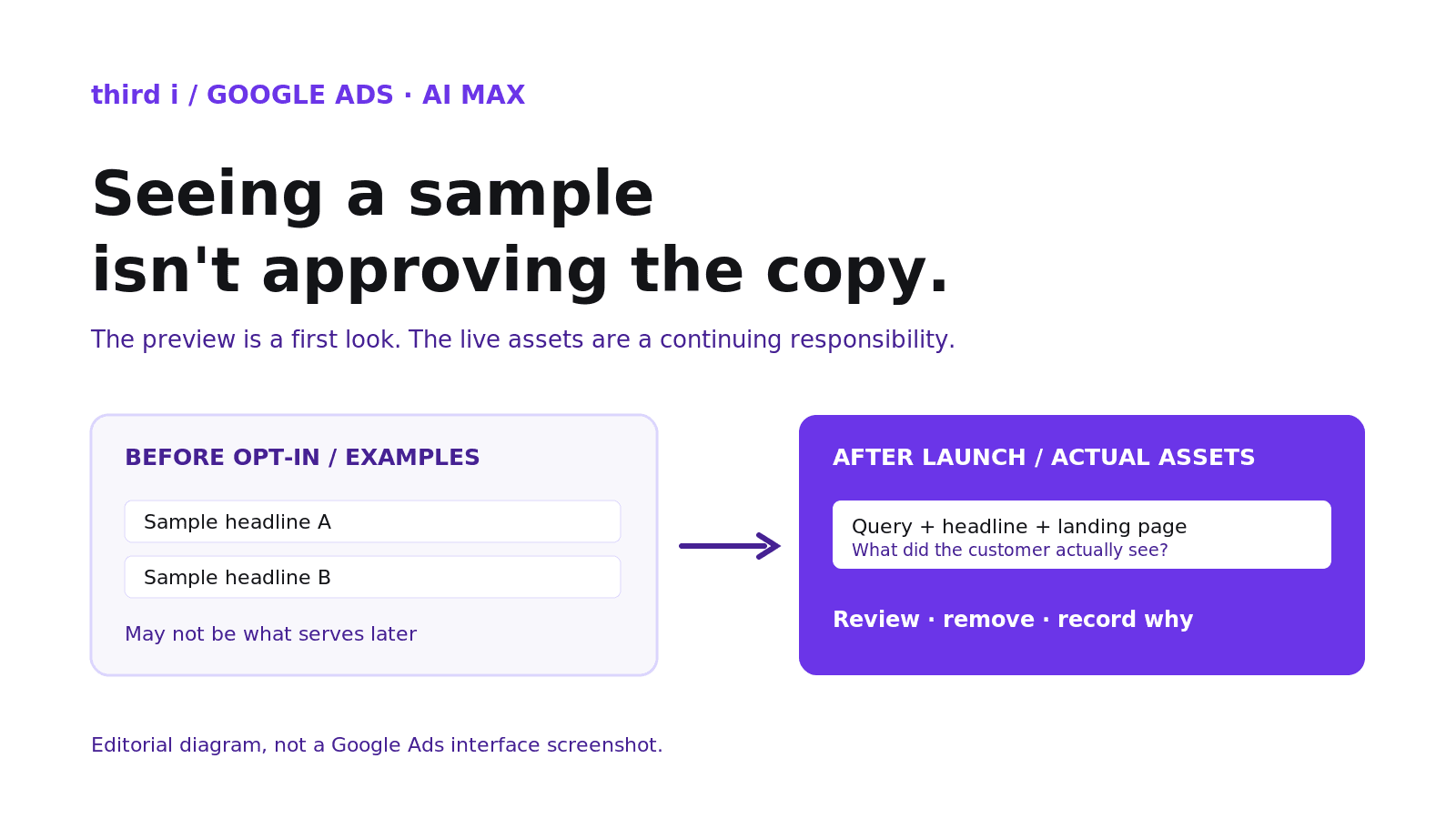
Ten polite headlines
Google will now show a Search advertiser examples of the headlines and descriptions its AI might write before the advertiser enables text customization. Give it a final URL, wait about half a minute, and as many as ten examples appear. This is a useful improvement.
It also makes for a curious sort of approval meeting. The copy on the screen is not necessarily the copy that will run. It is a demonstration of what the system may do. One might as well approve a restaurant after looking at a photograph of ten dishes the kitchen might serve.
I do not mean the preview is useless. If a sample immediately invents an offer or gets the business wrong, you have learnt something before spending money. But the absence of a mistake in ten samples cannot certify all the copy that comes later.
Google says text customization takes inputs from the landing page, domain, existing ads and keywords, and adds its own generated headlines and descriptions to the responsive search ad's pool. It can refresh those assets as the page and user behaviour change. The preview is therefore an introduction to a process, not a signed-off stack of finished ads.
The client brief Google has not read
In one of our agency reviews, the team was considering seasonal offers, retargeting and a brand-protection campaign while also dealing with tiring creative. That review was not about AI Max. It is useful here because it shows how much of an ad decision lives outside a URL.
An offer has dates. A claim may have conditions. One property may be included while another is not. A brand may be willing to use an aggressive phrase in an internal brainstorm but unwilling to put it before a guest. The landing page is an important source, but it is not the entire conversation that produced the campaign.
Suppose the page says “stay longer and save”. A generated headline may be accurate in the broadest possible sense and still conceal the conditions that make the offer fair. Or a line might sound wonderfully clear until the client asks whether it applies to every location. These are examples of questions to check, not claims about copy Google generated for that account.
The first person to see a generated line should therefore ask more than “Is it on brand?” What exactly does it promise? Which page supports that promise? Is it true for the date, market and customer seeing it? Who will notice if the page changes next week?
None of these questions can be answered by admiring the sample.
The part after the switch
The practical workflow is not complicated, though it is less satisfying than one grand approval button.
Before enabling text customization, review the examples and the pages they came from. Fix an ambiguous landing-page claim rather than hoping the system will ignore it. Decide which claims, offers and destinations would be unacceptable, and who owns the decision to enable the setting.
After enabling it, look at what actually served. Google’s asset reporting marks its customized text as “Google AI” in the “Added by” column. The reports allow advertisers to review and remove unfavorable assets; search-term and ad-combination views can show the query, headline and landing page together.
That second review is not a ceremonial repetition of the first. It is the first time the team can compare a live asset with the customer’s query, the destination and the campaign’s business constraints. If the copy is wrong, remove it or turn off the setting while investigating. Do not wait for a monthly performance report to discover that an attractive headline made a promise the business could not keep.
There is also a distinction between Google’s controls and a human approval gate. Google gives advertisers a way to preview examples and inspect or remove assets. It does not mean every future generated line waits for a person to approve it before serving. If your brand requires that level of sign-off, do not describe the preview as though it provides it.
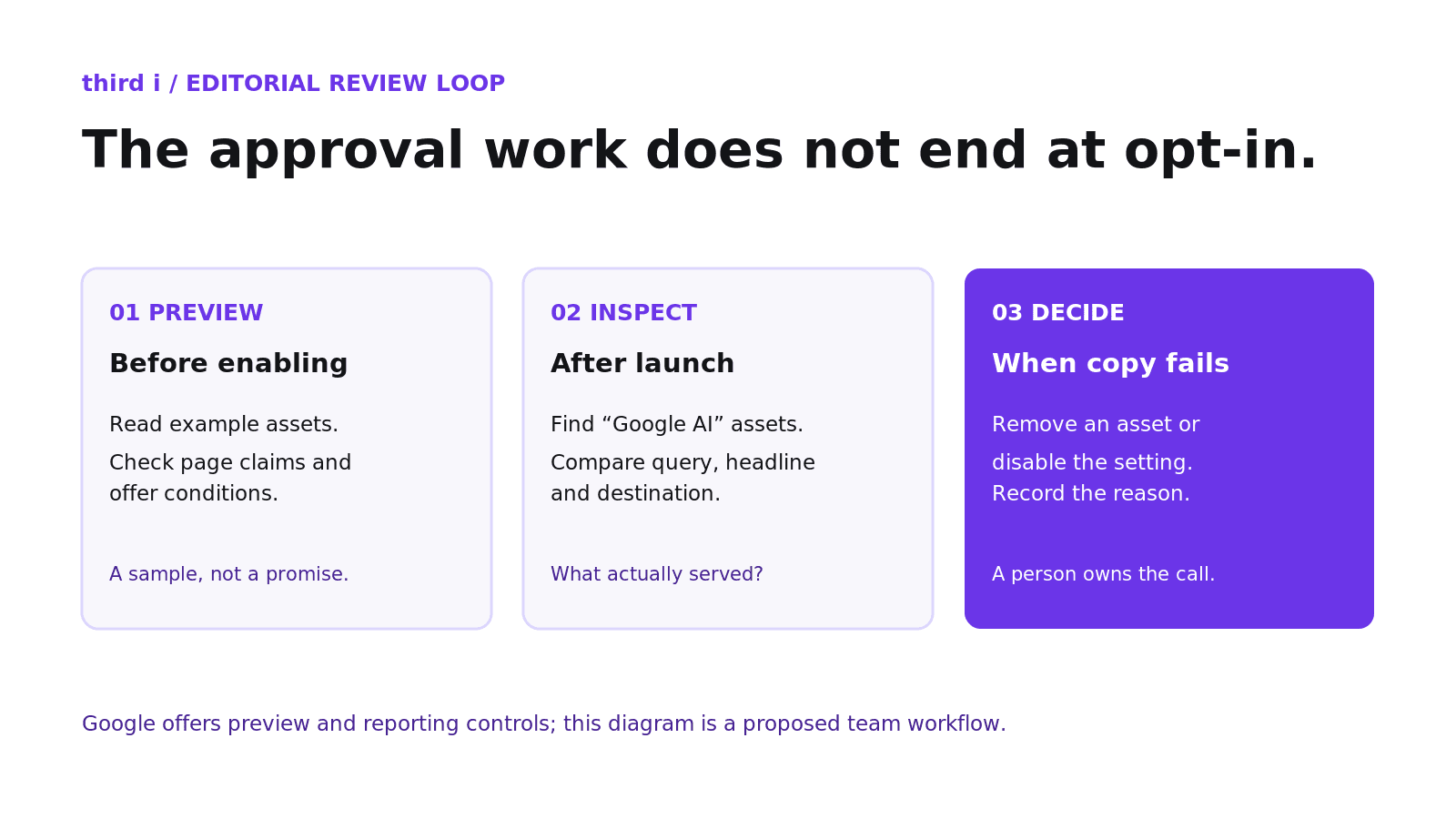
This is the question behind our work at third i. A system can bring the campaign, its evidence, the business context and the proposed next action into one place for a person to judge. That is useful. But it should not pretend that a nice-looking sample has approved all the copy an external ad platform may later generate.
Google has made the first look easier. The work of looking again remains with the advertiser.
See this on your own accounts
third i connects to the platforms you already run and does this work against your live numbers.
Read more
View all articles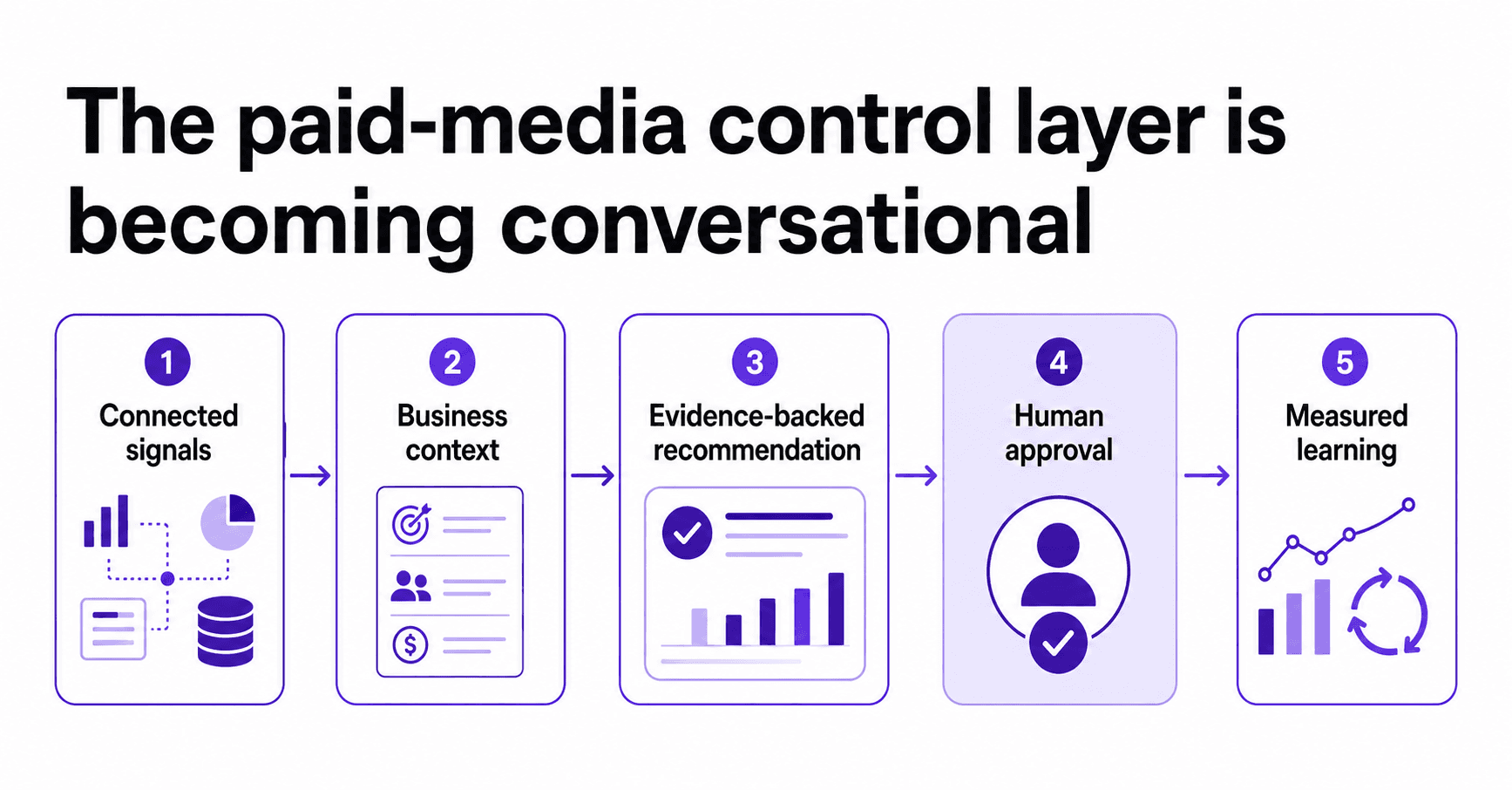
The Paid-Media Control Layer Is Becoming Conversational
Meta AI and ChatGPT Ads signal a shift in paid media: teams will ask for answers and recommendations in chat. The differentiator is trusted context, evidence and human approval.

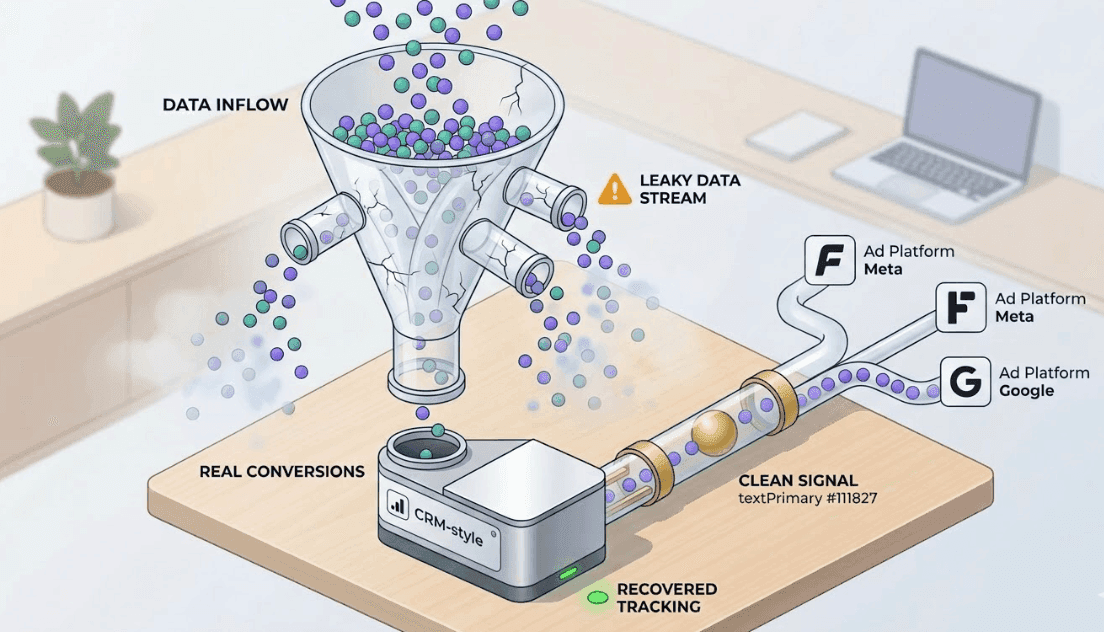

The Secret to Successful Paid Marketing: Strategy Meets Structure
Paid marketing is a powerful tool for driving immediate results, but its success hinges on having a clear strategy and structured execution. Without proper planning, preparation, execution, and optimization, campaigns can waste resources and miss opportunities. A checklist streamlines the process,…