
Meta Says 200 Purchases, Google Analytics Says 80: Why Your Ads Are Flying Blind And How To Fix It In 24 Hours
If you run paid ads on Meta, Google or TikTok, there is a good chance you have seen this before:
Meta reports 200 purchases.
Google Analytics reports 80.
Same dates, same campaigns, totally different numbers.
Most teams treat this as a reporting quirk. They average the numbers, build a story, and move on. The real problem is much deeper. When your ad platforms and analytics tools disagree by that much, it is a sign that your tracking is broken at the foundation.
This post breaks down why your numbers do not match, how much revenue you are likely leaving on the table, and what a complete tracking stack done for you can look like, live in under 24 hours, with Thirdi sitting on top as the agent layer that turns clean data into clear actions.
The tracking gap that is quietly killing your ROAS
Over the last few years, marketers have been hit by three forces at the same time:
iOS privacy changes (App Tracking Transparency)
Browsers like Safari and Firefox tightening cookie policies
Ad blockers on both desktop and mobile
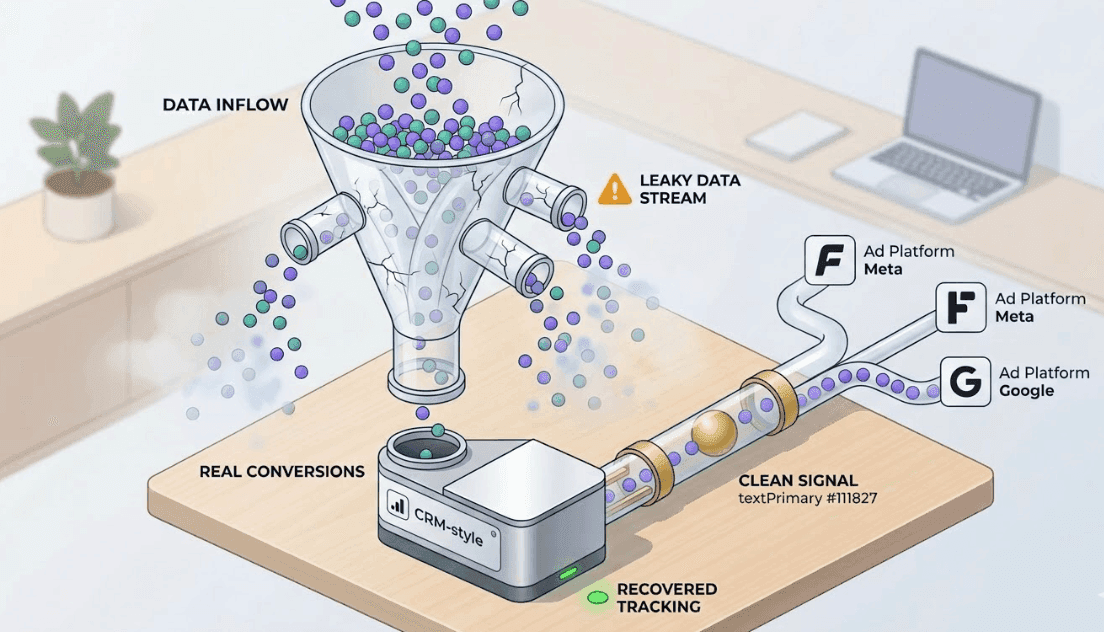
Together, these changes mean that a large share of your conversion events never make it from your site or app to the platforms that are supposed to optimise your ads.
Here is what that looks like in practice:
A user sees your Meta ad, clicks through, adds to cart and buys.
Your browser pixel is blocked by an ad blocker or limited by browser rules.
Meta never receives the purchase event, or receives only part of the funnel.
The algorithm thinks that user did not convert, or that your best converting audience is less valuable than it really is.
Multiply this across thousands of clicks and hundreds of purchases a month, and you get a campaign history that is fundamentally wrong.
This is why you see patterns like:
Meta over-reporting conversions compared to Analytics because of modelling and view-through assumptions.
Google Analytics under-reporting because events are blocked or dropped before they are logged.
TikTok, Meta and Google all giving you a different view of “what worked”, leaving you guessing.
What looks like “attribution drama” is often just missing events.
Your ad platforms are optimising on incomplete data
Ad platforms do not care about your dashboards. They care about raw signals: who converted, how much they spent, and what path they took.
When a large chunk of your conversion events are lost to iOS, Safari and ad blockers, your platforms are trying to steer the ship with one eye closed. They are still spending your budget, but they are doing it on a distorted view of your real customers.
The consequences show up in three clear ways:
Budgets flow into the wrong campaigns and ad sets because the true winners look weaker than they are.
Algorithms cannot learn from your best customers, so optimisation stalls or gets stuck in a loop around “easy clicks” instead of high-value buyers.
Your team wastes hours every week trying to reconcile dashboards, instead of fixing the actual tracking gap.
If you have ever killed a campaign that looked bad in-platform, only to see overall revenue drop, you have felt this problem first-hand.
What a complete tracking stack should actually do
The answer is not “another dashboard” or “yet another attribution tool”. The answer is a tracking stack that does one simple thing: capture every important event, on every platform, even in a world of iOS and ad blockers.
In work with brands across channels, the stack that holds up has four key pieces:
A browser pixel that is correctly implemented and tested
You still want a clean, first-party browser pixel on your site or app for immediate event capture. It should handle all key events in your funnel: page views, add to cart, start checkout, purchases and any high-value custom event.
A server-side pixel that does not depend on your domain
If your server-side events are sent through a proxy that uses your own domain, they can still be blocked when privacy tools flag your site. A resilient stack fires server-side events from independent infrastructure, so even if your domain is on a blocklist, events still reach Meta, Google and TikTok.
Clean CAPI connections with deduplication
Server-side alone is not enough. You need well-configured CAPI connections for each platform, plus deduplication rules so that if both browser and server events fire, they are tied together instead of double-counted or dropped. This is the step that tends to break when teams try to patch things manually.
Full logs, visibility and data ownership
If you cannot see your event stream, you cannot trust it. A solid stack gives you full logs, dashboards for your technical and marketing team, and complete portability. The events are yours, not locked in a black box that you cannot debug or export from.
When these pieces work together, you get something close to the ideal: every meaningful action is tracked, every platform receives a consistent signal, and your team can see exactly what is happening.
Why “done for you” beats DIY tracking for most teams
In theory, you can assemble this stack yourself. In practice, most teams are already stretched thin across creative, strategy and reporting. They do not have time to become experts in browser behaviour, CAPI nuances and server-side configurations.
DIY tracking tends to lead to:
Long implementation cycles where tracking is “in progress” for months.
One or two engineers who understand the setup, leaving you exposed when they switch roles or leave.
Silent failures when a small change in your site or a platform update breaks part of the pipeline and no one notices for weeks.
This is why more brands are moving to a done-for-you model for tracking, similar to how they work with specialists on performance creative or CRO. The bar is simple:
Get me fully live in days, not months.
Capture every important event, across browsers and blockers.
Give me visibility and control without asking my team to babysit the setup.
That is the problem Thirdi can solve as part of your growth stack, because the platform is already built as an always-on, multi-agent layer over your marketing data.
How Thirdi can get you tracking-ready within 24 hours
Fixing tracking is not just about sending more events into Meta, Google or TikTok. It is about making sure those events reflect what actually happened in your business, not just what an ad platform managed to attribute.
Thirdi agents do not stop at media platforms. They also connect to your internal CRM and revenue systems, read that data like an analyst on your team, and line it up against what the ad platforms claim happened. That is how they spot gaps, anomalies and broken flows that a normal dashboard would miss.
Here is what that looks like in the first 24 hours:
Connect your stack
Thirdi connects to your ad platforms (Meta, Google, TikTok), analytics tools and CRM so the agents see both sides of the story: attributed conversions and real recorded orders or leads.
Scan for anomalies and leaks
Agents run through recent campaigns and funnels to find patterns like “Meta shows 200 purchases, CRM shows 120” on specific ad sets, devices or geos. They flag where tracking is broken versus where attribution rules are just different.
Anchor on real conversion events
Instead of only optimising to what Meta or Google reports, Thirdi agents use the CRM events as ground truth. Recommendations are based on the conversions your system actually recorded, not just the ones a pixel happened to capture.
Turn findings into clear actions
For each issue, you get specific next steps: fix or extend tracking on a funnel step, adjust budgets on campaigns that look weak in-platform but strong in CRM, or cut spend where both views agree performance is poor.
Give you complete visibility into your event stream
Your team can see which events fire, where they go, and how they line up across platforms and CRM. That way, when someone asks “why do these numbers not match,” you can answer with evidence instead of guesswork.
Because Thirdi already runs as an autonomous agent layer over your campaigns, this tracking view does not sit in isolation. The same agents that analyse your keywords, creatives and social performance can now factor in the reality of your internal data before telling you what to do next. The goal is simple: within one business day, Thirdi behaves like an always-on growth analyst who has both your ad accounts and your CRM open, and who cares about real business outcomes, not just cleaner attribution charts.
See this on your own accounts
third i connects to the platforms you already run and does this work against your live numbers.
Read more
View all articles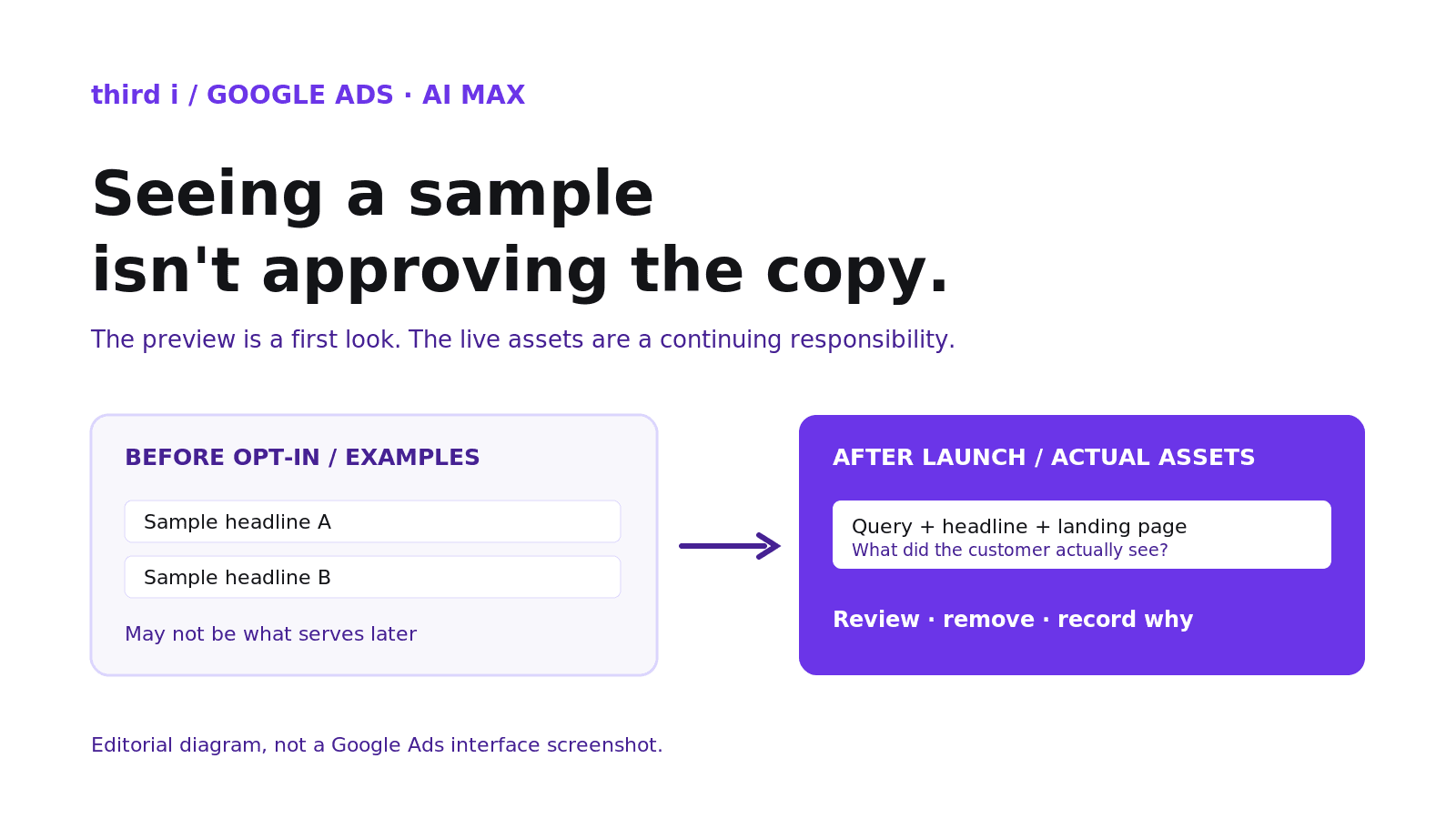
AI Max Copy Preview: Seeing a Sample Isn't Approving It
Google Ads now shows sample AI Max headlines before opt-in. Here is why previewing examples is useful, but does not replace reviewing the copy that actually serves.

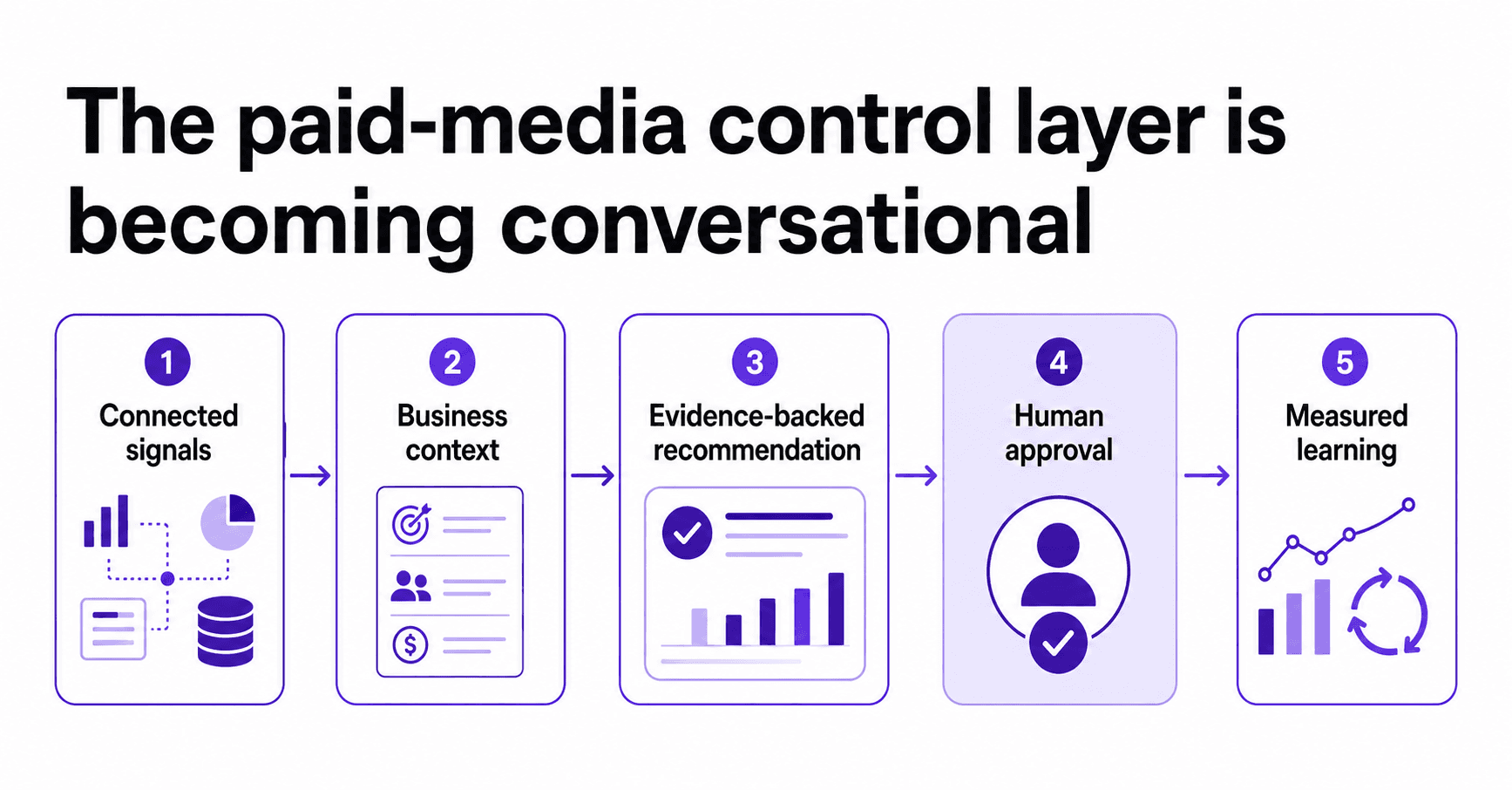
The Paid-Media Control Layer Is Becoming Conversational
Meta AI and ChatGPT Ads signal a shift in paid media: teams will ask for answers and recommendations in chat. The differentiator is trusted context, evidence and human approval.
The Secret to Successful Paid Marketing: Strategy Meets Structure
Paid marketing is a powerful tool for driving immediate results, but its success hinges on having a clear strategy and structured execution. Without proper planning, preparation, execution, and optimization, campaigns can waste resources and miss opportunities. A checklist streamlines the process,…
