
Third i vs Revealbot (Birch): Rules vs Intelligence
Evaluating Revealbot or its rebranded version Birch? Revealbot (now Birch) is a rule-based ad automation tool. You write conditions like "if ROAS drops below 2.0, pause this ad set" and the platform executes them. Third i is an AI-powered action platform that tells you what those conditions should…
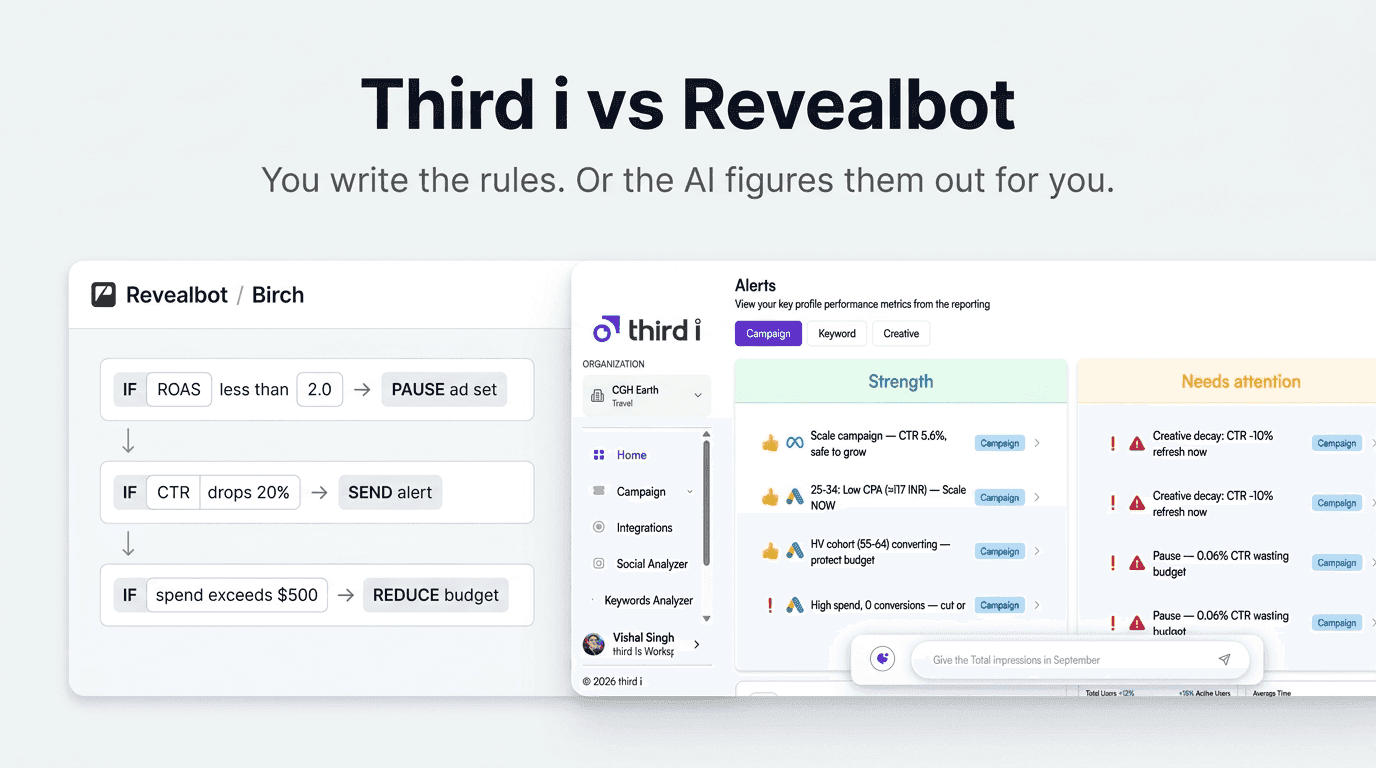
Revealbot has been around since 2016. It rebranded as Birch in 2024 and has earned a genuine following among performance marketers who want more control over Meta automation than the native Ads Manager provides. Over 15,000 clients trust the platform, and for good reason.
But there is a fundamental limitation baked into every rule-based tool, including Birch. Rules can only react to conditions you have already imagined. They cannot tell you what conditions you missed. They cannot see patterns across multiple platforms simultaneously. And they cannot explain why something is happening, only respond to a number crossing a threshold you set yesterday.
That gap is exactly what Third i was built to close.
What Revealbot (Birch) Does Well
Birch's rule engine is one of the most flexible in the market. With over 20 automation actions, nested AND/OR conditions, metric-to-metric comparisons, and ranking conditions, you can build genuinely sophisticated automation logic without writing code. Rules can fire every 15 minutes, which is far more responsive than Meta's native automated rules.
The platform also handles bulk ad creation for Meta well. You can launch dozens of ad variants at once, auto-tag campaigns for easier organization, and automatically boost high-performing organic posts when they hit engagement thresholds. Their white-label reporting is a real differentiator for agencies that need to send branded reports to clients.
For a performance marketer who knows exactly what they want to automate and has the time to build and maintain rules, Birch is a solid, battle-tested tool. Their Explorer feature also flags when creatives need refreshing, which is a step toward the kind of proactive alerting that agencies need.
The Three Pain Points Agencies Keep Running Into
1. Rules Are Only as Good as the Person Writing Them
This is the core limitation of every rule-based automation system, and it is not a knock on Birch specifically. It is a structural constraint of the approach.
Rules are reactive. By definition, a rule can only fire when a condition you already anticipated is met. But ad performance does not always fail in the ways you expect. A creative might be fatiguing not because ROAS dropped, but because click-through rate is holding while add-to-cart rate is collapsing. A budget might be leaking not because of low ROAS but because one audience segment is cannibalizing another. An offer might be performing well on TikTok and dragging down overall numbers because it is misleading Google traffic about the product.
None of those patterns have obvious rule triggers. They require cross-channel pattern recognition across conversion data, not a single metric crossing a threshold.
One Reddit user in r/FacebookAds put it plainly in December 2025: "The frustrating part is that I often forget to include any new campaigns I start in the rules. Additionally, other activities, such as optimizing targeting, still require manual effort."
Another noted that Birch is "expensive and often overkill" for teams that do not have the bandwidth to build and maintain complex rule libraries.
A review from cotera.co captured the problem precisely: "Rules are reactive by nature. By the time the rule fires, the ad has already spent money at an unacceptable CPA."
Third i does not require you to define the conditions. The AI analyzes your connected platforms continuously, identifies patterns you did not know to look for, and surfaces them as ranked actions with estimated business impact.
2. Ad Spend-Based Pricing That Scales Against You
Birch's pricing is tied directly to your total monthly ad spend across all connected accounts. The more budget your clients spend, the more you pay.
Here is how it looks in practice for agencies:
- Up to $10K ad spend: Essential at $49/mo, Pro at $99/mo
- $10K to $100K ad spend: Pro tier pricing rises to $179/mo
- $100K to $500K ad spend: Pro tier rises to $299/mo
- $500K+ ad spend: Enterprise, contact sales
For an agency managing 10 clients who collectively spend $200K per month on ads, you are already in the $299/mo to custom pricing territory, and that is before you factor in any overage fees for exceeding your spend tier limit. The Essential plan does not even include automated rules or the launcher, which means the base plan is essentially a reporting tool.
There is also the hidden agency-level cost: you may need multiple Birch accounts to manage multiple clients cleanly, depending on how your workspace setup works.
Third i is $199 per month. Flat. No ad spend tiers. No overage fees. No hidden agency costs. Whether your clients spend $20,000 or $2,000,000 per month combined, the price stays the same.
See how to connect your accounts
.
3. Multi-Platform Intelligence vs Multi-Platform Rules
Birch supports Meta, Google Ads, TikTok, and Snapchat. That multi-platform coverage is real and it is one of Birch's genuine strengths over tools that only cover Meta.
But supporting multiple platforms for rule execution is different from synthesizing cross-platform intelligence.
When a campaign is underperforming on Google, the cause might be a creative fatigue issue on Meta driving down brand awareness at the top of the funnel. When TikTok ROAS drops, it might be because the same audience is being retargeted better by a Meta campaign running simultaneously. When LinkedIn lead quality deteriorates, it might correlate with a change in Google Ad copy targeting a slightly different keyword intent.
Birch will execute your rules on each platform. It will not connect those dots for you.
Third i connects Meta, TikTok, Google Ads, LinkedIn Ads, and GA4 via direct OAuth integrations. The platform then analyzes cross-channel and full-funnel data together, surfacing actions that a single-platform or rule-based view would miss entirely. The Action Feed prioritizes these by estimated business impact so you always work on what matters most.
Feature Comparison
[table content removed during migration — recreate manually]
The Core Difference: Execution vs Intelligence
Birch and Third i are solving adjacent but different problems.
Birch answers: "How do I execute my optimization decisions faster and at scale?"
Third i answers: "What optimization decisions should I be making right now?"
If you already know exactly what conditions to automate and you need a reliable, flexible execution layer to carry them out across Meta, TikTok, and Google without manual intervention, Birch is a strong choice. Their rule engine is mature and the platform has been battle-tested across thousands of accounts.
But if you find yourself spending more time figuring out what to do than executing it, if your clients' accounts are surfacing surprises you did not build rules for, or if you are managing complex multi-channel portfolios where the signal comes from the relationship between platforms rather than any single one, that is where Third i's approach changes the workflow.
The two tools are not direct replacements for each other. Some agencies use both: Birch for rule execution, Third i for the intelligence layer that tells them which rules to set.
Real Results from Third i Users
- Outthinking (mobile gaming, 300M+ downloads) achieved a 40% lower cost per install using Third i's AI-led audience and creative insights. CEO Pavan said: "Thirdi's AI and expert driven capabilities have proven to be effective, as we acquired new users at 40% lower costs."
- Kraftwork Solar saw a 400% increase in lead volume in 45 days and a 48% lower lead acquisition cost. Their Co-founder said: "Third i's expertise has been pivotal in transitioning Kraftwork Solar from traditional marketing to a high-performing lead generation engine."
- A FinTech platform achieved 6x improvement in lead quality through targeted audience segmentation and channel optimization.
- Sadhana Tablet achieved 3.2x ROAS within 3 months across US and India markets.
All results are documented in our case studies
When Revealbot (Birch) Might Still Be the Right Choice
Choose Birch if you are a performance marketer or agency that needs precise, codified control over automation logic. If you have a clear playbook and need it executed reliably at scale across Meta, Google, TikTok, and Snapchat without manual intervention. If white-label reporting matters to your client delivery workflow. Or if bulk ad launching and post boosting are core parts of your day-to-day operations. Birch is excellent at executing decisions you have already made.
Choose Third i if you need help knowing which decisions to make in the first place. If you manage multiple clients across channels and need to surface the highest-impact opportunities without building a library of rules for every possible scenario. If LinkedIn Ads is part of your client mix. And if you want flat, predictable pricing that does not scale with your clients' total ad spend.
.
Frequently Asked Questions
What is the best alternative to Revealbot (Birch) in 2026?
The best alternative depends on what you need. For rule-based automation with a more AI-native layer, Madgicx and Optmyzr are strong alternatives. For a platform that moves beyond automation rules into proactive diagnosis and action prioritization across all channels including LinkedIn, Third i is worth evaluating. It connects to Meta, TikTok, Google Ads, LinkedIn Ads, and GA4 with a flat $199 per month pricing.
How much does Revealbot (Birch) cost compared to Third i?
Birch pricing starts at $49 per month for the Essential plan (no automation rules included) and $99 per month for Pro, both for up to $10K in monthly ad spend. As your ad spend grows, pricing rises to $179/mo at the $10K-$100K tier and $299/mo at the $100K-$500K tier, with overages applying if you exceed your plan limit. Third i is a flat $199 per month with no ad spend tiers and no overage fees.
Does Revealbot support LinkedIn Ads?
As of March 2026, Birch (Revealbot) does not support LinkedIn Ads. Their platform covers Meta, Google Ads, TikTok, and Snapchat. Third i includes full LinkedIn Ads support alongside Meta, TikTok, Google Ads, and GA4.
Can Revealbot tell me why my campaigns are underperforming?
Revealbot and Birch are rule-based execution tools. They carry out actions when conditions you define are met but they do not diagnose root causes or explain why performance changed. If you need a platform that identifies what is broken and why, including patterns across multiple platforms, Third i's Action Feed is built specifically for that.
Is Revealbot worth it for agencies?
Birch can be worth it for agencies with well-defined automation playbooks and high ad spend. Their white-label reporting and workspace features add genuine value for client delivery. However, the ad spend-based pricing model means costs scale directly with your clients' budgets, and the rule-based approach requires significant setup and ongoing maintenance. Agencies that need cross-channel intelligence rather than just execution may find the return limited.
What is the difference between Revealbot and Third i?
Revealbot (Birch) is an execution tool. You write automation rules, it carries them out. Third i is an intelligence tool. It analyzes your connected accounts, identifies what needs attention, and tells you what to do. Neither tool fully replaces the other for teams that need both execution and intelligence.
Getting Started
If you are spending more time managing your automation rules than actually improving your ad strategy, there is a faster approach.Connect your ad accounts to Third i In about 60 seconds, you will have a prioritized Action Feed with the highest-impact improvements across all your accounts, ranked by estimated business impact.
No rules to write. No thresholds to configure. No credit card required for your first audit.
The longer you wait, the more budget leaks go undetected.
Also read:
Third i vs Madgicx | Third i vs Supermetrics | Third i vs GoMarble | Third i vs Triple Whale
Third i is not affiliated with or endorsed by Revealbot or Birch. All product names, logos, and brands are property of their respective owners. Pricing and feature information is based on publicly available data as of March 2026. Visit bir.ch for their latest offerings.
See this on your own accounts
third i connects to the platforms you already run and does this work against your live numbers.
Read more
View all articles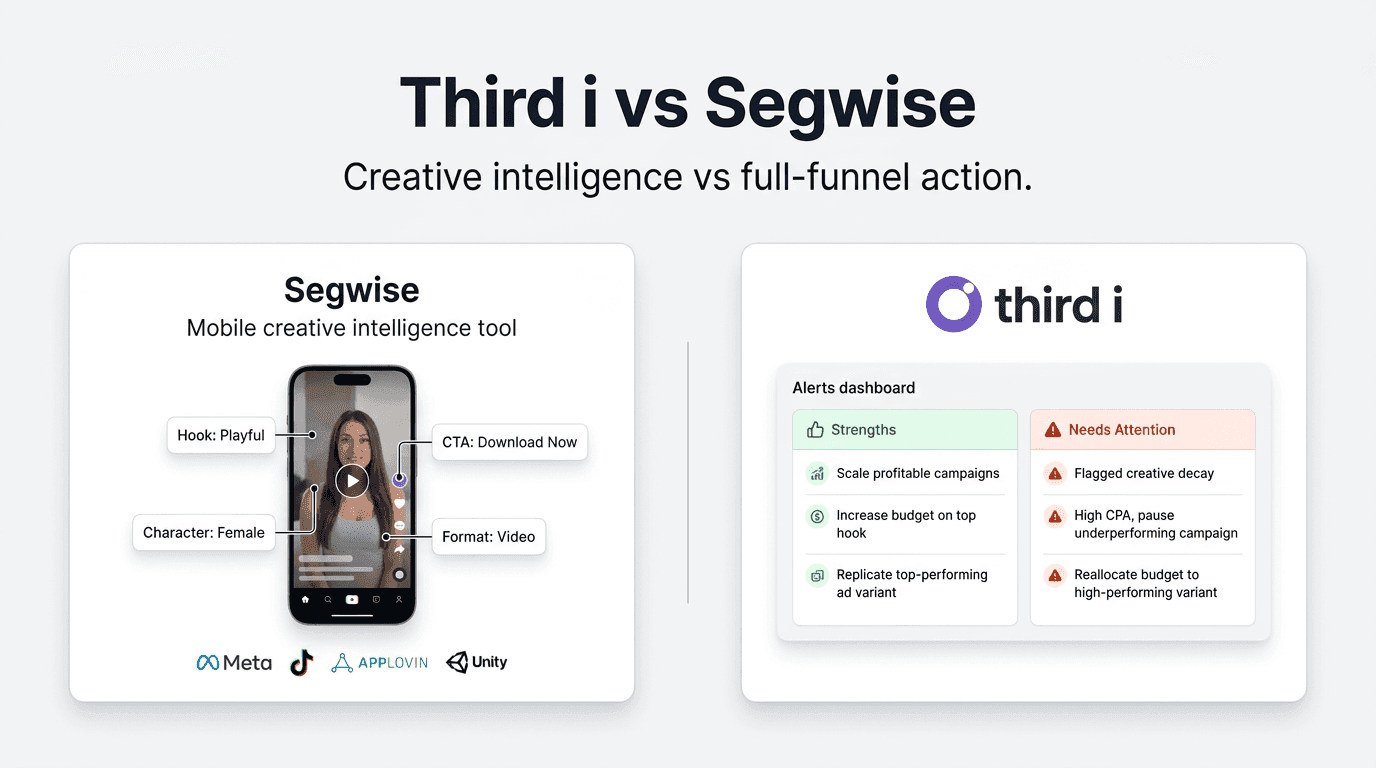
Third i vs Segwise: Creative Intelligence vs Full-Funnel Action Intelligence
Evaluating Segwise or looking for a Segwise alternative? Segwise is an AI-powered creative intelligence platform built specifically for mobile app and gaming advertisers. It automatically tags every element inside your ad creatives - video, audio, text, playable mechanics - and ties those elements…

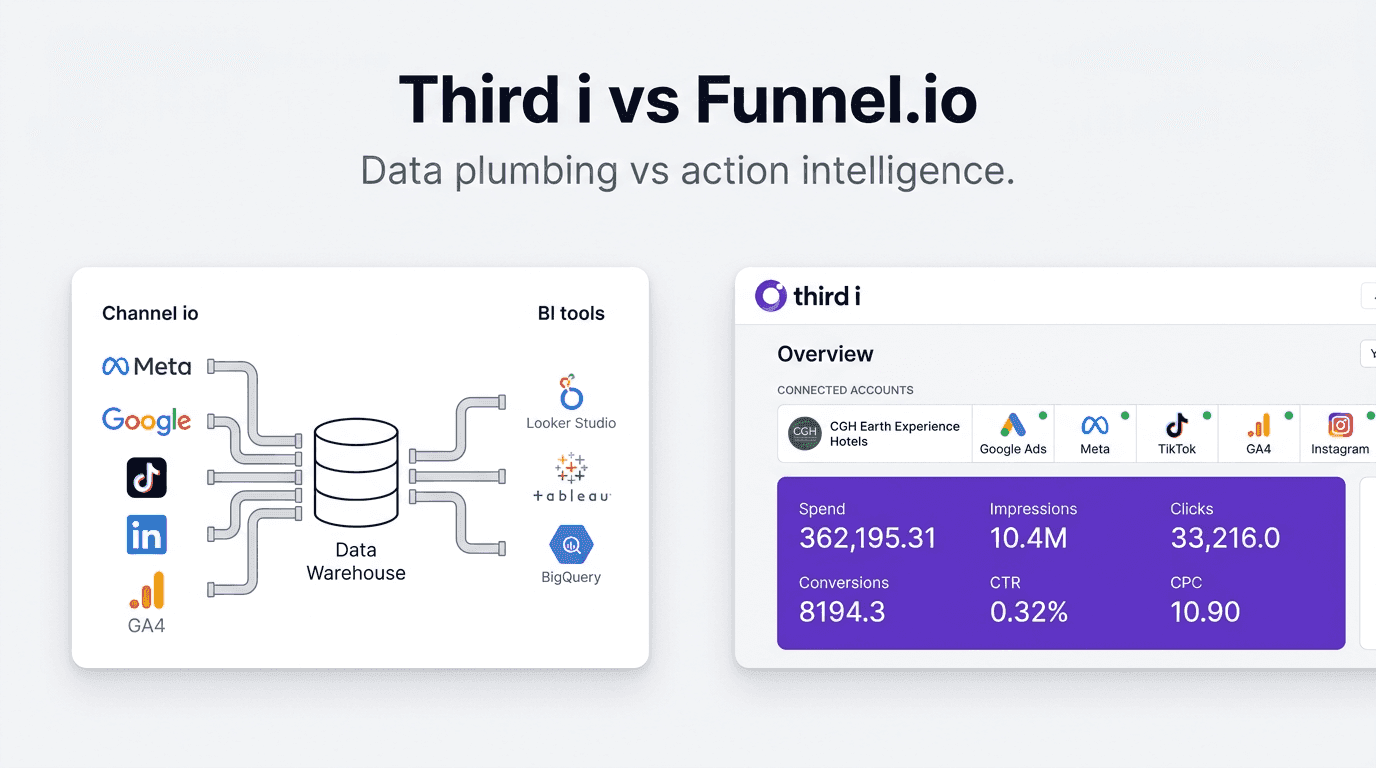
Third i vs Funnel.io: Data Pipeline vs Action Intelligence
Evaluating Funnel.io or looking for an alternative? Funnel.io is a marketing data hub that connects 600+ sources, normalizes your data, and pipes it into your BI tool, data warehouse, or reporting layer. It collects and cleans your data. Third i is an AI action platform that tells you what to do wi…
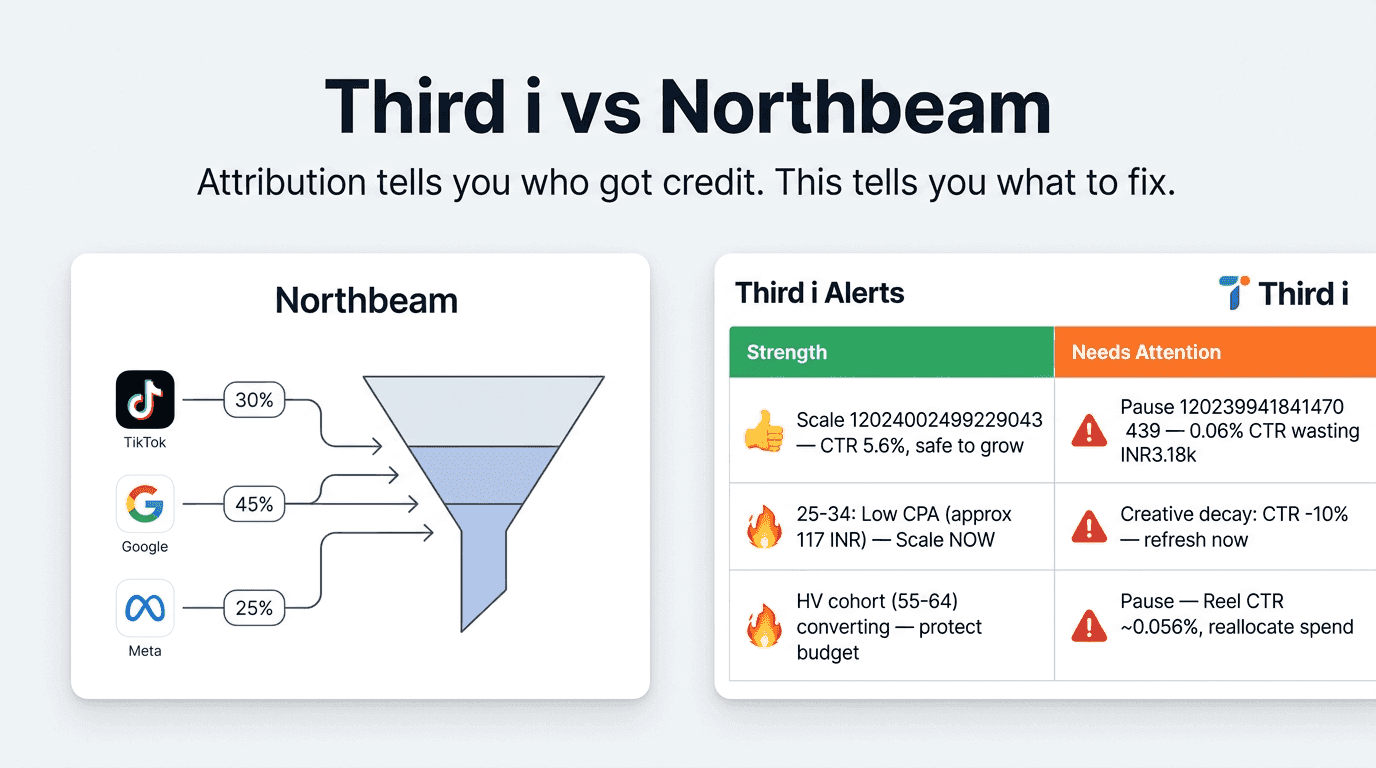
Third i vs Northbeam: Attribution Measurement vs Action Intelligence
Evaluating Northbeam or looking for a Northbeam alternative? Northbeam is a multi-touch attribution and media mix modeling platform built for mid-size to enterprise DTC and ecommerce brands spending over $50K per month on ads. It helps you understand how credit should be distributed across your mar…