From approvals to dispersals: why fintech campaigns need a two layer attribution model

Neeraj Kushwaha

I still remember the call that flipped a switch in my head.
On paper, this fintech marketer had a dream setup: 1 crore a month in ad spend, mostly on Meta, clean dashboards, “sales” numbers that looked solid. She walked me through her account, and for the first ten minutes it sounded like any other performance review.
Then she said one line that stayed with me.
“For us, approvals are vanity. Dispersals are sanity.”
Inside Meta, one campaign looked like a star. Great cost per lead, great “sales” volume on the objective they had set. Inside their own system, the same campaign was a mess. A big chunk of those “sales” never made it to actual loan dispersals. Every time she poured more money into it, her dashboards looked better and her business looked worse.
That was the day we stopped treating ad platform numbers as the final word for fintech.
Why a single layer view breaks in lending
If you run performance for a lender, you already live in two worlds.
One is the ad platform world:
impressions
clicks
leads
app installs
“sales” or approvals
The other is your internal world:
approved amount
ticket size
dropped cases
final loan dispersals
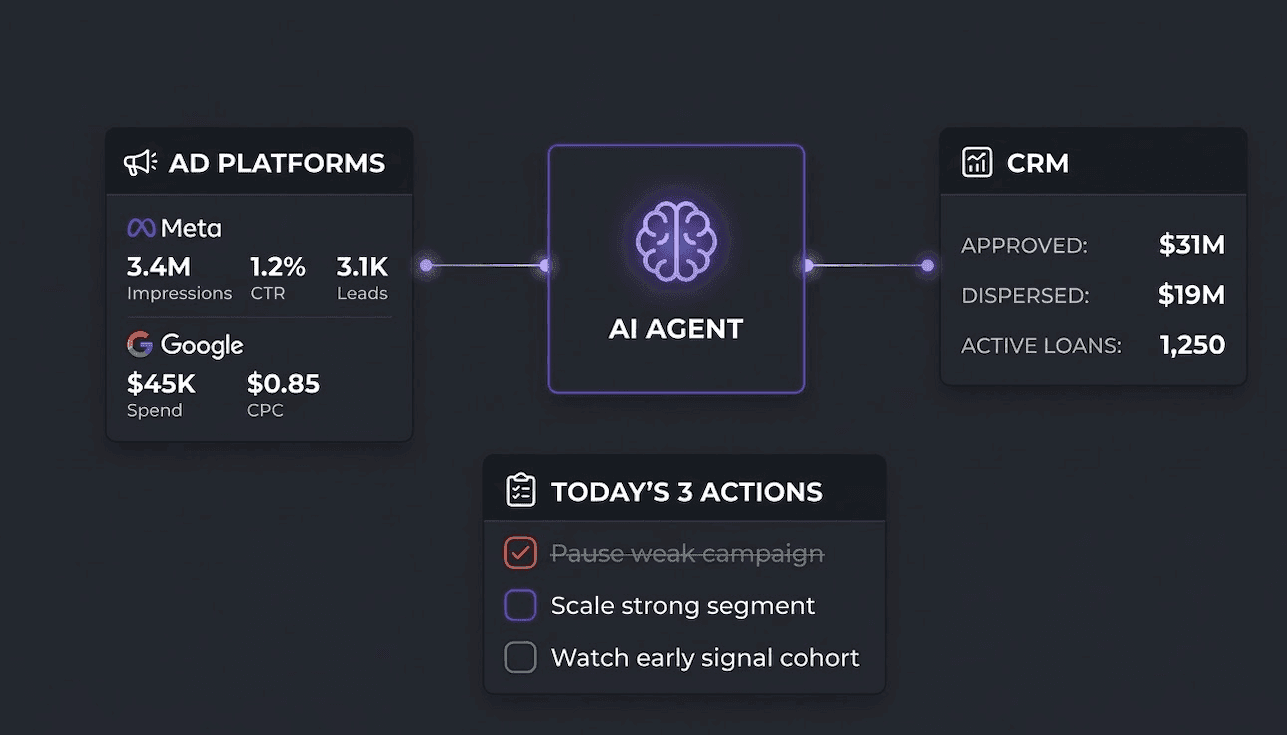
Meta and Google only see the first half. They have no clue how many of those shiny “sales” die when underwriting kicks in, or when a customer goes missing after the first call.
If you optimise on the first world alone, you are letting the vendor mark its own exam sheet.
What a two layer model looks like in real life
When we say “two layer model,” we do not mean a complicated data warehouse project. I mean something much simpler that we now try to set up for every fintech account we touch.
Layer 1: fast but shallow
This is the raw platform view. Meta and Google events, MMP data, early approvals. we still care about this because:
their algorithms learn from it
it moves in hours, not days
Layer 2: slow but honest
This is the CRM or in house dashboard. Approvals that passed your checks, final dispersals, revenue, maybe even early NPA signals. This is the world your finance and risk teams live in.
The mistake we used to make was treating layer 1 as “performance” and layer 2 as “finance.” In fintech, that split does not hold. Performance that does not end in money out is just an expensive distraction.
Once we connect both layers into one view, patterns jump out:
two ad sets with the same cost per lead can have a 3x gap on cost per dispersal
campaigns that look average in Meta sometimes send the cleanest book
“hero” creatives pumping cheap approvals often hide ugly drop off curves in the CRM
You cannot see this if you only live inside an ad manager.
How we now make decisions with lag
There is still the time lag problem. In many lending flows, it takes about 7 days from lead to dispersal on average. If I wait a full week before touching budgets, I lose money. If I react only to day one metrics, I repeat the same old mistake.
What I try to do instead:
use day one signals (click through, cost per lead, early form behaviour) for small tweaks
use 7 day cohorts from the CRM to judge which campaigns deserve real scale
Over time, you start to see “signatures.” Some campaigns show modest day one numbers but very strong 7 day dispersal rates. Others spike early and crash later. With enough history, you can train both humans and agents to recognise these shapes and act sooner.
Where AI agents fit into this
This is where the AI part of Thirdi started to make sense for me.
When the agent can see both:
platform data in near real time
CRM outcomes for recent cohorts
it can do a few useful jobs:
flag campaigns that are approval heavy but dispersal weak
spot segments where early signals usually lead to strong dispersals, even before the full week is done
prepare a daily “if you touch nothing else, change these three things” list for the marketer on duty
The human still decides what to actually change in the ad account. The AI just stops you from doing that job half blind.
The simple test I now use with every fintech
Whenever we speak to a lending brand now, we ask one blunt question:
“Show me your top 5 campaigns in Meta by ROAS, and then show me the same 5 ranked by cost per dispersal in your CRM.”
If the lists do not match, there is a lot of money left on the table.
The fix is not another pretty dashboard. It is wiring your marketing brain to the same source of truth your finance team already trusts. Approvals can be green all day. If dispersals are not, the campaign is not a winner.
Once I saw that clearly with a 1 crore per month account, I stopped calling any fintech setup “smart” until both layers were in place.
I still remember the call that flipped a switch in my head.
On paper, this fintech marketer had a dream setup: 1 crore a month in ad spend, mostly on Meta, clean dashboards, “sales” numbers that looked solid. She walked me through her account, and for the first ten minutes it sounded like any other performance review.
Then she said one line that stayed with me.
“For us, approvals are vanity. Dispersals are sanity.”
Inside Meta, one campaign looked like a star. Great cost per lead, great “sales” volume on the objective they had set. Inside their own system, the same campaign was a mess. A big chunk of those “sales” never made it to actual loan dispersals. Every time she poured more money into it, her dashboards looked better and her business looked worse.
That was the day we stopped treating ad platform numbers as the final word for fintech.
Why a single layer view breaks in lending
If you run performance for a lender, you already live in two worlds.
One is the ad platform world:
impressions
clicks
leads
app installs
“sales” or approvals
The other is your internal world:
approved amount
ticket size
dropped cases
final loan dispersals
Meta and Google only see the first half. They have no clue how many of those shiny “sales” die when underwriting kicks in, or when a customer goes missing after the first call.
If you optimise on the first world alone, you are letting the vendor mark its own exam sheet.
What a two layer model looks like in real life
When we say “two layer model,” we do not mean a complicated data warehouse project. I mean something much simpler that we now try to set up for every fintech account we touch.
Layer 1: fast but shallow
This is the raw platform view. Meta and Google events, MMP data, early approvals. we still care about this because:
their algorithms learn from it
it moves in hours, not days
Layer 2: slow but honest
This is the CRM or in house dashboard. Approvals that passed your checks, final dispersals, revenue, maybe even early NPA signals. This is the world your finance and risk teams live in.
The mistake we used to make was treating layer 1 as “performance” and layer 2 as “finance.” In fintech, that split does not hold. Performance that does not end in money out is just an expensive distraction.
Once we connect both layers into one view, patterns jump out:
two ad sets with the same cost per lead can have a 3x gap on cost per dispersal
campaigns that look average in Meta sometimes send the cleanest book
“hero” creatives pumping cheap approvals often hide ugly drop off curves in the CRM
You cannot see this if you only live inside an ad manager.
How we now make decisions with lag
There is still the time lag problem. In many lending flows, it takes about 7 days from lead to dispersal on average. If I wait a full week before touching budgets, I lose money. If I react only to day one metrics, I repeat the same old mistake.
What I try to do instead:
use day one signals (click through, cost per lead, early form behaviour) for small tweaks
use 7 day cohorts from the CRM to judge which campaigns deserve real scale
Over time, you start to see “signatures.” Some campaigns show modest day one numbers but very strong 7 day dispersal rates. Others spike early and crash later. With enough history, you can train both humans and agents to recognise these shapes and act sooner.
Where AI agents fit into this
This is where the AI part of Thirdi started to make sense for me.
When the agent can see both:
platform data in near real time
CRM outcomes for recent cohorts
it can do a few useful jobs:
flag campaigns that are approval heavy but dispersal weak
spot segments where early signals usually lead to strong dispersals, even before the full week is done
prepare a daily “if you touch nothing else, change these three things” list for the marketer on duty
The human still decides what to actually change in the ad account. The AI just stops you from doing that job half blind.
The simple test I now use with every fintech
Whenever we speak to a lending brand now, we ask one blunt question:
“Show me your top 5 campaigns in Meta by ROAS, and then show me the same 5 ranked by cost per dispersal in your CRM.”
If the lists do not match, there is a lot of money left on the table.
The fix is not another pretty dashboard. It is wiring your marketing brain to the same source of truth your finance team already trusts. Approvals can be green all day. If dispersals are not, the campaign is not a winner.
Once I saw that clearly with a 1 crore per month account, I stopped calling any fintech setup “smart” until both layers were in place.
Read more

From approvals to dispersals: why fintech campaigns need a two layer attribution model
Fintech performance marketing must use a two-layer attribution model to avoid optimizing on deceptive ad platform metrics (Layer 1: "approvals are vanity") and focus on true business outcomes (Layer 2: "dispersals are sanity"). Ad platforms only track up to the initial approval, often leading marketers to scale campaigns that look great externally but fail to convert to actual loan dispersals internally. By connecting fast platform data with slow, honest CRM data, marketers can identify campaigns that send a clean book, ensuring marketing optimization aligns with the finance team's source of truth: final loan dispersals

Neeraj Kushwaha
Mar 16, 2026

updates
Product Update: Blazing Fast Insights, Smarter Creative Agents, and Upgraded Reporting
Discover our latest platform upgrades, including instant data fetching, advanced creative pattern detection, a smarter CoDI - our marketing chatbot, and powerful new automated reporting features.

Anand Kumar
Mar 9, 2026

comparison
Third i vs Madgicx: Why Agencies Are Looking for Something Different
Looking for a Madgicx alternative? Third i is an action-first AI platform for agencies that connects Meta, TikTok, Google Ads, LinkedIn Ads, and GA4 in one view. Instead of dashboards and charts, you get a prioritized Action Feed that tells you exactly which ads to pause, which budgets to shift, and why. Flat pricing at $199 per month, no matter how much you spend on ads.

Anand Kumar
Mar 3, 2026

From approvals to dispersals: why fintech campaigns need a two layer attribution model
Fintech performance marketing must use a two-layer attribution model to avoid optimizing on deceptive ad platform metrics (Layer 1: "approvals are vanity") and focus on true business outcomes (Layer 2: "dispersals are sanity"). Ad platforms only track up to the initial approval, often leading marketers to scale campaigns that look great externally but fail to convert to actual loan dispersals internally. By connecting fast platform data with slow, honest CRM data, marketers can identify campaigns that send a clean book, ensuring marketing optimization aligns with the finance team's source of truth: final loan dispersals

Neeraj Kushwaha
Mar 16, 2026

updates
Product Update: Blazing Fast Insights, Smarter Creative Agents, and Upgraded Reporting
Discover our latest platform upgrades, including instant data fetching, advanced creative pattern detection, a smarter CoDI - our marketing chatbot, and powerful new automated reporting features.

Anand Kumar
Mar 9, 2026